My Next Speech: Bringing the Lung Cancer Patient to the Foreground at #ASCO16 CME

peerview grace asco logo

I’m excited to announce that I have been asked to speak on June 5, 2016, at a dinner symposium titled “NSCLC Forum: Bringing the Patient to the Foreground of Evidence-Based Lung Cancer Care.” It’s sponsored by PeerView Press (a medical education provider) and GRACE (a web resource for cancer patients).

This is an evening event concurrent with ASCO 2016 Annual Meeting in Chicago, usually called just ASCO. ASCO (short for American Society for Clinical Oncology) is the world’s biggest cancer conference—just you and 35,000 of your closest friends.  Attendees hear about results for cancer clinical trials along with prevention, diagnosis, survivorship, policy, advocacy, and oncology career info, and explore a huge exhibit hall.  Last year I clocked five miles a day just walking between sessions!

I’ll be talking about using social media to improve outcomes for lung cancer patients.  The meat of the program includes case studies presented by four research oncologists (including, coincidentally, my Denver oncologist Dr. Ross Camidge), and panel discussions. PeerView tells me this may be the first time a patient has been the lead speaker at an ASCO CME (Continuing Medical Education) program. I’m honored that the sponsors and my fellow speakers believe I’m up to the challenge.

At my request, PeerView modified their registration form so patients and caregivers/advocates can register for this event. If you’d like to see me speak, you can register (no charge) to attend in person (and have a free dinner starting at 6:30 PM Central) or watch the live stream online (starting at 7 PM Central).  The recording will be available later on the web (I’ll share the link when it’s posted).  Several other evening events (including the ASCO President’s Reception, alas) will be competing for the attention of ASCO attendees at the same time, so please attend and help fill the seats. Hope to see you there!


Edit 8-Jun-2016:

The unedited, uncut version of the 2-hour webinar in which I spoke at ASCO 2016 is available here. You must register, but it’s free. My talk begins at about 2:40, and runs about 10 minutes.

https://tallen.webcasts.com/starthere.jsp?ei=1104671

An edited version will be available soon.

New Survey Available for Patients with Any ROS1-Positive Cancer

You might already know that my cancer is ROS1-positive. This means my tumor cells test positive for a rearrangement of the ROS1 gene in my DNA.

Now we ROS1-positive patients can help researchers learn more about our cancer by taking a survey.  If you’re already sold, click on the link at the bottom of this page.  For more info, read on!

All human cells have the ROS1 gene, but in adult humans the ROS1 gene isn’t very active. However, sometimes the ROS1 gene fuses with another gene and becomes “rearranged.”  Cells that have certain ROS1 rearrangements become cancerous.  ROS1 cancer is rare – about 1% of non-small cell lung cancers – and is found in several types of cancer such as brain cancer (glioblastomas), angiosarcoma, and melanoma.  ROS1 cancer can be very aggressive, but many patients respond amazingly well to a drug called crizotinib, which is FDA approved for ROS1-positive lung cancer.  You can learn more about ROS1 cancer, some of the patients who have it, and available treatments and clinical trials on the ROS1 portal .

Over 100 patients who have ROS1-positive cancer of any type (regardless of where the cancer started) have joined a Facebook group called “ROS1 Positive (ROS1+) Cancer.” We hail from a dozen different countries. We discuss how to handle side effects of treatment, explore the treatments and clinical trials available to us, and post new research findings. And we share concerns about our futures, because … well, those of us with metastatic ROS1-positive cancer are not curable.

I’ve had no evidence of disease (meaning we can’t detect any cancer) on crizotinib since January 2013. I wish I could say I’m cancer free, but I can’t.  For most everyone who takes crizotinib, the cancer eventually develops resistance to the drug, and tumors start growing again.

We ROS1ers need researchers to learn more about our cancer, and find more effective treatments. Now we can do something to help.

PatientDrivenResearch_Final_April 13, 2016

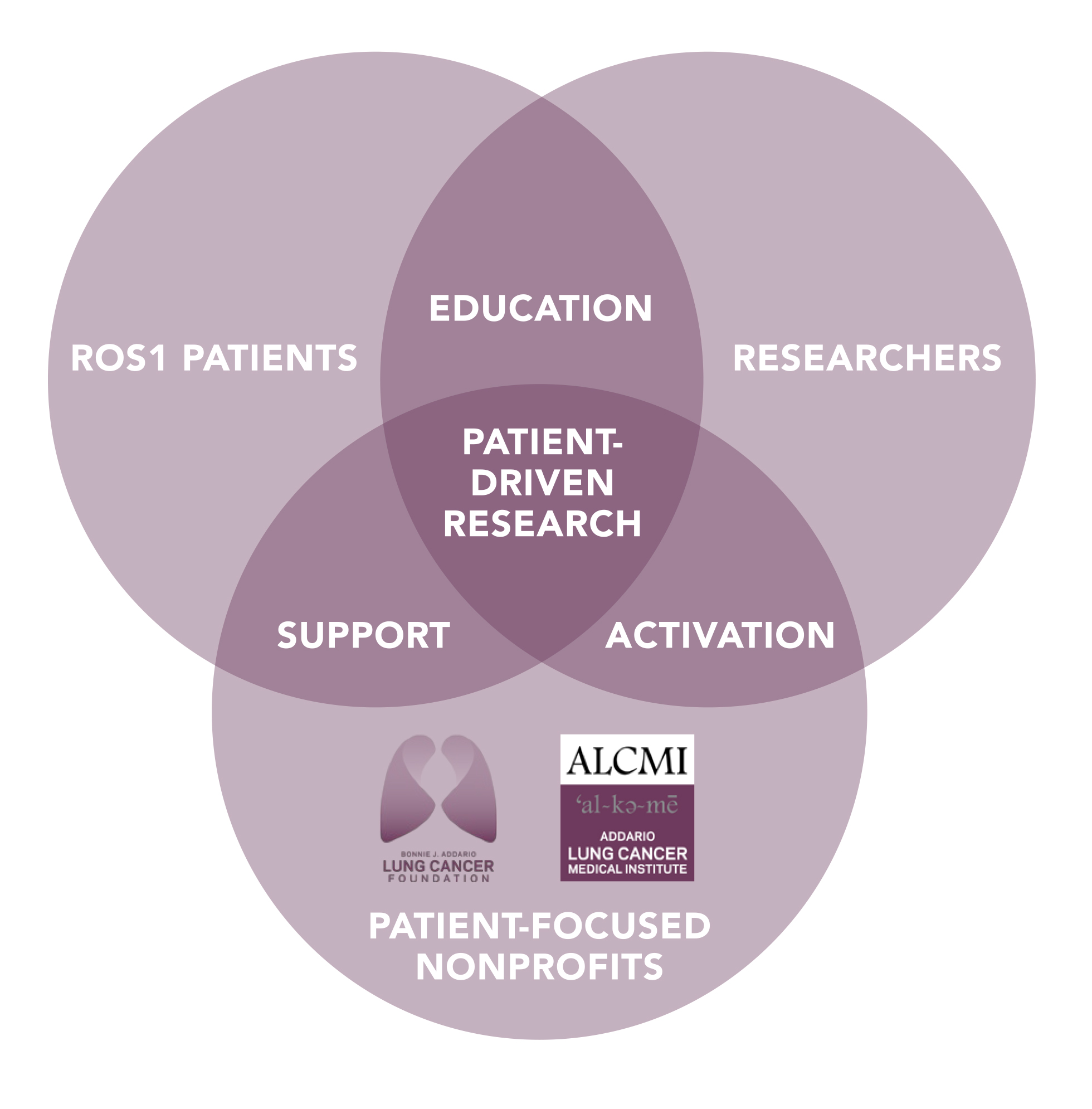
The Bonnie J. Addario Lung Cancer Foundation has partnered with ROS1ers to inform more people about our disease and develop patient-driven research that will hopefully find more effective treatments for us.  Although the ALCF focuses on lung cancer, this effort is addressing ROS1-positive cancer regardless of where in the body the cancer began.

The first step is an online survey that aims to discover what we ROS1ers might have in common and hopefully identify some causes for this rare cancer (the majority of the patients are young, fit never smokers). To our knowledge, this is the first-ever research into the possible causes of a genomically-driven cancer across cancer types.

Please complete your survey ASAP! While the survey will remain open for a long time, the first round of data analysis will commence on July 15, 2016, with a goal of announcing preliminary findings at the World Conference on Lung Cancer in December 2016.

If you have ROS1-positive cancer, please complete this survey.
If someone you know has it, please encourage them to complete this survey.
CLICK HERE FOR ROS1 PATIENT SURVEY

#LCSM Chat 5/5: Know Before You Go—Conference Prep 101

convention

image by Microsoft Office

Lung cancer patients and advocates are increasingly joining healthcare, pharma, government agency and biotech industry representatives at cancer-related medical conferences such as the American Association for Cancer Research (AACR) Annual Meeting in April and the American Society for Clinical Oncology Annual Meeting in June.

Planning ahead for these meetings is essential for getting the most out of your time. The events, which can last several days, often have many sessions happening at the same time in different rooms. In addition to scheduling considerations, the terminology, graphics, and scientific concepts discussed in the sessions can be overwhelming even for seasoned attendees.

Because no one can possibly attend every conference, attendees share the conference experience by posting tweets while at the conference (called “live tweeting”) about significant happenings and new findings. Often, these conferences have specific hashtags–for instance, those attending the ASCO Annual Meeting this year will include #ASCO16 in their tweets. However, live tweeting from sessions presents some challenges, like condensing new concepts into less than 140 characters, and continuing to follow slides while composing tweets.

In our Thursday May 5 #LCSM Chat at 8 PM Eastern Daylight Time (5 PM Pacific), we will share ideas how attendees might prepare in advance to get the most from a medical conference and share their conference experience with others in real time on Twitter. Janet Freeman-Daily will moderate our discussion using the following questions:

  • T1: What tips do you have for getting the most out of a medical conference? How do you prepare?
  • T2: What concepts would be most helpful for patients/advocates to know before attending cancer conferences? Where can they learn these?
  • T3: What tips do you have for live tweeting a medical conference? What kind of live tweets do you value most?

We hope you’ll join #LCSM Chat on Thursday May 5 at 8 PM EDT. If you’re new to tweetchats, please read this primer on how to participate in #LCSM Chats.

Reblogged with permission from the LCSM Chat website.

Opportunity to honor Dr D Ross Camidge

Camidge and daughters

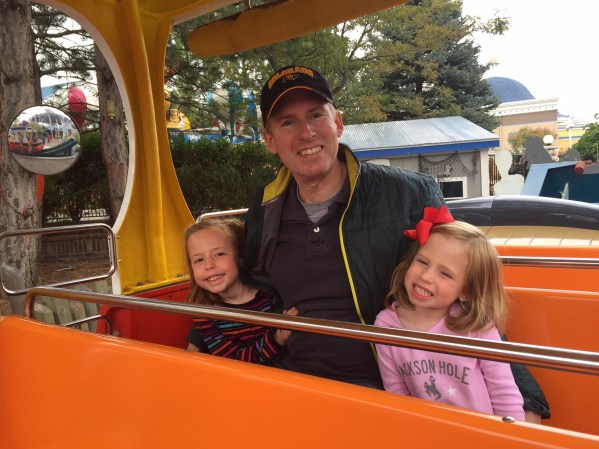
Dr. D Ross Camidge, MD, PhD, at the University of Colorado (CU) Cancer Center has provided me and many other lung cancer patients and caregivers with hope, support, effective clinical trials, remote second opinions and excellent cancer care. On April 5, Dr. Camidge’s work will be honored as he formally accepts the newly-created Joyce Zeff Endowed Chair in Lung Cancer Research.
   
A patient speaker (not me) will be talking at the event about Dr. Camidge’s impact on patients. We have a unique opportunity to show Dr Camidge–as well as the donor Ms. Zeff and CU–how many people he has helped in lung cancer patient communities .
   
If you are willing to have your Camidge experiences and kudos shared from the stage at the recognition ceremony, please post them below. I’ll make sure they get to the patient who will be speaking. If you want your name (real or online) associated with the quote, please say so in your post.
   
Thanks in advance for your contributions!
   
Janet Freeman-Daily (AKA Squanch)

Crizotinib (Xalkori) approved for ROS1-positive NSCLC!

The anticancer pill I take in my clinical trial, Xalkori (generic name crizotinib), was approved today by the FDA for my type of lung cancer: ROS1-positive non-small cell lung cancer.  I’m one of the 50 patients whose results were included in the clinical trial data.

In addition to being happy that I found an effective treatment for my lung cancer–I’ve had No Evidence of Disease for 36 months and counting–I feel proud to be part of the research that is making new cancer treatments available for more patients.

Precision medicine, targeted therapies, and clinical trials are awesome.

————————-
Edit 2016-03-11 2 PM to add:

Some people have asked what this approval means to my participation in the clinical trial.

The short answer:
Nothing has changed for me. I’m still in the clinical trial, and I still get my drug free (but have to pay for my travel).

The long answer:

Last April, Xalkori for ROS1+ NSCLC received “breakthrough” FDA designation, which is one type of accelerated FDA approval. The accelerated approval process allows the FDA to grant approval before a Phase 3 clinical trial is completed, but still requires a Phase 3 trial to be completed eventually. So my clinical trial must continue until the Phase 3 trial is complete, or the FDA will pull its approval of Xalkori for ROS1 NSCLC.

Xalkori originally received breakthrough designation for ALK+ NSCLC, and was granted FDA approval through the accelerated process in August 2011 (the fastest drug approval to date). The Xalkori for ALK+ NSCLC phase 3 clinical trial still continues over four years later. So I suspect my clinical trial will be continuing for some time.

However, even if I left the clinical trial, Xalkori is already covered by most insurance plans, and today’s FDA approval means pretty much all plans will cover it. However, the copays vary considerably.  Some plans cover it as a pharmacy benefit with a substantial out of pocket expense.  Others cover it as a medical expense, with a standard deductible.  I haven’t checked to see how (or if) my plan covers it.

I plan to stay in the clinical trial at the University of Colorado for the forseeable future.  I like having regular access to some of the top experts in the world on ROS1 cancer and molecular testing for precision medicine.  My writing income goes to fund their Lung Cancer Colorado Fund for lung cancer research.  I also participate in their research as a patient advocate on the NCI-sponsored CU lung cancer SPORE (Specialized Program for Research Excellence) and get to learn about cutting-edge cancer research, which satisfies the geek in me. Besides, I’ve grown fond of several people I’ve come to know at CU.  It’s become a second home of sorts.

So, yeah, this approval does not change my treatment. But hopefully it will make the treatment more available to more patients ASAP.

Communing with a Giant on Cancer, Life

This past week I attended the Rainforest Writers Village with twenty or so other science fiction writers.  The resort where we stayed is on the southeast tip of Lake Quinault, adjacent to the southern border of the Olympic National Park in Washington State.  It was quiet, beautiful, and slow-paced—the perfect place to take a break from everything and focus on my writing.

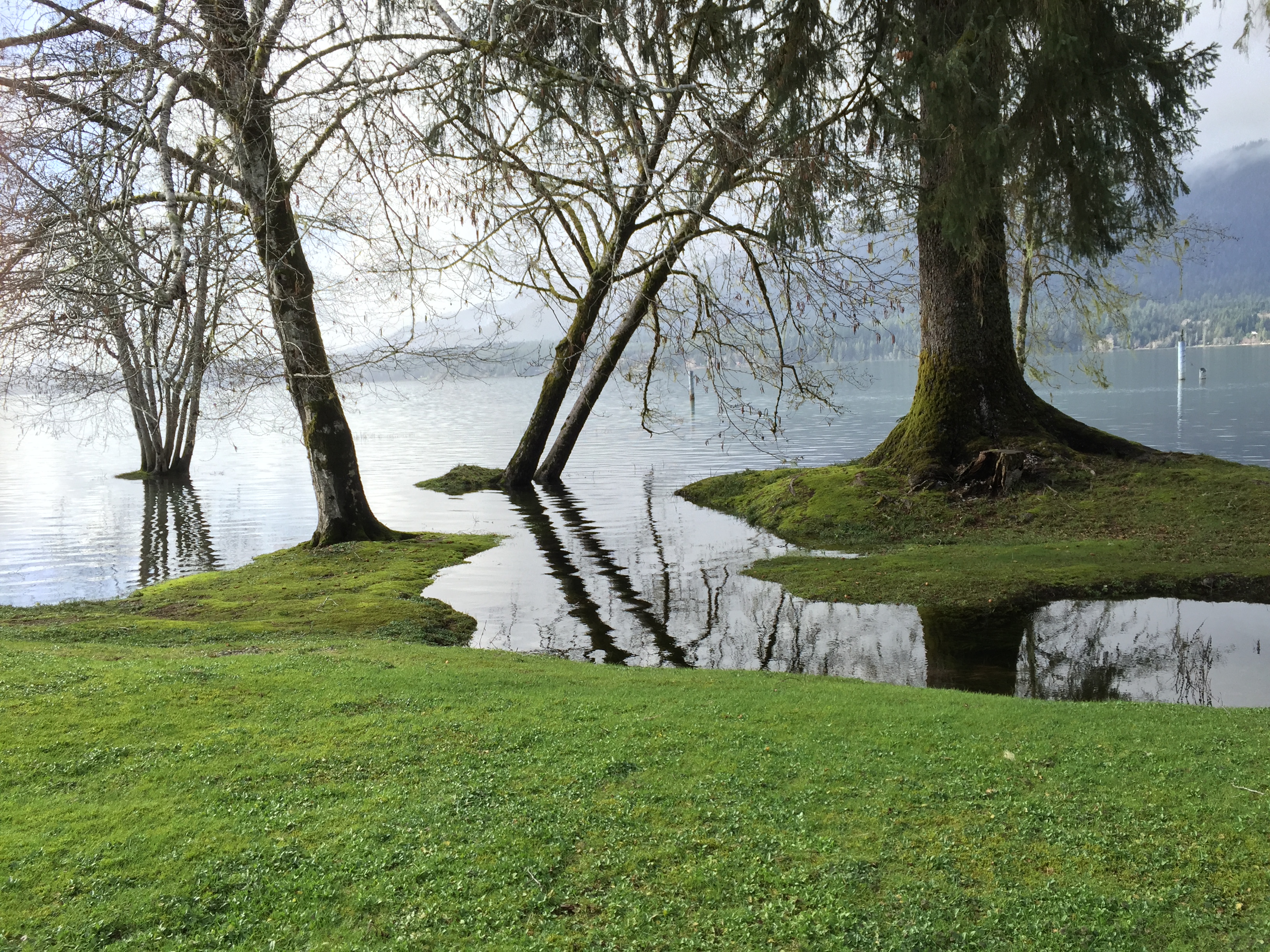
After lunch the first day, I decided to take a meditation walk along the lakeshore in hopes of absorbing some of the abundant tranquility. When I walked this same path 14 months ago (December 2014), Washington was experiencing a drought. This year, we’d had our wettest winter EVER, and the level of the lake reflected the additional rainfall.  Tree roots normally anchored on the mossy bank now stood in a couple of feet in water.

The first hours of the retreat were graced with several downpours, but for the moment, the rain had stopped. I took deliberate steps along the soggy pathway, carefully placing my feet to avoid adding another fall to my medical file.  I concentrated on taking slow, deep breaths.  Gradually my thoughts came to rest in the moment.  I smelled the surrounding evergreens, felt the moist rainforest air, heard the enthusiastic creek swollen with runoff, saw a raven stepping carefully on puddled lawn.

I meandered past deserted trailer slots and a closed bathhouse to the end of the campground, where stood the World’s Largest Sitka Spruce Tree.  There I encountered a couple of other writers who were also taking a break from their labors.  We imagined the tree was lonely and had called for company.  Eventually, the others wandered off, leaving me alone with the tree, and my thoughts.

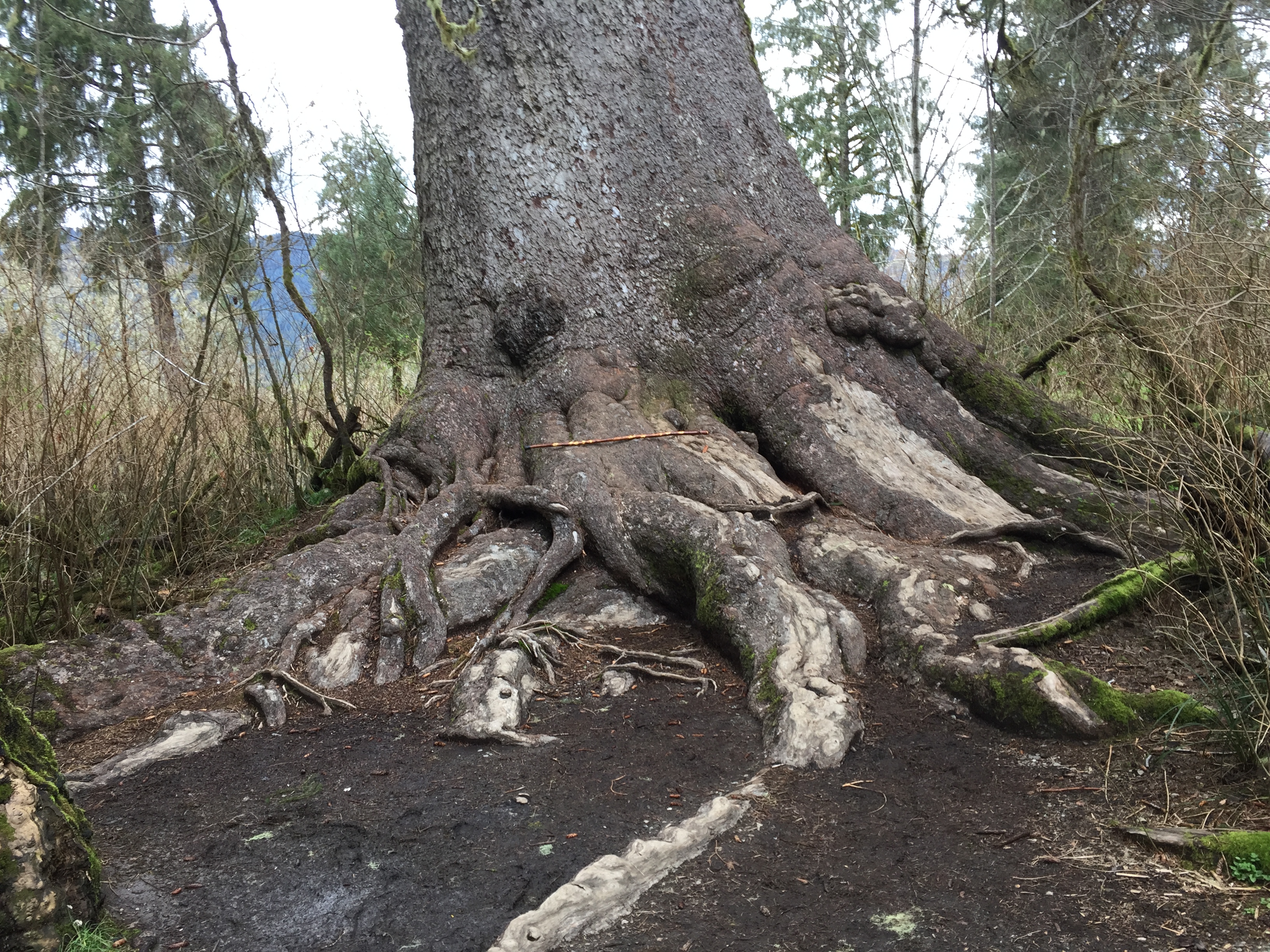
Despite hundreds of droughts and downpours, the thousand-year-old giant before me stood firmly anchored in the earth, continually adding rings to its impressive girth.  The diameter of its trunk exceeded twice my armspan, and the massive roots spread at least twice again as far.

Standing under its broad arms, dwarfed by its great size and age, I was struck by … Read more

A Crowning Achievement

Here’s an example of technology making a huge positive difference in healthcare, with very little fanfare.

While waiting for the dentist to see me during my recent checkup, I asked the hygienist if they had an old printer running a large print job–I could hear a continuing buzz from somewhere in the office.  I was imagining a 1970’s style printers with those spiky little wheels feeding long continuous sheets of paper and a dot-matrix ink cartridge zipping back and forth, like those that ran our card batch jobs during my college days (yeah, I’m that old).

Turns out, it wasn’t an OLD printer.  She took me into the next room and showed me a device the size of a microwave.

My dentist can now create a custom crown using a 3D printer during one office visit. The system designs the crown using 3D imaging to ensure a good fit in your mouth–no more temporary, ill-fitting crowns.  More on the process is here.

3D crown printing

So we have a new variation on Precision Medicine–custom crowns designed while you wait.  Technology is so cool.

image from “New At The Dentist: 3D Printing Dental Crowns While You Wait


Patient Advocate Scholarships Available to Attend #ASCO16

Photo shows two mean chatting in the bustle of Annual Meeting.

If you are a cancer patient advocate interested in attending ASCO 2016, consider applying for the Conquer Cancer Foundation Patient Advocate Scholarship Program.

I have attended ASCO’s annual meeting in Chicago for the past two years.  While the five-day conference can be exhausting, it’s perhaps the best way to learn what treatments are up and coming for your type of cancer, become educated about the science behind research and clinical trials, and discover (and even chat with) the experts in your type of cancer.  It’s also a place to meet the people in your cancer community who you might only know online.

The ASCO (American Society of Clinical Oncology) 2016 Annual Meeting–held in Chicago June 3-7–will bring together over 30,000 cancer professionals from around the world for sessions about state-of-the-art treatment, results of clinical trials, as well as policy, advocacy, and survivorship issues.  You might strike up a conversation with a world-class expert in your type of cancer at a poster presentation or even walking between sessions.  The exhibit hall is a great place to learn about new biotech technologies (such as genomic testing panels and liquid biopsies) as well as what’s in each pharmaceutical company’s drug pipeline.

The Patient Advocate Scholarships are intended for expenses related to air or train travel, lodging, and meeting registration for advocates traveling from outside the Chicago area to attend the meeting (which can add up to $2K US or more).  Eligibility is based primarily on financial need as well as advocacy experience and current activities. Applicants will need to demonstrate why they would not be able to afford to attend the ASCO Annual Meeting without a scholarship award, and are encouraged to provide a compelling reason why their attendance at the meeting is vital to their advocacy role(s).

Although the application period for the doesn’t open until April 4, get an early start now on preparing your application –the application period will only open for three days!

Three pavement dives make a trend

falling

Yesterday morning I repeated the pavement diving stunt I pulled in Chicago last May that broke my left shoulder: I caught my toe, staggered a few steps, and played Superman on the hard deck.  My official “Klutz” merit badge is due to arrive any day now.

This time I had the foresight to fall just as I entered the University of Colorado Cancer Center for my monthly labs.  The staffers at the information desk rated it a 5 out of 10 for style, and a flurry of doctors and nurses descended immediately.  The nurse who drew my labs insisted on walking me to the ER for a quick x-ray, which showed I had not reinjured my left shoulder (**whew**).  I was discharged from the ER just in time to drive to the airport for my flight home. I still have full range of motion in both arms, but movement is a bit less comfortable. Since I still can’t take anti-inflammatory drugs like NSAIDs (due to blood thinners), I might choose to get that second cortisone shot I’ve been avoiding, unless icing can adequately soothe my angry tendons (good name for a rock band, isn’t it?).

My legs have seemed weaker recently.  I’ve been traveling a lot lately, and therefore walking and climbing stairs more than usual, which might be at least partly responsible.  Also, my feet are getting more vocal in recent months about their objections to past chemotherapy — a paper published in January found peripheral neuropathy greatly increases the risk of falls among cancer survivors  (to which I reply … ya think?).

This is my third fall in nine months, which set off alarms for my docs at my check-in today.  They say three falls  in a year counts as a “trend.”  I’ve been referred to physical therapy for an evaluation of leg muscle strength, range of motion, and other possible mechanical reasons for my falls.  If this doesn’t reveal anything useful, my next stop is a neurologist. I had another clear brain MRI in January, so brain mets are unlikely.

A potential neurological issue seems relatively trivial compared to my metastatic cancer, but it does mean more medical appointments when I’d rather be writing.  When will I learn to be a boring vanilla cancer patient?


#LCSM Chat topic 2/25: Communicating patient goals and values for #lungcancer treatment


This is reblogged with permission from the LCSM Chat website.

———————–

The best lung cancer care considers the patient’s goals and values when choosing a treatment. However, identifying and communicating those goals is not always a straightforward process for either the care provider or the patient.  

This week’s #LCSM Chat explores the process of communicating patient goals and values. Care providers need to know how to elicit them. Patients (even those who want to leave treatment decisions entirely to their doctors) must be able to identify and express them, and, if need be, initiate a conversation about them.  

Choosing the right treatment and care for a lung cancer patient is a matter of weighing risks of side effects versus evidence that the treatment has a good chance of success. Physical side effects can run the gamut from mildly annoying tummy upset to life-threatening organ failure. Yet sometimes a drug that causes severe side effects might result in cure or prolonged No Evidence of Disease. While the doctor or other care provider can learn about the risks and benefits for specific treatments from medical literature, only the patient knows what risks they are willing to accept to achieve their individual treatment goals. 

Willingness to tolerate risks varies from patient to patient. Some patients (perhaps those with small children) might favor an aggressive new treatment with the goal of living as long as possible regardless of side effects. Others (perhaps those who have additional health problems that would be dangerously aggravated by cancer treatment) may choose to forego active treatment and aim to be comfortable enough to attend a dear friend’s wedding in six months.  

In addition to physical side effects, patients also have financial, logistic, cultural and family concerns. Although it would be wonderful if all cancer patients had sufficient resources to access the most effective treatment options and the best care, we know this is not the case. Some patients must make treatment choices based on their ability to pay or to travel to a treatment site–a cancer center may not covered by the patient’s insurance, or may be hundreds of miles away. Unfortunately, bankruptcy is not a rare side effect of cancer treatment.  

The discussion of patient goals and values must continue throughout a patient’s lung cancer treatment, because patient preferences may change over time. An early stage patient might choose to be aggressive in their first-line treatment in hopes of a cure. Yet that same patient may find that after their cancer has become metastatic and they have had three different aggressive cancer treatments, they hesitate to try another treatment likely to have severe side effects. 

Some patients are comfortable trusting their doctors to determine whether the potential benefits of a treatment are worth the potential side effects, while other patients prefer to participate in shared decision making. Both approaches are valid choices, but in both cases, one would hope that one’s doctors would consider each patient’s goals and values when weighing treatment options.  

However, the process each care provider uses to determine patient goals and values is far from standardized. It is not a skill that has been (or is currently) taught in most medical schools. Sometimes the process doesn’t happen. 

During our chat on February 25 at 8 PM Eastern (5 PM Pacific), moderator Janet Freeman-Daily (@JFreemanDaily) will lead the discussion about communicating patient goals & values for lung cancer treatment using these topic questions: 

  • T1: What are examples of patient goals & values that would be helpful in discussions of #cancer treatment? #lcsm
  • T2: How can we encourage patients (including those who want to leave decisions to docs) to think about treatment goals & values? #lcsm
  • T3: How might care providers solicit patients goals & values for #lungcancer treatment? Are any topics (e.g., cost) off limits? #lcsm
  • T4: How might patients initiate the discussion of their goals and values if their #lungcancer care provider doesn’t ask? #lcsm
  • T5: How can we encourage discussions of goals and values between #lungcancer care providers and patients? #lcsm

We hope you will join the 2/25 chat. Remember to add the hashtag #LCSM to your tweets during the chat so other chat participants can see them. For more info, check out how to participate in #LCSM Chat. If you can’t join us, please leave your comments below.   

References

“Patient-centered: providing care that is respectful of and responsive to in­dividual patient preferences, needs, and values, and ensuring that patient values guide all clinical decisions.”  Institute of Medicine, CROSSING THE QUALITY CHASM: A NEW HEALTH SYSTEM FOR THE 21ST CENTURY, p. 3

Patient-Centered Communication and Shared Decision Making,” National Academies Committee on Improving the Quality of Cancer Care, Delivering High-Quality Cancer Care, Chapter 3.