Please comment by 26-Feb-16: Bree Collaborative Oncology Workgroup recommendations

The Bree Collaborative’s Oncology Workgroup (I am their patient advocate) is seeking feedback on our recommendations regarding (1) advanced imaging for early stage breast and prostate cancers, and (2) palliative care during anti-cancer therapy.  Hope you’ll read the recommendations and take the survey! Feedback is due by February 26. 

——————————-

Your feedback is requested on the Bree Collaborative’s latest draft report and recommendations for Oncology Care.

Please complete all comments regarding the report using this link to Surveymonkey. The survey should take 5-10 minutes to complete. Comments must be received by 5pm on Friday, February 26th.      

Summary of Recommendations

Cost and quality of cancer care vary greatly in the United States. Significant variation in diagnosis, treatment, and supportive care for patients promotes poor outcomes and excessive cost for patients and the health care system.  While evidence-based guidelines exist, adoption has been inconsistent. Our report has two primary focus areas:

  1. That all clinics follow the American Society of Clinical Oncology’s Choosing Wisely recommendations:
    • Do not use PET [positron emission tomography], CT [computed tomography] and radionuclide bone scans in the staging of early prostate cancer at low risk of spreading.
    • Do not use PET, CT, and radionuclide bone scans in the staging of early breast cancer that is at low risk of spreading.
  2. That palliative care be offered alongside active anti-cancer care, as needed. Oncology care should be aligned with a patient’s individual goals and values and follow ASCO’s position statement of key elements for individualized cancer care. Patients should be apprised of the harms, benefits, evidence, and potential impact of chemotherapy and radiation at all stages in their illness trajectory.

About This Public Comment Process

  • The Oncology Care workgroup reviews and uses public comments to develop the report submitted to the Bree Collaborative for adoption.
  • The final report is submitted to the Washington State Health Care Authority (HCA). This state agency oversees Washington’s largest health care purchasers – Medicaid and the Public Employees Benefits Board Program (PEB).
  • Collaborative recommendations guide state purchasing policies for these programs.
  • The Collaborative also works to promote implementation of the recommendations across Washington State

For more information or to give additional feedback, please contact Ginny Weir, Program Director of the Bree Collaborative at GWeir@qualityhealth.org or (206) 204-7377 or visit www.breecollaborative.org

Thank you in advance for your participation in this effort to improve health care quality, outcomes, and affordability in Washington State.

Ginny Weir, MPH
Program Director, Bree Collaborative
Foundation for Health Care Quality
705 Second Avenue, Suite 410 | Seattle, WA 98104
GWeir@qualityhealth.org | (206) 204-7377
www.breecollaborative.org

Help lung cancer doctors learn about patient decision making

decision making

If you are patient with lung cancer, or a caregiver of a patient with lung cancer, please consider completing this 15-minute survey. It was created by Dr. Laurie Gaspar, a radiation oncologist at the University of Colorado, to gather information about:

– How prepared patients are for making difficult decisions?
– How involved patients are in the decision process?
– What would help to improve the decision making process?

The study results will help doctors, patients, and caregivers understand how the process of making decisions about lung cancer treatment and care might improved.

The survey is here:

Looking forward: 2016 AACR Annual Meeting and the Scientist-Survivor Program

Microscope

I recently learned I was selected to participate in the American Association of Cancer Research (AACR) 2016 Scientist-Survivor Program!  I’m excited to be attending the AACR Annual Meeting this April in New Orleans.  Thanks to the Bonnie J. Addario Lung Cancer Foundation for sponsoring my application.
I’m looking forward to networking with researchers as well as meeting advocates for other types of cancers to discuss their work.  I’ll also be presenting a research poster on Lung Cancer Social Media (#LCSM) on Twitter, which offer a unique opportunity to connect with all types of stakeholders in the lung cancer community — patients, caregivers, healthcare providers, researchers, hospitals, pharmaceutical companies, advocacy groups, and insurance payers.  Afterwards I plan to blog about the experience and share some of the exciting research presented at the meeting.
After the meeting, I’m going to have a few days vacation to enjoy New Orleans (which I’ve never visited).  I’ll then take The City of New Orleans Amtrak route to Chicago, followed by another train to Boston.  I’ll arrive just in time to present at another conference (GET 2016) at Harvard the next day! I had originally planned to take the Sunset Limited from New Orleans to LA, but after I was invited to GET my travel coordinator (e.g., hubby Gerry) could not find any place where I could disembark along the way and fly to Boston in time for the conference.  After GET, I’ll take a train to Washington DC, where I’ll be a speaker at LUNGevity’s National HOPE Summit.  Whew!
Glad I have willing housesitters who love (and are loved by) the cats.

My Norwescon 39 Panel Schedule

nwc 2016 banner

The Norwescon 39 Science Fiction Convention happens March 24-27, 2016, in SeaTac, Washington.  I will once again be a science panelist.  You can find me on the panels listed below, or maybe hanging out in the bar with other writers and science geeks, scarfing down a snack in the Green Room, or wandering the corridors on my way to the art show, dealers room, a friend’s reading, or an interesting panel.  hope to see you there!


BIO21 – Blinded by Pseudoscience
Fri 6:00 PM-7:00 PM – Cascade 3&4
Gregory Gadow (M), Janet Freeman-Daily, Caroline Pate, Dr. Misty Marshall, Jake McKinzie

TEC05 – Real Radiation for Writers & Readers
Fri 8:00 PM-9:00 PM – Cascade 5&6
Mike Brennan (M), Janet Freeman-Daily, Arthur Bozlee, Daniel P. Lynge

BIO20 – Facts & Fictions of Cancer
Sat 1:00 PM-2:00 PM – Cascade 5&6
Janet Freeman-Daily (M), Dr. Misty Marshall, Vickie Bligh, Nicholas Maurice

BIO16 – Ask the Experts: Biology
Sat 2:00 PM-3:00 PM – Cascade 5&6
Alan Andrist (M), Janet Freeman-Daily, Caroline Pate, Dr. Misty Marshall, Nicholas Maurice

TEC01 – Remembering In Tomorrow
Sat 7:00 PM-8:00 PM – Cascade 9
Sean Hagle (M), Janet Freeman-Daily, Michael Ormes

BIO19 – Evolution Is Just a Theory!
Sun 10:00 AM-11:00 AM – Cascade 5&6
Dr. Ricky (M), Janet Freeman-Daily, Alan Andrist, Michael McSwiney, Jake McKinzie

BIO03 – Future Pharma
Sun 2:00 PM-3:00 PM – Cascade 5&6
Janet Freeman-Daily (M), Caroline Pate, Vickie Bligh, Nicholas Maurice

How do you see a good death?

An emergency room physician has written a great piece comparing what dying is like today compared to a century ago.  The experience today isn’t necessarily better. Everyone needs to read I Know You Love Me — Now Let Me Die by .

The majority of humans will experience a gradual decline and loss of function in their lives before they die. Everyone–healthy or otherwise–needs to talk with loved ones NOW about what quality of life means, and how they would prefer to spend their last days. Because we WILL die.

Unfortunately, one can have all the Advance Directive paperwork in place and still have one’s wishes overridden by the hospital if the papers are not in the right hands at the right time. Also, Advanced Directives cannot cover every possibility–for instance, do you want your pneumonia treated with antibiotics if you’re already cognitively impaired by dementia? That’s why it’s so important to make sure loved ones know your wishes and will ensure they are carried out to the best of their ability.

Visit The Conversation Project to get started.

Tropical Sniffles, or Under the Wonderful Weather

 The night before we left for our Hawaiian vacation, I had developed a stuffy nose and sore throat, and slept only three hours because I couldn’t breathe through my CPAP.  On the plane, I went through an entire pack of Kleenex.  In the Kapaa condo, I collapsed at 8 PM with a fever, but awoke at 1:30 AM with screaming sinuses.  To avoid waking hubby, I hung out in the darkened bathroom playing Whirlyword on my phone with tissue stuffed up my nose for two hours.  I finally got back to sleep around 3:30 AM.

This morning, I awoke to guava juice, sunshine, tropical breezes, a balcony overlooking a lovely garden, and the crow of Kauai roosters.  If I’ve got to be sick, this is the sickroom I want!

  
Today was a Kauai afternoon with 3 generations of family, good Hawaiian food, whales breaching offshore, the sound of crashing waves below, and a stellar sunset. I just sat in a corner of the lanai and soaked it all in while life happened all around me.

  
 I am sated.  Sometimes it’s enough to just BE.

————–

Thanks to Steve and Gerry for crowdsourcing the blog title

Take It Personally: How decoding your genes might unlock the future of health care

Denver’s “5280” magazine just published a terrific article on precision medicine called  Take It Personally: How decoding your genes might unlock the future of health care by Julie Dugdale (click on the link to read it). It’s a top-level summary of the benefits and issues that arise from using genomic data in medicine.  One of the main players in the article is the University of Colorado School of Medicine, and some of the providers I work with at CU are quoted (Dr. Dara Aisner and Dr. Robert Doebele).

P.S.  I play a bit role in the article (as a lung cancer case study)


2015 in review

The WordPress.com stats helper monkeys prepared a 2015 annual report for this blog.

Here’s an excerpt:

The concert hall at the Sydney Opera House holds 2,700 people. This blog was viewed about 60,000 times in 2015. If it were a concert at Sydney Opera House, it would take about 22 sold-out performances for that many people to see it.

Click here to see the complete report.

Oh, the places I’ve been … (Dec-2015 version)

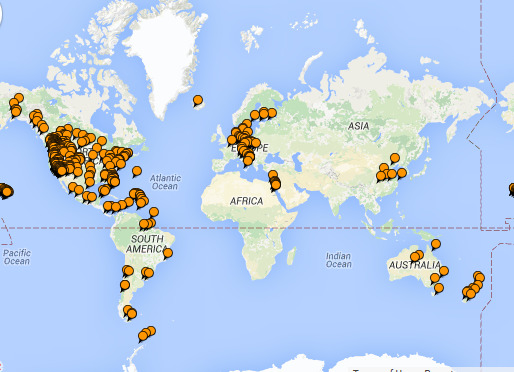
Today, since my to-do list is overflowing, I avoided doing anything productive and instead marked places I’ve been on the TripAdvisor.com map. According to them, I’ve seen 26% of the world. I’ve visited all 7 continents — although I did not set foot on Antarctica soil, sailing within sight of penguins on shore still counts, right? However, I’ve barely seen anything of Asia and Africa–obviously I have more traveling to do before I rest.

Places I've been (on TripAdvisor map) 2015-12-29

I guess I also need to write more travelogue posts, too …

Guest Blog by Dann Wonser: Do I stay in my clinical trial?

My friend and fellow lung cancer patient Dann Wonser recently blogged an update about his treatment status.  In it, he shared how he made his decision about whether to stay in his targeted therapy clinical trial after the drug received FDA approval.  It’s a worthwhile discussion–an increasing number of cancer patients will face such decisions as more targeted therapies are approved–so I asked his permission to share it on my blog.  The entire text is listed below.

—————————————

NEW SCAN RESULTS + CLINICAL TRIAL DECISION

published December 17, 2015 by 

Friends and Family,

After our usual pre-scan hyper-sensitivity to every indigestion burp, cough, or body ache, I kicked my anxiety into overdrive by getting a cold/flu. It gave me all the symptoms of lung cancer gone rampant: Difficulty breathing, heavy chest, cough, feeling not so great. Then we flew to San Diego, where Dr. Patel gave us the good news: No new growth! We’re celebrating!!! We are now a couple of months past the average time that Tagrisso usually remains effective, which leaves me even more grateful. I have another six weeks of sweet life, and have bought another six weeks of time for the next new drugs to be developed before I need them. Clinical researchers out there, you are my heroes! Keep up the great work!

A couple weeks ago I asked what you would do if you had the choice of ending the clinical trial, but continuing to get the same medication in my home town. I thought I had probably covered the major topics pretty well, but found that there was much more to consider after listening to your thoughts. Thank you for contacting me through every means imaginable to share your thoughtful contributions! If you just want to know what I decided, skip straight to the bottom of this email. If all the facets of this decision fascinated you as much as they have me, keep reading and I’ll share what I learned from you.

First, Tagrisso is so new that the insurance company may not cover it, or may not have a contract with a pharmacy that carries it. They may also have a much higher co-pay for a new drug. This could critical, since the reported cost is $425 per pill. That’s right: $425 per day. I am very fortunate to have an insurance plan that has a maximum out-of-pocket expense. I usually meet that annual maximum out-of-pocket around January 7th, 🙂 and then I’m covered 100% for the year.

But what about those who do not have such great coverage? Fortunately, Astra Zeneca has a patient assistance program. See  http://www.astrazeneca-us.com/medicines/help-affording-your-medicines/ if you are in this boat. I believe other drug companies have similar programs… Worth checking out.

Several people told me they would get out of the clinical trial as soon as possible, to cut radiation exposure in half, by having half as many CT scans. Ashley, my clinical trial coordinator, petitioned the study sponsor to decrease the scan frequency for everyone. I’m impressed, and very grateful! Thank you, Ashley! Hey, I know it’s a long shot, but I appreciate the advocacy!

A friend and fellow blogger, Linnea Olson, actually contacted her study sponsor herself. Way to be your own advocate, Linnea!

But how much radiation is too much? Fortunately, I know someone who has spent years measuring radiation levels in workers at a nuclear-related facility. She can’t give an accurate response without knowing the radiation dose levels of the CT scans, but her best estimate is that the dose is still less than the daily level of radiation considered safe for workers in the nuclear industry. I don’t know whether that makes me feel relieved, or worried for the nuclear workers. All the same, it would be helpful to get dose info from a radiologist who does CT scans. I’ll work on it.

Several people mentioned the advantages of staying close to clinical researchers who are on the cutting edge of treatment. How could I replace that?

The length of the clinical trial was questioned. Dr. Patel has no idea how much longer the trial will continue. However, I have the choice of exiting the trial at any point.

Several of you mentioned the importance of contributing to research that affects the lives of so many. More data will help guide more research, and benefit more people.

The travel expense is not the biggest issue, but one that seemed reasonable for the drug company to cover at this point. The cost is roughly the equivalent to the price of one pill ($425) every six weeks.  UCSD told me that they never go back to the sponsor to ask for travel assistance. So…. I bypassed the system! I have my own Astra Zeneca connections, so I made my own request. We all have to be our own advocates.

I asked Genevieve how this impacts her, since she makes every trip with me. She dismissed the question as trivial and irrelevant. That says a lot about love, doesn’t it? She’s a keeper!

One friend, Joe, had a more noble take. He said that it’s good to stay with the girl that brought you to the dance, and make sure she gets home safe. In other words, since this clinical trial saved my life, perhaps loyalty should be a consideration.

Thank you  all for making me consider so much more, and in so much more depth. It makes me feel more comfortable with my decision… to stay with the clinical trial. You helped me crystalize that my biggest concern was the radiation, which I feel a little better about now. You also helped me to decide just how important it is to contribute to the research, and to realize that the most important factor for me is sticking close to Dr. Sandip Patel. He is the most cutting-edge oncologist that I know about for my situation, and I have direct access to him. That is irreplaceable.

Wishing you happy holidays, and decisions you can live with.

Love,

Dann