
Have a story about living with metastatic lung cancer on targeted therapy (as a patient or caregiver)? Submission deadline for the Life Between Scans anthology is July 1!
Submissions guidelines are here:


Photo Credit: personalexcellence.co
In some ways, my father was ahead of his time. An engineer, aviator, inventor, WWII vet, and medical doctor (Ok, he was an overachiever), Dad wanted all of his children, regardless of gender identity, to have a good science, technology, engineering, and math (STEM) education because he believed it would be essential for thriving in the future economic and political landscape. “Education is something that no one can take away from you,” he told me more than once.
Dad (and Mom too) fought school policy to make sure I was allowed to take science instead of being forced to take Home Economics with the other girls. Dad taught me how to use a slide rule, and when my math class did not cover essential concepts–like using π to calculate the area of a circle–he taught me himself (though at the time I would have much rather gone to bed). He advocated so that I and some other advanced students could take algebra and chemistry a year early, which allowed us to cram all the available STEM classes into four high school years. And he made sure that I could afford to attend my choice of colleges that focused on science and engineering.
In his sparse free time (he was a practicing family doctor while working as chief engineer at his father’s company on the side), he showed me how an oscilloscope could analyze an electronic circuit, taught me how to find the constellations using a telescope, took me and a classmate out in his boat to collect plankton for a science project, and talked to my physiology class about medicine.
True, he missed most every ball game, skipped a lot of music concerts, and often wasn’t home to read to me (thankfully Mom picked up the slack). True, I had issues with his insistence on perfection and lack of positive feedback. Still, I am the happy, inquisitive science geek I am today in large part because my father made sure my scientific curiosity and abilities were nurtured.
So, thanks, Dad, for believing in me. Despite your humanity and parenting missteps, you made a positive difference in my life. I wish 60-year-old me could talk to you face to face and make sure you knew how much I loved you–and love you still–and reassure you that I know how much you did for me.
To all who have been, will be, or wished they were fathers; who stand in as a loving father figure; or who had or wished they had a good father ….
may you spend Father’s Day remembering or making happy memories.

I’m excited to be one of the handful of patients speaking in a public forum tomorrow evening at The Broad Institute in Boston, Massachusetts (well, technically, Cambridge). We’ll be sharing our “Lessons for Creating Patient‐Researcher Partnerships to Accelerate Biomedical Progress.” I get to talk about the founding of the ROS1ders and the Global ROS1 Initiative.
A host of engaged patients, cancer researchers, and other healthcare types, among them the American Society for Clinical Oncology and the Biden Cancer Initiative (which grew out of the Cancer Moonshot) will be there. This could be the start of something BIG. At a minimum, it will spontaneously generate a HUGE group hug with advocate friends old and new.
Coincidentally, we’ll be staying at a hotel just a few blocks from my old MIT dorm during MIT Reunion Weekend. I’ll be too late for reunion festivities–attending the ASCO Annual Meeting last week took priority. Still, I’ll wander over on my knee scooter (still healing after foot surgery) in the 90º-plus heat. I ought to be able to reflect on my crazy undergrad days on Third East in the East Campus dormitory for at least five minutes before seeking refuge inside an air-conditioned building. Next year I plan to indulge in my 40th MIT Reunion–I didn’t expect to live long enough to see it, and I’m going to take full advantage of the the opportunity!

Thanks to cancer clinical trials, engaged patients, and a devoted spouse, I have lived to see my silver wedding anniversary.
I don’t know which is more amazing – that I’ve lived six years beyond a diagnosis of advanced lung cancer (and currently have no evidence disease), or that two strong-willed, opinionated engineers have shared a house for 25 years without killing each other. I think the second might be a rarer occurrence.
My cancer diagnosis definitely put a strain on our marriage, and I know Gerry struggled at times as he watched me experience the discomforts, losses, dashed hopes, and side effects of living with lung cancer as a chronic illness. Oddly, cancer has also strengthened our marriage. It has caused both of us to focus more on what’s really important, to be more tolerant of each other’s idiosyncrasies (we got a lot), and to find more ways to spend time together.
My husband has gradually become more involved in supporting my patient advocacy work. He’s met people that I have helped, and he can see the purpose and meaning it gives me. He said he wanted to help me have that in my life. (sniff sniff) Appropriately, hubby and I going to celebrate our 25th anniversary at the ASCO Annual Meeting in Chicago this weekend. He’ll be escorting me to events since I’ll still using a knee scooter after foot surgery (isn’t he sweet?). We’re hoping he’ll be able to watch me give my first-ever ASCO presentation, despite having only a guest badge.
So, happy anniversary, Gerry. Thanks for sticking with me for better or worse. Love you!
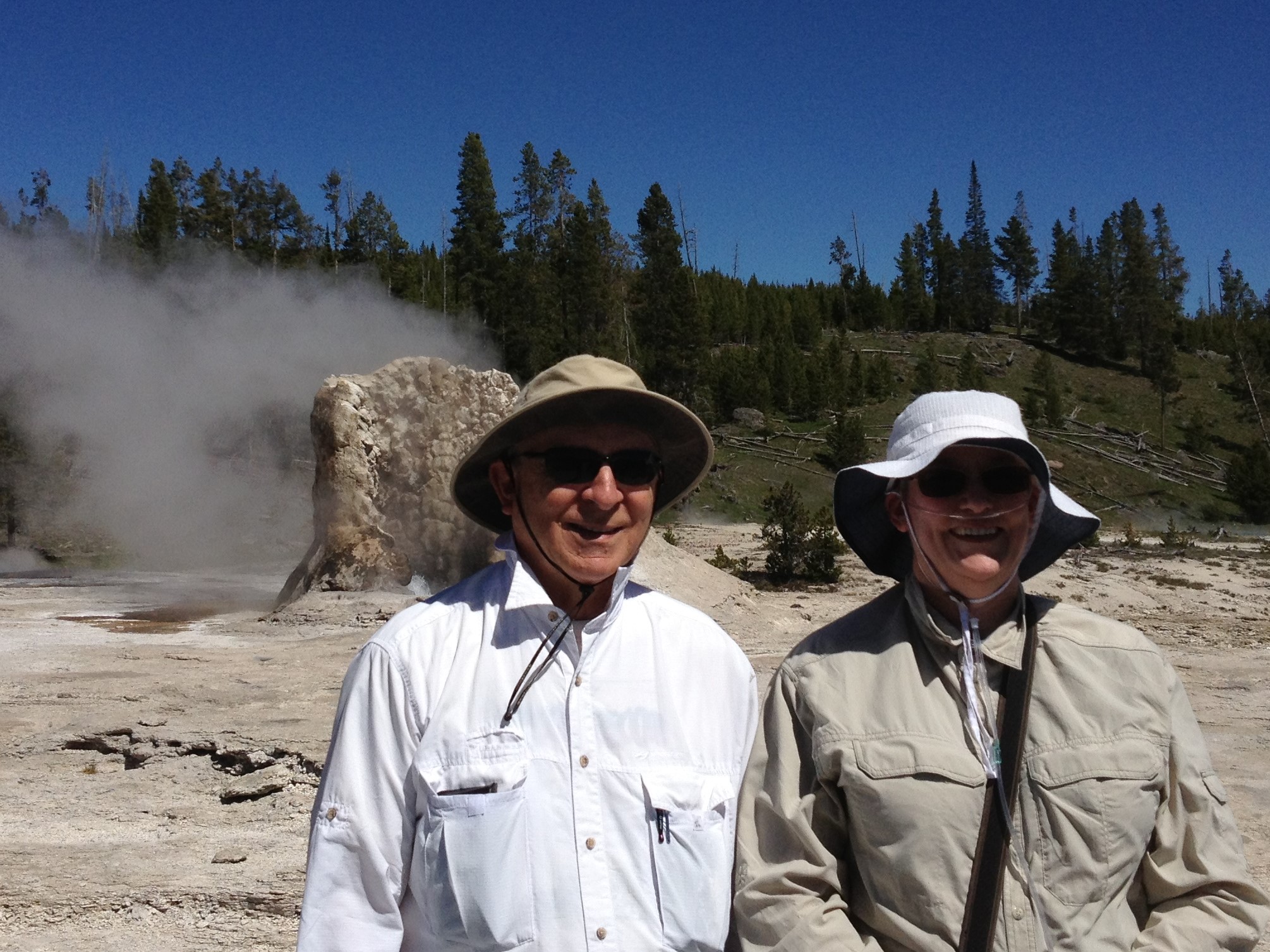
Gerry and Janet blowing off steam in Yellowstone, 2013.

Today the National Cancer Institute published this blog about the ROS1ders on the Center for Cancer Genomics “Insights and Innovations” blog. The Global ROS1 Initiative is underway! I’m glad I was able to help share our story.
———————————————-
In May 2015, I met four friends in a bar near Washington, D.C., to talk about not dying of cancer.
This conversation planted a seed that has grown into The Global ROS1 Initiative, a patient-researcher partnership that is redefining research into ROS1-positive (ROS1+) cancer. The Initiative includes a group of over 150 patients in 19 countries; two patient-focused foundations, Bonnie J. Addario Lung Cancer Foundation (ALCF) and Addario Lung Cancer Medical Institute (ALCMI); academic cancer researchers; and industry. The Initiative includes more than twice the number of patients enrolled in any ROS1 clinical trial thus far.
How did this happen? Let’s return to the bar. Read More …
I was eating a typical breakfast this morning, at our typical time, in the typical place, when I realized today was not typical. Today is my six-year cancerversary.
Took me a moment to digest that thought.
Considering how shocked I was to hear my diagnosis of advanced lung cancer on May 10, 2011, I’m surprised this day seems typical. Perhaps I shouldn’t be. I’ve been living with No Evidence of Disease for 52 months and counting (thanks to a clinical trial, medical research, and other patients), and my scans only happen twice a year. I might almost ignore the fact that I’m still a cancer patient in active treatment if not for the persistent side effects of previous treatment, daily medication ritual (seven different meds for cancer and side effects), and occasional bouts of pneumonia and coughing.
My time with lung cancer has been eased by the wonderful friends I’ve made along the way in the lung cancer community. Some of my favorite experiences are watching them discover how to combine their passion for changing lung cancer outcomes with their unique skills and interests to meet a need. Whatever skills they may value and enjoy, they can use them to find a purpose that gives meaning beyond a lung cancer diagnosis. Maybe it’s making memories with family and friends, creating a blog or piece of art, supporting newly-diagnosed patients and their caregivers in person or online, telling their lung cancer story in public, volunteering for a lung cancer advocacy organization, writing to lawmakers, conducting a fundraiser, or serving as a research patient advocate. The needs in the lung cancer community are huge, and there are many ways to make a difference. A caring act need not be global to be great. And the funny thing is, when you’re caring for others, one’s own issues seem smaller and more manageable.
Since my diagnosis, I’ve gone through this discovery process. I found a way to combine skills I enjoy using (for me, it’s learning and communicating about science) with my passion to improve lung cancer outcomes for myself and others. I’m making a difference in the world doing something that I love.
My evolution happened in phases, punctuated by seemingly random events that invited me into the next phase:
As I’ve evolved, I’ve found purpose. This purpose gives me focus, and helps me think myself as something more than just a lung cancer patient. I get up most days knowing I have something useful to do, no matter how I feel physically.
I would not say cancer gifted me with this purpose. The challenges of cancer only forced me to reassess what matters most by confronting me with a foreshortened lifespan and loss of abilities. We all must deal with some level of adversity in life. It’s how we handle that adversity that defines us. I truly believe the Native American proverb: “The soul would have no rainbow if the eyes had no tears.”
I’m not just surviving with cancer, I’m living. I’m fulfilling a purpose, for as long as I can, however long I may have.
Here’s to finding the meaning.


This is a reblog of a post I wrote on lcsmchat.com.

Lung cancer is a complicated disease. Diagnosing and treating complex cases can require skills that cross a variety of medical specialties. Larger medical centers and hospitals may decide to discuss complex cases in tumor boards that include physicians that represent a variety of medical specialties.
Our May 4, 2017, #LCSM Chat (at 8pm Eastern, 5pm Pacific) will focus on defining what a multidisciplinary tumor board (MTB) does, who is involved, and why MTB are important in the treatment of lung cancer.
The National Cancer Institute defines a tumor board review as:
A treatment planning approach in which a number of doctors who are experts in different specialties (disciplines) review and discuss the medical condition and treatment options of a patient. In cancer treatment, a tumor board review may include that of a medical oncologist (who provides cancer treatment with drugs), a surgical oncologist (who provides cancer treatment with surgery), and a radiation oncologist (who provides cancer treatment with radiation). Also called multidisciplinary opinion.
Some of the medical doctors with specialized training that might participate in an MTB are:
Moderator @JFreemanDaily will lead our discussion using the following questions:
Please join us for this valuable discussion. If you’re new to tweet chats, this primer will help.

This post originally appeared on lcsmchat.com
 Our topic for the next #LCSM Chat on Thursday, April 6th at 5 PM Pacific/ 8 PM Eastern is “Who Needs Research Anyway: How Have You Been Impacted by Lung Cancer Research?” The moderator for this chat is Dr. David Tom Cooke (@DavidCookeMD)
In its most recent budget outline, the Trump administration is looking to propose an 18% cut to the National Institute of Health’s (NIH; @NIH) $31.7 billion budget (#trumpbudget). In addition to this funding cut, the Trump administration proposes to 1) reorganize the current NIH institute structure and 2) fold the Agency for Healthcare Research and Quality (AHRQ; @AHRQNews) into the NIH, potentially diffusing it’s $334 million budget into other NIH institutes that perform similar quality investigative work. AHRQ funds research that focuses on patient safety and quality improvement. For example AHRQ has funded the development of lung cancer screening decision aides, and cancer specific…
View original post 355 more words
If your loved one was treated for lung cancer at a community hospital, and has since died, you can help find new lung cancer treatments that might spare other families the anguish you’re feeling.
Lung cancer is the biggest cancer killer. Fortunately, researchers have discovered several new therapies that are helping to turn metastatic lung cancer into a chronic illness instead of an automatic death sentence. Some of these therapies are effective for 70-80% of patients whose tumors have certain biomarkers .
Unfortunately, not all types of lung cancer have such effective treatments — yet. Researchers need to find more lung cancer biomarkers and develop more drugs to target them. Discovering these biomarkers and new therapies requires studying LOTS of lung cancer tumor tissue. If more tumor tissue from different patients were available for researchers to study, we might find new biomarkers and effective targeted therapies faster.
How can I help?
If your loved one was treated for lung cancer at a community hospital, and has since died, you can help by donating your loved one’s archived tumor tissue.
Researchers usually obtain tumor tissue from lung cancer biopsies and surgeries performed at their academic cancer centers. However, most lung cancer patients (about 80%) are treated at community and clinics, not academic cancer centers. Those hospitals generally just archive any tumor tissue that is not needed for guiding patient care, and destroy those tissues five to ten years after the patient has died. This means a lot of tumor tissue that could be used for finding new lung cancer therapies never gets to researchers.
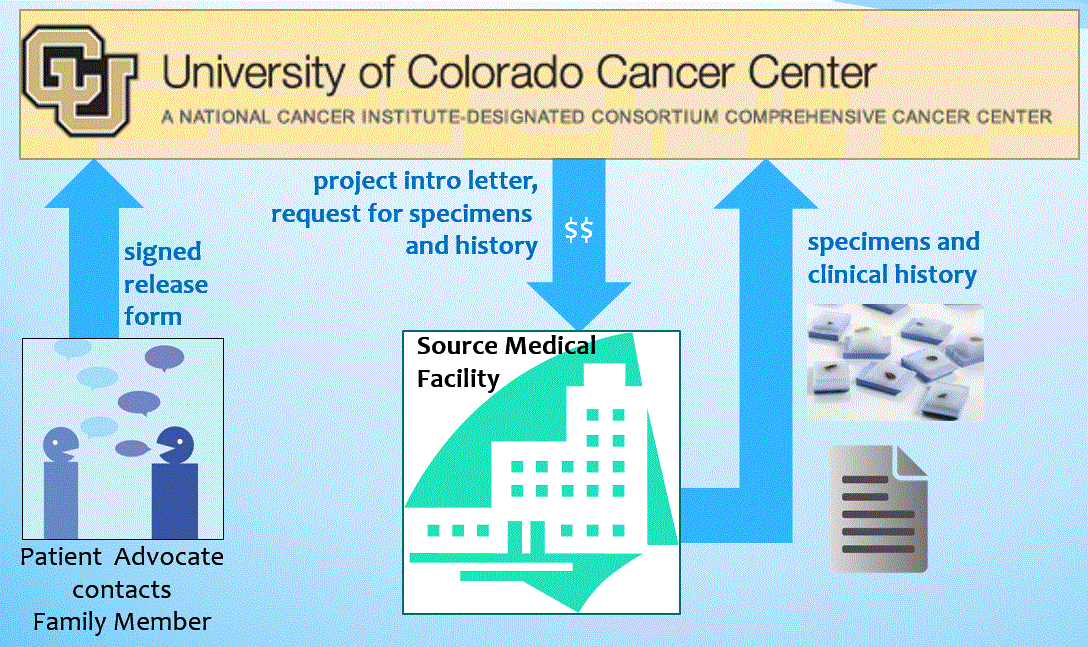
The National Cancer Institute’s Lung Cancer SPORE at the University of Colorado (I’ll call it CU Lung SPORE for short) aims to help lung cancer researchers find cures faster. Like other NCI SPOREs, CU has a biorepository (some people may call it a biobank) where they store patient specimens and medical records. The biobank provides the tissues along with the important clinical background to scientists studying new ways to treat lung cancer, not only from the University of Colorado, but to institutions all around the country. Researchers can search for available specimens and request them for research projects.
The CU Lung SPORE created a pilot study to collect archived tumor tissue and medical records of deceased lung cancer patients, and place these in their biobank so that researchers can use them. This study focuses on deceased patients because they have no further need of the tissues (living patients may need their specimens for tumor testing later). The study needs five to ten more family members to submit signed release forms so we can complete the pilot study and assess whether this a feasible way to gather more lung cancer tumor tissue for research.
HIPAA laws forbid a research center from asking patients or family members about donating tissues and medical records if the patient wasn’t treated at their facility. But advocates (like me) CAN ask.
What do I have to do?
To participate, all you need do is:
Filling in the release form only takes about 20 minutes (assuming you have to look up the contact information for the hospital). Pretty easy, isn’t it?
What happens next?
The SPORE will contact the hospital where your loved one was treated and request your loved one’s archived tissue and medical records. Once these documents are received at CU, they will be reviewed by the study team, de-identified (which means personally identifying information is removed), and placed in the CU Lung SPORE’s biobank.
THAT’S IT!
PLEASE consider donating your deceased loved one’s archived lung cancer tissue and medical records for research through this project. You can learn more by contacting me (the patient advocate for the CU Lung SPORE) at jfreeman.wa@gmail.com, or the CU Lung SPORE at the address above.
Do it to honor your loved one. Do it for the next family stricken by lung cancer. Whatever your reason, please do it. We’ve lost too many to this disease.
Note: This research study’s official project title is “Patient-Initiated Biobanking of Deceased Lung Cancer Patient Tissues” and its study number is COMIRB# 15-1294. It is not a clinical trial dealing with live patients, so you will not find it listed on clinicaltrials.gov.

We are happy to announce a new upcoming anthology tentatively titled “Life Between Scans: How to Live with Lung Cancer as a Chronic Illness.” Its personal essays will show how metastatic lung cancer patients and their loved ones cope with the emotions and situations that arise when you’re taking new precision medicine treatments and know your lung cancer could become terminal at any time.
A group of award-winning lung cancer bloggers is developing this book to share honest personal experiences, offer hope for those dealing with metastatic lung cancer, raise awareness and positive impressions of our disease, and encourage investment and participation in lung cancer research and supports. These stories will highlight lung cancer patients on precision medicine approved drugs and clinical trials who are living well for months or years longer than those on traditional chemotherapy.
All submissions will be reviewed by the group, with assistance from editor Ann Vandermeer, who has extensive anthology publishing experience both for New York publishers and as a freelancer. Ann has graciously donated her time to this project in support of cancer patients.
July 1, 2017
Send an email to lifebetweenscans@gmail.com and include the following:
You might also want to include your age at diagnosis, relationship status (married, single, committed partnership, etc.), ages of children at diagnosis, and clinic(s) where you were treated. This information can help inspire readers.
Please be sure the contact email and/or phone will be answered even if you are unavailable.
We are negotiating with a small press to get the book published. We expect the book will be available in hardcopy and in electronic format from online sellers.
One of our bloggers is funding this project personally. After the payments to authors and production costs are covered, proceeds from the sale of the book will be designated in perpetuity to support lung cancer research at the University of Colorado, one of the premier targeted therapy lung cancer research centers in the world.
In alphabetical order:
Last update: 6-Mar-2017 16:00 Pacific Time


 Gray Connections