Why Advocates Seem to Talk So Much About Lung Cancer Screening

On Thursday, September 25th, 8PM ET/ 5PM PT, #LCSM Chat will discuss the existing barriers in lung cancer screening in late 2014.

Recently I’ve heard some lung cancer patients say they feel abandoned by lung cancer advocacy groups.  These patients think the groups are focusing too much on early detection with lung cancer screening, and have abandoned those who already have the disease.

As a metastatic lung cancer patient, I don’t feel abandoned.  I feel lung cancer advocacy has never been more vibrant or successful than it’s been in the past year.  In the past year, lung cancer advocacy has featured:

  • Wide-spread national media coverage about lung cancer: Valerie Harper on “Dancing with the Stars” and other national shows, national news coverage of testimony on Capitol Hill about the need for lung cancer research funding, the “Turquoise Takeover” of prominent landmarks, and Molly Golbon’s cancer journey documented on NBC, for example.
  • Print and online articles discussing the need to eliminate lung cancer stigma and featuring the hope offered by new treatments and clinical trials.
  • More advocates, patients, doctors, and researchers posting and collaborating with the #LCSM hashtag on Twitter.
  • An increase in lung cancer bloggers compared to last year.

The focus of lung cancer advocacy hasn’t shifted away from research or treatments.  By my count, there are more new treatment options offered or announced this year for a wider range of lung cancer types than in any previous year: two new FDA-approved targeted therapies,  immunotherapy trials for all lung cancer types, an innovative new trial for squamous cell LC, a new study of Young Lung Cancer, new targeted drugs for mutations, newly-discovered mutations … the list is long.

Lung cancer screening with LDCT is a big deal because it is projected to save 18,000 lives PER YEAR by catching lung cancer before it spreads.  That’s more lives than most new targeted lung cancer treatments will save in a year.

We’re seeing more public discussion of lung cancer screening than treatments for four reasons:

(1) Lung cancer screening with LDCT gained major support at the end of 2013.
In December 2013, the US Preventative Services Task Force recommended lung cancer screening with LDCT.  As a result, the ACA now requires private insurance plans to cover LDCT as of January 2015.

(2) LDCT is becoming more available.
More hospitals and clinics are beginning to offer LC screening with LDCT, and are advertising that fact.

(3) The need for support is urgent.
The majority of lung cancer patients are over age 65.  In February, the Centers for Medicare and Medicaid (CMS) began evaluating whether to provide insurance coverage for LC screening with LDCT.  CMS will decide in November.   We must act NOW.

(4) Individual advocates have a chance to make a difference that will save lives.
The CMS decision is being made by a branch of the US government.  Our voices are needed to ensure those over 65 have access to LC screening, since most of them have Medicare as their primary insurance.  Lung cancer advocacy organizations are leading the charge.

The lung cancer community is still dedicated to raising awareness for ALL lung cancer patients and increasing research that will allow more lung cancer patients to be cured or to live with lung cancer as a chronic illness.   Advocating for LC screening is just one way to help more patients survive.  It’s part of the 2014 sea change in lung cancer.

Hyperintensities

Last Monday and Tuesday, September 8-9, I was in Denver for my clinical trial at University of Colorado Hospital (UCH). I had my once-every-eight-weeks PET-CT scan along with a once-every-six-months brain MRI.

I’m happy to report that both scans were clean. I’m now twenty months with No Evidence of Disease of metastatic lung cancer.  That Xalkori is great stuff for those of us with ROS1 NSCLC!

I’ve been in my clinical trial for 22 months, and the trial has been running for over three years. The medical journal article summarizing trial results is due out sometime in the next two weeks.  Judging from the response to Xalkori of several ROS1ers I’ve met online, I expect the news will be positive.  Can’t wait to read it–I’ll probably hustle to the University of Washington Library and download it first chance I get.  Yes, besides being a science geek, I’m an INTENSE science geek.  One of those “complete response” lines on the waterfall plot will be ME!

The scanxiety for this visit was different than my previous visits to Denver. It’s been a very busy summer for me.  As I posted previously, before flying to Denver I attended the Stanford Medicine X conference in Palo Alto September 4-7.  I gave my speech on lung cancer stigma on the main stage Sunday morning, left the conference a couple of hours early to fly to Denver Sunday night, and had my clinical trial labs and scans Monday.  I was so focused on the conference and my speech that I barely noticed any scanxiety –it was difficult to distinguish from the intensity that precedes my speaking publicly.  The only real indication of any anxiety was my increasing inability to focus during the conference and three hours of lost sleep the first night in Palo Alto (although my husband might have a different perspective about my intensity in the days before I flew to Palo Alto).

A few other things were different about this clinic visit:

  • On the day of my visit, I spent an hour talking with the American Lung Association of Colorado’s office about LUNG FORCE.
  • A pleasant UCH oncology Fellow conducted my clinic visit. My primary oncologist Dr. Camidge came in to chat with us both for a few minutes afterwards–he knows I always have a list of questions for him. We talked about an exciting new clinical trial design at UCH for FGFR-positive NSCLC (more on that in a future post).
  • UCH had recently installed new software for their MRI machine, so the report of my brain MRI was not available at the time of my clinic visit. However, Dr. Camidge and the Fellow both reviewed the scan itself and reassured me it was normal.
  • After Dr. Camidge completed his clinic hours on Tuesday, he joined me, Dora (an online friend of mine who is also his lung cancer patient), and Dora’s husband Bill for a chat at a restaurant near UCH. How many world-renown lung cancer doctors do that? Well, yes, I did bribe him with a cup of coffee and a pastry. Here’s a selfie we took:

selfie with Camidge

Something else was also new to me after this clinic visit. I had a headache after I arrived home.  Since I’d just had a clean brain scan two days before, I knew the cause could not possibly be a brain met.  Somehow this reinforced the feeling that I was more a normal person than a cancer patient at this point.  Sometimes a headache is just a headache.

The brain MRI report appeared in our mail yesterday. It didn’t say much except “normal,” but a few terms were new to me.  I was Googling the new terms when an infolinks box popped up with this message:

“Searching for T2 hyperintensities in white matter? Try Kelley Blue Book!”

Maybe Kelley Blue Book can tell me how my hyperintensities affect the resale value of my brain.

Pondering Resources for Affordable Healthcare

I’ve been thinking about the US healthcare system thanks to a fascinating Facebook discussion with other Stanford Medicine X epatients.  Each of us are too familiar with the strengths and weaknesses of the US healthcare system and its mix of insurers: Medicare, employers, and private insurance companies.

My focus is this:  whatever healthcare system we decide to have in the US, we need to be able to pay for it.  The reality is that healthcare resources are not unlimited.

Whether or not a healthcare system is government run and/or devoted to serving the good of all people, the resources required to operate the healthcare system are driven by a free market.  Governments and nonprofits fund only a small percentage of healthcare research and development.  Healthcare providers still choose what type of work they want to do and where they want to live in order to enjoy life and perhaps support a family.  For-profit companies still choose when and how to develop and manufacture drugs and technology, which are required to provide treatment and services. The government can’t afford to fund and/or control all these resources completely (even if some think it should).

Even if healthcare were universally acknowledged (and it isn’t) to be a basic human right, any comprehensive healthcare system will still have to ration healthcare services such as time with providers, technology, and treatments.  As a metastatic cancer patient, I am acutely aware of the rising cost of cancer care.  The drug keeping me alive would cost about $10,000 per month if I weren’t getting it free in a clinical trial.  Even if we acknowledge that everyone deserves to receive the treatments they need, we simply can’t afford to treat everyone with leading edge medical care at those prices.

A good example of this quandary is the new drug Sovaldi, which offers a breakthrough and long-awaited cure for Hepatitis C.    More than 3.2 million people are chronically infected with hepatitis C virus in the US.  A cure with Sovaldi currently costs about $84,000 per person.  A little math shows curing all the US patients would cost around $270 billion–and the cure is not permanent (people can get reinfected with the virus). Having health insurance cover that $270 billion could break the healthcare system and put premiums out of reach for many, no matter whether the system is structured as private pay, single payer (government health system), or a mixture of the two. So who gets the treatment?

Other countries with single payer, government-funded health plans solve this problem by limiting services they cover.  For instance, the National Health Service in the UK will not pay for the lung cancer drug, crizotinib (approximately $10k/mo), even though the drug can give a small population of lung cancer patients years of quality time.  When the government must consider how to use its resources to provide the best care for the nation as a whole, they decided the cost to keep that small group of cancer patients alive for only a year or two is too high.  So people who can afford crizotinib in the UK pay privately, creating a two-tiered health system.

You can’t duck the issue by simply saying, “Get rid of the gatekeeper insurance companies.”  Because healthcare resources are limited, and provided by a market economy, SOMEONE or SOMETHING is going to be the gatekeeper.  Who should it be?  Insurance companies? Government?  Healthcare providers?  Medical societies? Pharmaceutical companies?  Companies that manufacture generic drugs?  Research institutions?  Individuals?

To me, the most important questions are these:

1. What guidelines should our healthcare system use to determine who gets healthcare, so that everyone is treated in the same fair and ethical manner?

2. Who gets to make and enforce those decisions?

You might want to learn more about these questions.  The next person who declares bankruptcy due to a health crisis such as a heart attack or metastatic cancer may be you.  Or your child.

Stuart Scott Knows How to Beat Cancer

This year’s ESPY awards honored ESPN anchor Stuart Scott with the Jimmy V Perseverance Award for his ongoing battle with cancer. The intro by Kiefer Sutherland and tribute video are inspiring, but my favorite part is this line in Scott’s acceptance speech:

“When you die, it does not mean that you lose to cancer. You beat cancer by how you live, why you live and the manner in which you live.”

He gets it. And he lives it.

20140729-081017-29417567.jpg

Meeting the Chemist

This post originally appeared July 15, 2014, in ASCO’s cancer.net blog. Reposted with permission.
—————————

My first ASCO Annual Meeting was an educational and exhilarating experience. As a science geek, I loved learning about new cancer treatments from leading researchers. But the highlight for me happened in a noisy back corner of a crowded poster session when I met Dr. J. Jean Cui, the chemist who is saving my life.

A little backstory: I was diagnosed in May 2011 with stage IIIa non-small cell lung cancer (NSCLC). After two series of chemo, two radiation protocols, two recurrences, and promotion to stage IV, I was told I’d be on chemo for the rest of my life. Thanks to “CraiginPA,” who I met in an online support group, I learned about a tumor mutation called ROS1 and arranged to have my tumor tested. I’m now enrolled in the same ROS1 clinical trial as CraiginPA, taking a pill called crizotinib (Xalkori) to suppress my lung cancer. I’ve had no evidence of disease (NED) status since January 2013. I know my cancer will likely return, but for now, life is almost normal.

CraiginPA and I both attended the 2014 ASCO Annual Meeting as patient advocates. We met “in real life” in Chicago the day before the meeting began and attended many sessions together. On the third day, June 1, we went to a lung cancer poster highlights session. Similar to a high-powered science fair, the session featured 25 large posters explaining ongoing studies, each with a researcher standing by to answer questions. One poster described a study of our drug crizotinib for ROS1 in Europe.

While we were tag-teaming the researcher with questions, we noticed two representatives of the pharmaceutical company who makes crizotinib standing nearby. We introduced ourselves and moved to a table to discuss when our trial drug might obtain FDA approval for ROS1.

After several minutes, one of the reps smiled and said, “Jean is here.”

CraiginPA’s face lit up. “She’s the chemist—the lead inventor who developed our drug!”

My geek meter pegged at ecstatic. The chemist who invented the drug that was keeping me alive was HERE!

“If I see Jean, I’ll tell her you’re looking for her,” one of the reps said. They excused themselves to talk to another researcher.

A bit giddy, CraiginPA and I went back to digesting the ROS1 poster. We had started debating where the drug actually bonded with the ROS1 protein on our tumor cells when a smiling young woman approached us.

CraiginPA recognized her instantly. “Jean! So good to see you again.”

I felt like I did when I’d been introduced to idols like Nobel Laureate Physicist Richard Feynman or MD/PhD/Astronaut Story Musgrave. This was not some academic stuck at a bench with glassware and data analysis. This cancer rock star was a real person, and she seemed just as happy to meet us as we were to meet her. How often does a researcher get to see the living, breathing proof that her work saves lives?

We hugged all around and coerced someone into taking a picture with Jean’s smartphone. I couldn’t have grinned any wider.

For the next 20 minutes, Jean fielded our questions about her background, why she chose chemistry as a career, and how her team designed the drug. CraiginPA and I were like two kids getting a peek behind the Wizard’s curtain at the magic of cancer research. We agreed this experience was easily our highlight of the meeting, especially for me since I experienced it with CraiginPA who first told me about this drug.

Later Jean emailed us the picture, along with an invitation to ask her any further questions we might have—a perfect end to an amazing day.

So stop me if you’ve heard this one: a patient advocate, a pharma rep, and a chemist walk into a poster session…

20140715-110726-40046427.jpg

New Take on an Old Excuse

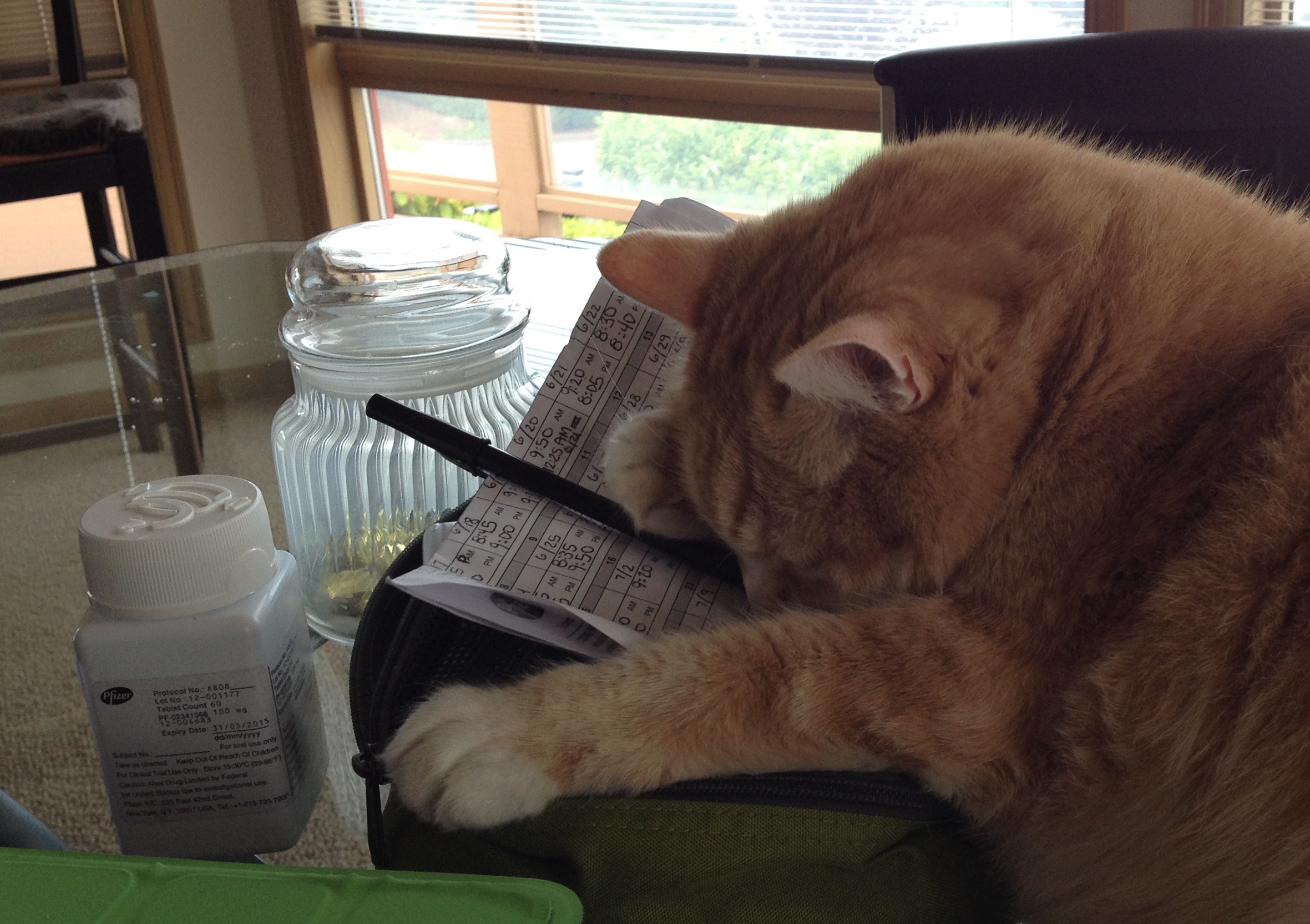
Like many housecats I’ve met, my cats have quirks. Admiral Dufus demolishes cardboard boxes and chews paper, while General Nusiance licks plastic bags.  I don’t know why they do this.  Perhaps they lack certain minerals. Perhaps their tongues like the taste or texture. Perhaps they’re studying how humans react to the behavior of feline companions.

While Admiral’s tendency to shred papers has caused some inconvenience, General’s fondness for licking things has not been an issue.  Until now.

I never told a teacher “the dog ate my homework,” but as of this morning I have to explain to my cancer clinical trial that my log of dosing times for my trial drug may be hard to read because …

 “My cat licked my journal.”

Any port in a scan

I’ve had a Bard power port in my upper left chest almost 30 months, since December 2011.  This consists of a small titanium reservoir with a layer of silicone under my skin, connected to a catheter than runs into a vein near my heart.  I originally had it implanted so chemo could be administered through the port, sparing my veins.  While I don’t need it right now to receive treatment–I take my targeted therapy as a pill–the port is accessed every month for my clinical trial blood draws, and every other month to administer contrast and the FDG tracer for my PET-CT scans.

Ports are really convenient.  I don’t have to get poked every month, I can shower and exercise with it (unlike my former PICC line), and after so many months, the scar from the implant surgery isn’t even noticeable.  All that’s visible are three tiny bumps on a slightly raised, faintly bluish area under the skin. The only accommodation it requires is a small pad between it and my seatbelt when driving.  I’ve heard of people keeping a port for several years.

Here’s the hitch.  My port has misbehaved fairly often since it was implanted. I am apparently very good at growing a fibrin sheath over my port’s catheter. When a sufficiently long fibrin sheath , similar to the stuff in blood clots, forms over the catheter, it’s impossible to draw blood–the suction from the blood draw pulls the loose flap of the sheath over the tip of the catheter and closes it off.  The problem seems to be worse if I’m dehydrated.

To keep the port accessible, it gets flushed with drano on average every 1.5 months. No, not Drano the household chemical.  Drano is my not-so-affectionate name for TPA (sometimes called Cathflo), a chemical which dissolves the fibrin sheath and clears the catheter. Typically, a small amount of TPA (just enough to fill the catheter but not go into the bloodstream) is injected and left in the catheter for about 30 minutes, then withdrawn.  Usually this clears the port, although sometimes I’ve had the stuff left in overnight to clear a particularly persistent blockage–one interventional radiology xray showed I had a sheath about two inches long at the tip of my catheter. Well, everybody needs a skillset.

The fibrin sheath also sucks up the FDG tracer used for PET scans, so I often have a very bright spot on my scan right at the tip of my catheter.  The radiologist can see the catheter in the associated CT scan, so he knows that hot spot is just the fibrin sheath, but sometimes I wonder if that spot could overshadow a tiny cancer nearby.

I’ve considered having the port removed surgically and just tolereating the monthly needle pokes for my labs and scans, but to be honest, my veins aren’t very cooperative nowadays either. I’m going to keep the port in as long as the drano can keep it functional.  I just plan to drink a few quarts of water the day before it’s used so I’m well hydrated, and show up early for lab work in case my port needs a dose of drano.

My monthly labs today required more than the usual amount of blood. However, my port worked perfectly! I felt like celebrating, so I ordered a grande soy mocha at the clinic’s coffee stand.

I forgot to say “half-decaf.”

I expect to get an amazing amount of work done this morning and early afternoon. Just don’t expect much from me after 3 PM.

Third Time’s a Charm

Today I celebrate my three-year cancerversary. It was May 10, 2011, when biopsy results confirmed my lung cancer diagnosis.

My life has evolved quite a bit since that day. My first cancerversary in 2012 fell two days after my sixth (and last) dose of second line chemo, and a month before my second series of radiation treatments. I was stage IV, continually felt like I had the flu, and though hopeful, didn’t feel much like celebrating. My second cancerversary in 2013 fell sixth months into my current clinical trial. I had achieved No Evidence of Disease (NED) and focused on enjoying life, but was nearing the timeframe when others who took the same experimental drug typically progressed. I flew to Denver every 4 weeks for trial check-in, juggled side effects of treatments past and present, and felt anxious about the future.

My third cancerversary is different. Life no longer revolves around cancer treatment. I’m 17 months NED in my clinical trial, and the drug’s side effects are minimal. My visits to Denver every other month seem almost routine, with only a hint of scanxiety. I’m exercising most days, rebuilding my fitness level, and starting to lose the 60 pounds gifted to me by various cancer treatments. Physically, I’m less a cancer patient and more an out-of-shape fifty-something.

My life still revolves around lung cancer, but not in the same way. I’m busy most days with lung cancer patient advocacy. In addition to writing this blog for over a year, I moderate Lung Cancer Social Media (#LCSM) chats on Twitter and work with lung cancer nonprofits, healthcare professionals, researchers, and patient advocates to raise awareness and support of lung cancer issues such as benefits of mutation testing, screening with low dose CT, living with metastatic cancer as a chronic illness, and the need for increased research funding.

To celebrate this cancerversary, my husband and I spent a quiet vacation week in Whistler BC. The drive from Vancouver along Howe Sound into the volcanic coastal range (via Sea to Sky Highway) showcased Mother Nature at her finest. I enjoyed exploring Whistler Village and surrounds as well as writing. As I watched the snowboarders walking down from the Blackcomb gondola, I did feel a twinge of regret that I can no longer ski. However, I later reveled in the warm sun as I walked the mile around Lost Lake (2200 feet elevation!) at a moderate pace, with only a few stops–I could not have done that in 2011, 2012, or 2013.

So life has returned to an acceptable state of normality. At this point in time, a headache is just a headache—it doesn’t automatically trigger anxiety about brain mets. I look forward to seeing my son graduate from college next May. I accepted a commitment in fall 2015 without first asking if I’d be alive on that date. I know my targeted therapy cancer pill likley will fail me someday, but I now can go weeks without thinking about that.

As Trillian says in Hitchhiker’s Guide to the Galaxy:
“We have normality. I repeat, we have normality. Anything you still can’t cope with is therefore your own problem.”


Howe Sound, British Columbia


Sea to Sky Highway, British Columbia

Lost Lake Outflow near Whistler BC

Clinical Trial Check-In Number 18

Denver gifted me with a warm, bright day today — clear skies, 60 degrees, a hint of breeze — perfect for sitting on a sun-drenched bench and basking in the glow of another clean scan. I’m still No Evidence of Disease (NED) status. Woohoo!

You’d think I would have had enough radiation for one week, but that spring sunshine was simply irresistible after such a long winter.

I had a PET-CT scan as well as a brain MRI and lab work yesterday, and had my once-every-eight-weeks visit with my clinical trial oncologist Dr. Camidge at University of Colorado this afternoon. Today I started cycle 19 on the drug Xalkori. Each cycle is 4 weeks, so I’ve been on this drug trial for 76 weeks now, which is almost 17 months.

I’ve been NED for nearly 15 months on Xalkori. According to interim results published about this clinical trial last year, only myself and one other person achieved NED on this trial. It’s possible I don’t have many cancer cells available to mutate and develop resistance to the drug. My particular flavor of lung cancer (ROS1-driven NSCLC) hasn’t been studied very long — the first article about it was published in January 2012 — so little data exists to know what will happen in my case. Xalkori may continue to suppress my cancer for years. It’s cool to hear my doctors say they have no idea of how long I might have left, and know they’re being honest with me. I’m an outlier for those gloomy stage IV lung cancer statistics.

I feel so fortunate to be blessed with more time to enjoy family and the miracle of life. I aim to make good use of it.

Speaking of making good use of my time … should I mention I have to work on tax returns after I fly home? Nah.

Trial Travel Notes to Self (March 2014 edition)

I still travel to Denver every eight weeks for my clinical trial appointment. On each visit, I refine my travel skills. Here’s what I learned (or relearned) this time:

1. Denver employs hidden moisture vacuums in airport jetways.

2. Dodge Avengers are built for people shorter than me.

3. Weather Channel three-day forecasts for Denver aren’t sufficiently fine tuned to indicate whether it will snow when I leave the hotel.

4. Hospital cafeteria hours don’t necessarily mesh with radiology schedules.

5. No matter how many times I push the button, MY car key will not unlock a rental car.

6. To avoid repeating #5, review #4 and pack a snack.

7. If one must sleep in the MRI machine, don’t snore loud enough to jerk awake.

8. While waiting to get scan results, plan something distractingly fun. Trying to verify tomorrow’s weather report on clinic wifi does not qualify.

9. No matter how calm and relaxed I may be, and what arsenal of sleep medicines I may possess, I won’t fall asleep at a reasonable hour the night before a scan.