Your Life, Your Choices — A Conversation

your-life-your-choices-poster_10-9-16

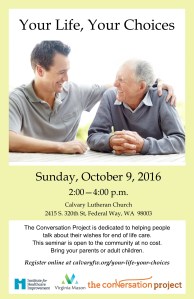
If you live in the South Puget Sound area of Washington State, and are interested in starting a conversation with family members about what’s important to you when you think about the end of life (which comes to all of us, though we know not when), please join us on Sunday, October 9, 2016, at Calvary Lutheran Church in Federal Way, Washington, at 2 PM for a free two-hour workshop.  Ann Hagensen, RN, FABC, (Virginia Mason Medical Center) will be presenting materials based in part on The Conversation Project. She will be joined by Karen Freeman Worstell (transformational grief coach and founder of NarrowBridge Solutions), Pastor Lori Cornell (of Calvary Lutheran Church), and myself.

This is a topic of vital interest to me, and not just because I have metastatic cancer.  I have extensive experience exercising durable power of attorney and navigating communications between family members over estate and end-of-life choices. I know friends who had serious accidents or died unexpectedly without having these conversations with their loved ones, and as a result their family members were completely unprepared for the decisions they faced. Because this is so important to me, I serve as an advocate on regional and statewide initiatives to identify and honor patient goals of care and end-of-life wishes.

I hope you’ll join us!

Lung Cancer Update: August 2016

I haven’t blogged much about my cancer status or advocacy activities in 2016.  Not to worry — I’m still dancing with NED (No Evidence of Disease), still taking Xalkori (crizotinib) for my stage IV lung cancer, and still advocating for improved outcomes and quality of life for lung cancer patients.  Life has just been amazingly, overwhelmingly busy up through July, and my blogging became one of the dropped balls in my juggling act.

How busy, you ask?  Here’s a summary of the past nine months. The numbers are estimates, as I had trouble reading the small print I had to use on my calendar to fit everything in.

  • Traveled 54 days for advocacy and writing
  • Traveled 28 days for my clinical trial in Denver (and got snowed in once)
  • Gave 25 formal presentations or informal talks
  • Presented a poster at a medical conference (in AACR Scientist-Survivor Program)
  • Attended 7 medical conferences
  • Attended a 5-day writers’ retreat (wrote a new short story!)
  • Participated in working groups for 3 healthcare agencies (including the National Cancer Institute)
  • Attended 3 science fiction conventions
  • Worked on 2 patient-initiated research projects (ROS1, and biobanking tissue of deceased patients)
  • Consulted for 2 pharmaceutical companies
  • Moderated a joint #LCSM-National Cancer Institute Google Hangout on Air
  • Advocated at the US Capitol for more healthcare funding
  • Captained a team for a lung cancer fundraising walk
  • Co-moderated biweekly #LCSM twitter chats

And on the personal side …

  • Travelled 33 days with family
  • Purged unneeded books, college class notes, household items and cruft from 3 rooms
  • Helped my son find and move into a new apartment (twice)

Sometimes I was barely home long enough to unpack,  pile my collected travel papers on the floor, repack, and perform a couple of necessary household chores before flying out again.  Glad I’ve had a few weeks at home in July and August to decompress and spend time with my family.

While compiling the statistics for this post, I begin to realize why I’ve been so fatigued. I’ve never been particularly good at taking things slow. The above list demonstrates that I must fine tune my advocacy work in order to focus on my top priorities.  I need to say “no” to some opportunities so that I can have more time to process what I’ve learned and write. Juggling four conferences in April left me drained–one conference a month should do.  As my husband has reminded me more than once, I am a cancer patient as well as an advocate.

I’ve been attempting to exercise regularly, give myself enough hours in bed to feel rested, eat healthy, and stay hydrated.  Over the past nine months, my medical team and I have also made some tweaks to my treatment plan.

Less frequent scans. Sometime last year, I became eligible to increase the time between my scans for the clinical trial, but I was too anxious about my cancer possibly coming back to do it.  However, a long talk with fellow lung cancer activist (and 11 year survivor) Linnea Olson at the World Conference on Lung Cancer in September made me realize I was having a LOT of scans over the past years.  I realized reducing my exposure to radiation was probably a good thing.  So, as of November 2015–at three years of NED–I asked Dr. Camidge to schedule my scans for every sixteen weeks instead of every eight weeks (I wasn’t confident enough to go with every 24 weeks).  I’ve also switched from eyes-to-thighs PET-CT scans to chest and abdomen CT scans, primarily because insurance was denying coverage of the PET-CT scans.

Change of blood thinners.  At the beginning of 2016, I realized the frequent labs required to monitor my warfarin dose would be difficult to accommodate with all my upcoming travel. My Denver and Seattle docs all agreed that my pulmonary embolism (remember that pesky blood clot in my lung’s artery?) probably didn’t represent an increased risk of blood clots from cancer, but instead was just a pile of fibrin sheaths that had sloughed off my power port’s catheter (I’m really good at growing fibrin sheaths).  So we switched me to a different blood thinner (Xarelto) that doesn’t require regular blood tests.  The downside of Xarelto is that it doesn’t have an antidote if I happen to overdose.

Crizotinib is approved! Do I stay in the trial? In March 2016, the FDA approved my clinical drug crizotinib for ROS1-positive lung cancer patients–YAHOO!  This meant I had the option of leaving the trial and eliminating my travel to Denver while continuing to stay on the wonderful drug that’s keeping my cancer in check.  I thought long and hard (with the help of a great blog from my friend Dann Wonser). Eventually decided I wanted to keep seeing one of the world’s top lung cancer docs (Ross Camidge) in Denver, despite the cost and hassle of travel. I love being a part of the University of Colorado (CU) lung cancer SPORE, and I’ve grown close to many people at CU. The trial will likely continue for a few more years; the crizotinib trial for ALK-positive lung cancer started in 2008 and is still ongoing. So. I’ll keep traveling to Denver for the foreseeable future–which is much shorter nowadays than when I was 20.

Regaining my balance.  After my three falls in nine months, I had several sessions of physical therapy to strengthen my leg and core muscles. It improved my balance and helped me get back into exercising.  Alas, I fell again at a conference earlier this month.  **grumble** I’ve become a klutz in my old age.  At least I’m around to see what my “old” looks like.

Dose reduction of crizotinib. I’ve struggled with swelling of my legs and belly–edema, a known major side effect of crizotinib–since my second month on the drug. Alas, it’s gotten worse with time.  As of January, I couldn’t bend my ankle at the end of the day if I didn’t wear my thigh-high compression hose and take a diuretic (Lasix).  My weight can go up by eight pounds in two days solely from water retention. I’m told edema is the reason patients most often cite for stopping crizotinib therapy.  Dr. Camidge first offered me a dose reduction of crizotinib last year (from 250 mg twice daily to 200 mg twice daily), but I didn’t want to reduce the dose while I was also increasing time between scans–much too anxiety-making for me.  However, in July 2016 I’d had enough of puffy feet and legs, and decided to try the lower dose. Dr. Camidge says he wouldn’t lose a second of sleep over the dose reduction, because he’s seen the lower dose work for many patients. I think it’s helping me.  I can always increase the dose again in the future if necessary, although I’d have to leave the clinical trial if I did.

I’m de-ported! I’ve kept my power port while on oral meds, although I only use it for blood draws and scan contrast. The docs have always said it’s my choice, so I’ve left it in because it was easier than getting stuck every month (and my veins tend to misbehave).  At my June 2016 clinical trial appointment, however, my power port decided it would cooperate with neither the blood draw nor the scan contrast. I’ve had the little beastie since December 2011, which is a good long run, but I finally decided it was time to pull it out.  The surgeon who installed it was thrilled to be taking it out of a metastatic lung cancer patient more than four years later. So, as of July 21, I am no longer Borg.  Now that I no longer have a catheter in a vein, I probably won’t be forming piles of fibrin sheaths in my pulmonary artery.  My docs say if my next scan in October shows my pulmonary embolism looks good, I may even be able to go off blood thinners. Wahoo!

Coping with chemobrain.  My continuing fatigue and mental fuzziness are a great frustration. Caffeine and exercise help, but don’t eliminate the problem. I finally asked my oncs what could be done, and they both suggested Ritalin, a stimulant commonly used to increase ability to attend for people who have ADHD.  I take 5 mg twice daily on days when I need energy and focus (especially useful at conferences and speaking events).  However, it masks how tired I truly am, and results in something of a crash when I stop taking it.  I’ll be visiting a neuro-oncologist soon to explore other medication options–Dr. Camidge mentioned Provigil (a narcolepsy drug) and Effexor (an antidepressant) as possibilities, and another patient said she found Concerta (long-acting Ritalin) helpful.

So, that’s what happening with me.  I promise to blog a bit more often so I won’t have as much news the next time.

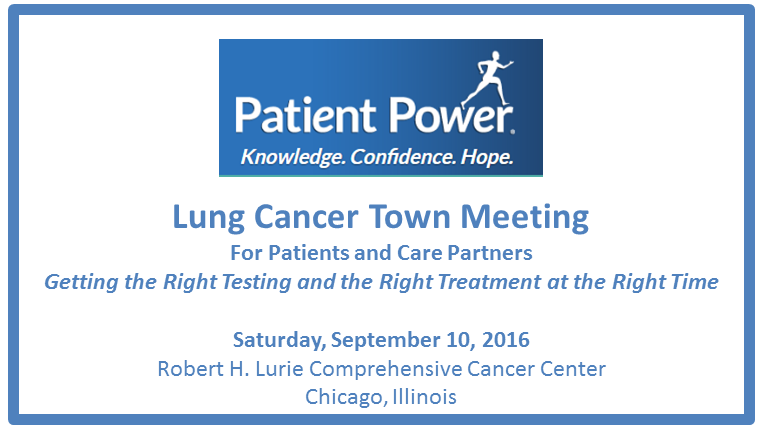
Lung Cancer Town Meeting Sept 10: “Getting the Right Testing and the Right Treatment at the Right Time”

Town Hall graphic
If you or someone you know is a lung cancer patient or caregiver who wants to learn about “Getting the Right Testing and the Right Treatment at the Right Time,” check out this Lung Cancer Town Meeting in Chicago on September 10th (FREE in person or live online). I’ll be hosting several doctors from Northwestern’s Lurie Cancer Center AND my oncologist Dr. Ross Camidge.

AGENDA (Central Time)

9:30 – 10:00 AM Registration | Connecting With Other Lung Cancer Patients and Care Partners
10:00 – 10:45 AM Current and Novel Treatment Options for Lung Cancer
10:45 – 11:30 AM Understanding Biomarker Testing in Lung Cancer
11:30 – 11:45 AM Meet the Patient Panel
11:45 – 12:30 PM Lunch Provided
12:30 – 1:00 PM Resources and Strategies for Living Well With Lung Cancer
1:00 – 2:00 PM Interactive Q&A Session
This in-person town meeting is sponsored by the Patient Empowerment Network through educational grants from Helsinn, Genentech and Novartis, with additional funding from LUNGevity Foundation through an educational grant from Pfizer. It is produced by Patient Power in partnership with the Robert H. Lurie Comprehensive Cancer Center of Northwestern University and LUNGevity.  Thanks to Patient Power for inviting me to host it.
You can register by clicking here.  Hope to see you in Chicago September 10!

Celebrating Cancer Hashtag Communities and a Moonshot

This coming week, the online cancer hashtag communities will be celebrating. Why, you ask? We have two good reasons.

  1. The Cancer Moonshot Summit happens Wednesday, June 29, in DC and in satellite locations all over the US (see DC agenda at bottom of this post). While several of our members will be attending, we all have the opportunity to provide input to the Cancer Moonshot (deadline July 1).
  2. The 5th Anniversary of the beginning of Breast Cancer Social Media (#BCSM)—and the beginning of cancer hashtag communities on the web—happens July 4!

Our celebration will take the form of several coordinated chats open to everyone, regardless of cancer type.

Mon 6/27:
#BCSM Chat (use both #BCSM and #cancerchat hashtags) will host a cross-cancer chat at 9 PM Eastern Time about three of the Cancer Moonshot Working Group topics (check blog on #BCSM website for chat details):
–Expanding Clinical Trials
–Enhanced Data Sharing
–Precision Prevention and Early Detection
Ideas generated can be submitted online to the Cancer Moonshot.

Wed 6/29:
Cancer Moonshot events in DC and satellite locations (see agenda for DC Summit below)

Wed 6/29:
#Hcchat will conduct the official Moonshot chat (use both #Hcchat and #Moonshot hashtags) at noon Eastern Time on the topic “Will the Moonshot lead to the death of cancer?” This chat applies to all types of cancers. Special guest will be Vincent T. DeVita, Jr, MD, who was head of the NCI during Nixon’s Cancer Act and author of “The Death of Cancer.”

Thu 6/30:
#LCSM Chat (use both #LCSM and #cancerchat hashtags) will host a cross-cancer chat at 8 PM Eastern Time about the remaining four Cancer Moonshot Working Group topics (check blog on #LCSM Chat website for chat details):
–Cancer Immunology and Prevention
–Tumor Evolution and Progression
–Implementation Sciences
–Pediatric Cancer
Ideas generated can be submitted online to the Cancer Moonshot.

Thu 6/30:
Last day to submit Moonshot ideas at https://cancerresearchideas.cancer.gov/a/index

Sun 7/03:
#BTSM Chat (use both #BTSM and #cancerchat hashtags) will host a cross-cancer chat at 9 PM Eastern Time about our hopes and dreams for cancer research and treatment in the future.

Mon 7/04:
5th anniversary of #BCSM and cancer hashtag communities

Mon 7/04:
#BCSM anniversary celebration chat at 9 PM Eastern (use both #BCSM and #cancerchat hashtags)

The cancer hashtag communities hope you’ll join us for some (or ALL) of these special events and help us celebrate! To learn more about the cancer hashtag communities, visit http://www.symplur.com/healthcare-hashtags/ontology/cancer/

 AGENDA FOR THE CANCER MOONSHOT SUMMIT IN WASHINGTON, DC


Cancer Moonshot Summit Agenda 1 (CROPPED) Cancer Moonshot Summit Agenda 2 (CROPPED)

Advocacy and the Science of Cancer Research: the AACR Scientist↔Survivor Program

The AACR Scientist↔Survivor Program lets cancer advocates network with scientists driving cancer research

This year I was among the cancer patient advocates who applied for and were selected to participate in the American Association for Cancer Research (AACR) Scientist↔Survivor Program (SSP) .  As part of the program, I attended the AACR 2016 Annual Meeting held April 16-20 in New Orleans, Louisiana.

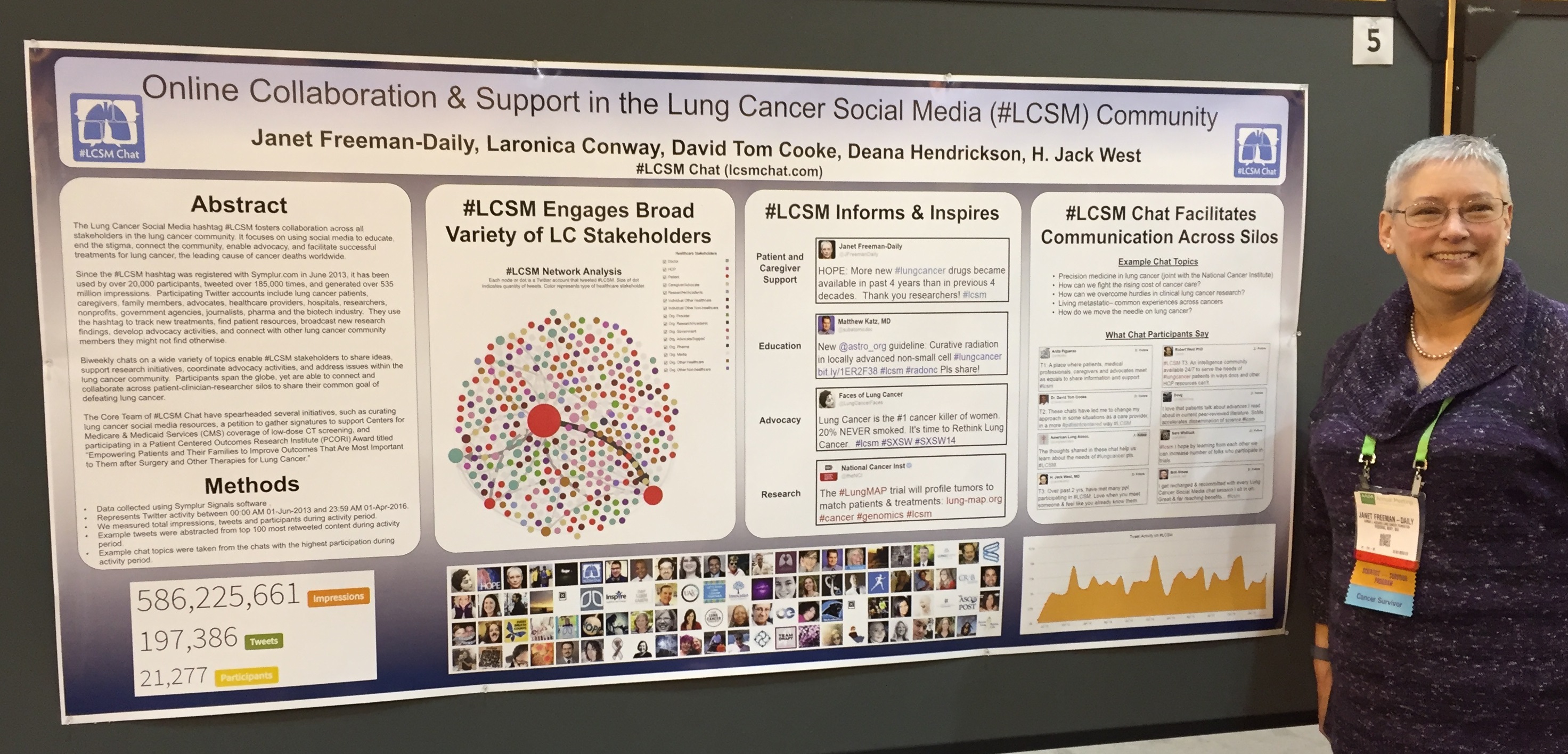
The program consisted of an orientation day, including an excellent Cancer 101 briefing by Dr. Carolyn Compton; SSP-only sessions in which advocates met with top researchers to discuss specific topics such as immunotherapy and FDA policies; presenting an original poster during an AACR poster session; a group project in which a scientific advisor and an experienced SSP mentor helped us explore a major aspect of cancer research; evening networking events; and, of course, attending the Annual Meeting with cancer researchers.

Posters created by advocates talked about a variety of subjects–cancer journeys, advocacy organization outreach, even personal research projects. My poster discussed the benefits of the Lung Cancer Social Media (#LCSM) community on Twitter–thanks to my fellow #LCSM Chat Core Members for their valuable suggestions and feedback.

JFD with AACR poster

I didn’t understand every presentation in the actual AACR meeting — in at least one presentation I didn’t understand ANYTHING (gene editing is very technical) — but I did come away with a better understanding of the scope of cancer research, some of the issues impeding progress, and a list of topics I wanted to explore further.

I loved listening to researchers explain cutting edge work that … READ MORE

This article was first published 24-Jun-2016 on my Cure Today blog

Live Tweeting #ASCO16 with @LUNGevity

ASCO twitter logo

This year I’ll be live tweeting the big American Society of Clinical Oncology (ASCO) Annual Meeting June 3-7 as a Patient Research Representative for LUNGevity Foundation. What does “live tweeting” mean? It means I will be using Twitter to share information from ASCO sessions and  perspectives on the meeting in near real time.

I’ll be tweeting from the @LUNGevity Twitter account (along with Dr. Upal Basu-Roy and Katie Brown) and my own account (@JFreemanDaily).  If you want to find me or other tweeps at ASCO, please come to the Official ASCO Tweetup June 4th at 5:45pm in the McCormick Convention Center Plate Room (South Building, Level 2.5 Food Court).  Hope to see you there!

My Next Speech: Bringing the Lung Cancer Patient to the Foreground at #ASCO16 CME

peerview grace asco logo

I’m excited to announce that I have been asked to speak on June 5, 2016, at a dinner symposium titled “NSCLC Forum: Bringing the Patient to the Foreground of Evidence-Based Lung Cancer Care.” It’s sponsored by PeerView Press (a medical education provider) and GRACE (a web resource for cancer patients).

This is an evening event concurrent with ASCO 2016 Annual Meeting in Chicago, usually called just ASCO. ASCO (short for American Society for Clinical Oncology) is the world’s biggest cancer conference—just you and 35,000 of your closest friends.  Attendees hear about results for cancer clinical trials along with prevention, diagnosis, survivorship, policy, advocacy, and oncology career info, and explore a huge exhibit hall.  Last year I clocked five miles a day just walking between sessions!

I’ll be talking about using social media to improve outcomes for lung cancer patients.  The meat of the program includes case studies presented by four research oncologists (including, coincidentally, my Denver oncologist Dr. Ross Camidge), and panel discussions. PeerView tells me this may be the first time a patient has been the lead speaker at an ASCO CME (Continuing Medical Education) program. I’m honored that the sponsors and my fellow speakers believe I’m up to the challenge.

At my request, PeerView modified their registration form so patients and caregivers/advocates can register for this event. If you’d like to see me speak, you can register (no charge) to attend in person (and have a free dinner starting at 6:30 PM Central) or watch the live stream online (starting at 7 PM Central).  The recording will be available later on the web (I’ll share the link when it’s posted).  Several other evening events (including the ASCO President’s Reception, alas) will be competing for the attention of ASCO attendees at the same time, so please attend and help fill the seats. Hope to see you there!


Edit 8-Jun-2016:

The unedited, uncut version of the 2-hour webinar in which I spoke at ASCO 2016 is available here. You must register, but it’s free. My talk begins at about 2:40, and runs about 10 minutes.

https://tallen.webcasts.com/starthere.jsp?ei=1104671

An edited version will be available soon.

Opportunity to honor Dr D Ross Camidge

Camidge and daughters

Dr. D Ross Camidge, MD, PhD, at the University of Colorado (CU) Cancer Center has provided me and many other lung cancer patients and caregivers with hope, support, effective clinical trials, remote second opinions and excellent cancer care. On April 5, Dr. Camidge’s work will be honored as he formally accepts the newly-created Joyce Zeff Endowed Chair in Lung Cancer Research.
   
A patient speaker (not me) will be talking at the event about Dr. Camidge’s impact on patients. We have a unique opportunity to show Dr Camidge–as well as the donor Ms. Zeff and CU–how many people he has helped in lung cancer patient communities .
   
If you are willing to have your Camidge experiences and kudos shared from the stage at the recognition ceremony, please post them below. I’ll make sure they get to the patient who will be speaking. If you want your name (real or online) associated with the quote, please say so in your post.
   
Thanks in advance for your contributions!
   
Janet Freeman-Daily (AKA Squanch)

Patient Advocate Scholarships Available to Attend #ASCO16

Photo shows two mean chatting in the bustle of Annual Meeting.

If you are a cancer patient advocate interested in attending ASCO 2016, consider applying for the Conquer Cancer Foundation Patient Advocate Scholarship Program.

I have attended ASCO’s annual meeting in Chicago for the past two years.  While the five-day conference can be exhausting, it’s perhaps the best way to learn what treatments are up and coming for your type of cancer, become educated about the science behind research and clinical trials, and discover (and even chat with) the experts in your type of cancer.  It’s also a place to meet the people in your cancer community who you might only know online.

The ASCO (American Society of Clinical Oncology) 2016 Annual Meeting–held in Chicago June 3-7–will bring together over 30,000 cancer professionals from around the world for sessions about state-of-the-art treatment, results of clinical trials, as well as policy, advocacy, and survivorship issues.  You might strike up a conversation with a world-class expert in your type of cancer at a poster presentation or even walking between sessions.  The exhibit hall is a great place to learn about new biotech technologies (such as genomic testing panels and liquid biopsies) as well as what’s in each pharmaceutical company’s drug pipeline.

The Patient Advocate Scholarships are intended for expenses related to air or train travel, lodging, and meeting registration for advocates traveling from outside the Chicago area to attend the meeting (which can add up to $2K US or more).  Eligibility is based primarily on financial need as well as advocacy experience and current activities. Applicants will need to demonstrate why they would not be able to afford to attend the ASCO Annual Meeting without a scholarship award, and are encouraged to provide a compelling reason why their attendance at the meeting is vital to their advocacy role(s).

Although the application period for the doesn’t open until April 4, get an early start now on preparing your application –the application period will only open for three days!

#LCSM Chat topic 2/25: Communicating patient goals and values for #lungcancer treatment


This is reblogged with permission from the LCSM Chat website.

———————–

The best lung cancer care considers the patient’s goals and values when choosing a treatment. However, identifying and communicating those goals is not always a straightforward process for either the care provider or the patient.  

This week’s #LCSM Chat explores the process of communicating patient goals and values. Care providers need to know how to elicit them. Patients (even those who want to leave treatment decisions entirely to their doctors) must be able to identify and express them, and, if need be, initiate a conversation about them.  

Choosing the right treatment and care for a lung cancer patient is a matter of weighing risks of side effects versus evidence that the treatment has a good chance of success. Physical side effects can run the gamut from mildly annoying tummy upset to life-threatening organ failure. Yet sometimes a drug that causes severe side effects might result in cure or prolonged No Evidence of Disease. While the doctor or other care provider can learn about the risks and benefits for specific treatments from medical literature, only the patient knows what risks they are willing to accept to achieve their individual treatment goals. 

Willingness to tolerate risks varies from patient to patient. Some patients (perhaps those with small children) might favor an aggressive new treatment with the goal of living as long as possible regardless of side effects. Others (perhaps those who have additional health problems that would be dangerously aggravated by cancer treatment) may choose to forego active treatment and aim to be comfortable enough to attend a dear friend’s wedding in six months.  

In addition to physical side effects, patients also have financial, logistic, cultural and family concerns. Although it would be wonderful if all cancer patients had sufficient resources to access the most effective treatment options and the best care, we know this is not the case. Some patients must make treatment choices based on their ability to pay or to travel to a treatment site–a cancer center may not covered by the patient’s insurance, or may be hundreds of miles away. Unfortunately, bankruptcy is not a rare side effect of cancer treatment.  

The discussion of patient goals and values must continue throughout a patient’s lung cancer treatment, because patient preferences may change over time. An early stage patient might choose to be aggressive in their first-line treatment in hopes of a cure. Yet that same patient may find that after their cancer has become metastatic and they have had three different aggressive cancer treatments, they hesitate to try another treatment likely to have severe side effects. 

Some patients are comfortable trusting their doctors to determine whether the potential benefits of a treatment are worth the potential side effects, while other patients prefer to participate in shared decision making. Both approaches are valid choices, but in both cases, one would hope that one’s doctors would consider each patient’s goals and values when weighing treatment options.  

However, the process each care provider uses to determine patient goals and values is far from standardized. It is not a skill that has been (or is currently) taught in most medical schools. Sometimes the process doesn’t happen. 

During our chat on February 25 at 8 PM Eastern (5 PM Pacific), moderator Janet Freeman-Daily (@JFreemanDaily) will lead the discussion about communicating patient goals & values for lung cancer treatment using these topic questions: 

  • T1: What are examples of patient goals & values that would be helpful in discussions of #cancer treatment? #lcsm
  • T2: How can we encourage patients (including those who want to leave decisions to docs) to think about treatment goals & values? #lcsm
  • T3: How might care providers solicit patients goals & values for #lungcancer treatment? Are any topics (e.g., cost) off limits? #lcsm
  • T4: How might patients initiate the discussion of their goals and values if their #lungcancer care provider doesn’t ask? #lcsm
  • T5: How can we encourage discussions of goals and values between #lungcancer care providers and patients? #lcsm

We hope you will join the 2/25 chat. Remember to add the hashtag #LCSM to your tweets during the chat so other chat participants can see them. For more info, check out how to participate in #LCSM Chat. If you can’t join us, please leave your comments below.   

References

“Patient-centered: providing care that is respectful of and responsive to in­dividual patient preferences, needs, and values, and ensuring that patient values guide all clinical decisions.”  Institute of Medicine, CROSSING THE QUALITY CHASM: A NEW HEALTH SYSTEM FOR THE 21ST CENTURY, p. 3

Patient-Centered Communication and Shared Decision Making,” National Academies Committee on Improving the Quality of Cancer Care, Delivering High-Quality Cancer Care, Chapter 3.