Advocacy and the Science of Cancer Research: the AACR Scientist↔Survivor Program

The AACR Scientist↔Survivor Program lets cancer advocates network with scientists driving cancer research

This year I was among the cancer patient advocates who applied for and were selected to participate in the American Association for Cancer Research (AACR) Scientist↔Survivor Program (SSP) .  As part of the program, I attended the AACR 2016 Annual Meeting held April 16-20 in New Orleans, Louisiana.

The program consisted of an orientation day, including an excellent Cancer 101 briefing by Dr. Carolyn Compton; SSP-only sessions in which advocates met with top researchers to discuss specific topics such as immunotherapy and FDA policies; presenting an original poster during an AACR poster session; a group project in which a scientific advisor and an experienced SSP mentor helped us explore a major aspect of cancer research; evening networking events; and, of course, attending the Annual Meeting with cancer researchers.

Posters created by advocates talked about a variety of subjects–cancer journeys, advocacy organization outreach, even personal research projects. My poster discussed the benefits of the Lung Cancer Social Media (#LCSM) community on Twitter–thanks to my fellow #LCSM Chat Core Members for their valuable suggestions and feedback.
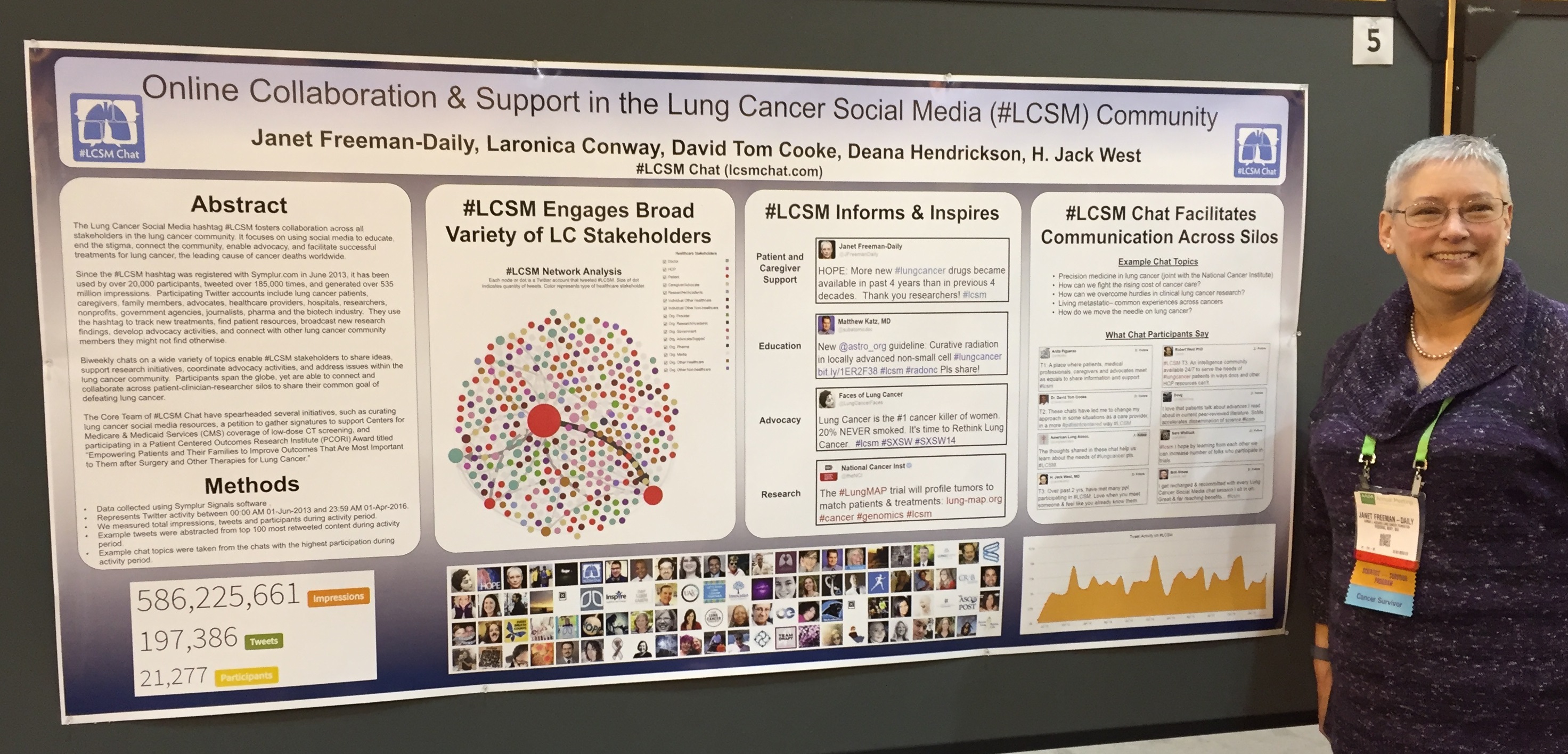
JFD with AACR poster

I didn’t understand every presentation in the actual AACR meeting — in at least one presentation I didn’t understand ANYTHING (gene editing is very technical) — but I did come away with a better understanding of the scope of cancer research, some of the issues impeding progress, and a list of topics I wanted to explore further.

I loved listening to researchers explain cutting edge work that … READ MORE

This article was first published 24-Jun-2016 on my Cure Today blog

My Upcoming Appearances: Westercon 69 (July 4 weekend)

Over the 4th of July weekend I will be attending Westercon 69 in Portland, Oregon, where I will speak on three panels and conduct one Kaffeeklatsch. I will also be participating in a lung cancer meetup in Portland on Monday July 4 at 10 AM–please post in the comments if you want to be part of it.

Here is my tentative schedule at Westercon:

How being an engaged patient can save your life (Hawthorne)
Friday Jul 1 5:00 pm – 6:00 pm
Patients around the world are changing the healthcare model by becoming partners in their own care. What is an engaged patient, how can you become engaged, and why should you care?
Ari Goldstein, Ellen Klowden, Frog Jones, Janet Freeman-Daily, Jennifer Willis

Recent Scientific Breakthroughs – What (Lincoln)
Saturday Jul 2 1:00 pm – 2:00 pm
Is it black holes, gravitational waves, global warming, a new species discovered, or something else? Which recent discoveries intrigue you most.
Dan Dubrick, Gregory Gadow, James Glass, Janet Freeman-Daily

Kaffeeklatsch (Multnomah)
Sun Jul 3 11:00 am – 12:00 pm
Small group discussions with authors, artists, and other interesting personalities (referred to as “hosts”) Sessions are limited to the host and a small group of attendees.
Ctein, Daniel H. Wilson, Janet Freeman-Daily, Jeff Sturgeon, Manny Frishberg, Sara Stamey, Sue Bolich

Is Gibson Getting Out of Hand? (Hawthorne)
Sun Jul 3 1:00 pm – 2:00 pm
Is corporate control of research and the drive for short-term profit crippling scientific innovation and basic research? Do established companies always feel threatened by new technology and lobby for legislation to restrict it?
Bob Brown, Frank Hayes, Janet Freeman-Daily, Jim Doty

New Survey Available for Patients with Any ROS1-Positive Cancer

You might already know that my cancer is ROS1-positive. This means my tumor cells test positive for a rearrangement of the ROS1 gene in my DNA.

Now we ROS1-positive patients can help researchers learn more about our cancer by taking a survey.  If you’re already sold, click on the link at the bottom of this page.  For more info, read on!

All human cells have the ROS1 gene, but in adult humans the ROS1 gene isn’t very active. However, sometimes the ROS1 gene fuses with another gene and becomes “rearranged.”  Cells that have certain ROS1 rearrangements become cancerous.  ROS1 cancer is rare – about 1% of non-small cell lung cancers – and is found in several types of cancer such as brain cancer (glioblastomas), angiosarcoma, and melanoma.  ROS1 cancer can be very aggressive, but many patients respond amazingly well to a drug called crizotinib, which is FDA approved for ROS1-positive lung cancer.  You can learn more about ROS1 cancer, some of the patients who have it, and available treatments and clinical trials on the ROS1 portal .

Over 100 patients who have ROS1-positive cancer of any type (regardless of where the cancer started) have joined a Facebook group called “ROS1 Positive (ROS1+) Cancer.” We hail from a dozen different countries. We discuss how to handle side effects of treatment, explore the treatments and clinical trials available to us, and post new research findings. And we share concerns about our futures, because … well, those of us with metastatic ROS1-positive cancer are not curable.

I’ve had no evidence of disease (meaning we can’t detect any cancer) on crizotinib since January 2013. I wish I could say I’m cancer free, but I can’t.  For most everyone who takes crizotinib, the cancer eventually develops resistance to the drug, and tumors start growing again.

We ROS1ers need researchers to learn more about our cancer, and find more effective treatments. Now we can do something to help.

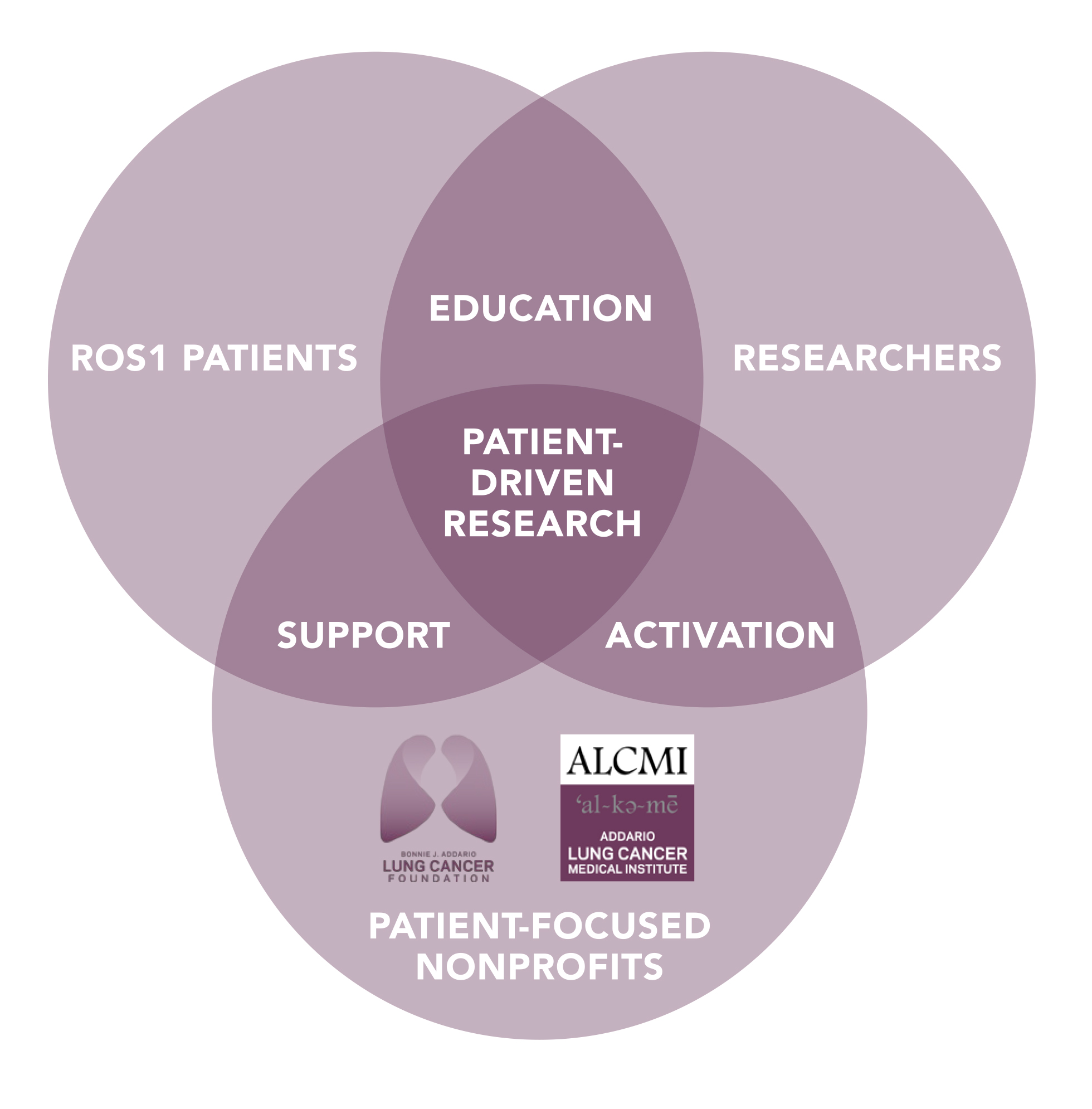
PatientDrivenResearch_Final_April 13, 2016

The Bonnie J. Addario Lung Cancer Foundation has partnered with ROS1ers to inform more people about our disease and develop patient-driven research that will hopefully find more effective treatments for us.  Although the ALCF focuses on lung cancer, this effort is addressing ROS1-positive cancer regardless of where in the body the cancer began.

The first step is an online survey that aims to discover what we ROS1ers might have in common and hopefully identify some causes for this rare cancer (the majority of the patients are young, fit never smokers). To our knowledge, this is the first-ever research into the possible causes of a genomically-driven cancer across cancer types.

Please complete your survey ASAP! While the survey will remain open for a long time, the first round of data analysis will commence on July 15, 2016, with a goal of announcing preliminary findings at the World Conference on Lung Cancer in December 2016.

If you have ROS1-positive cancer, please complete this survey.
If someone you know has it, please encourage them to complete this survey.
CLICK HERE FOR ROS1 PATIENT SURVEY

#LCSM Chat 5/5: Know Before You Go—Conference Prep 101

convention

image by Microsoft Office

Lung cancer patients and advocates are increasingly joining healthcare, pharma, government agency and biotech industry representatives at cancer-related medical conferences such as the American Association for Cancer Research (AACR) Annual Meeting in April and the American Society for Clinical Oncology Annual Meeting in June.

Planning ahead for these meetings is essential for getting the most out of your time. The events, which can last several days, often have many sessions happening at the same time in different rooms. In addition to scheduling considerations, the terminology, graphics, and scientific concepts discussed in the sessions can be overwhelming even for seasoned attendees.

Because no one can possibly attend every conference, attendees share the conference experience by posting tweets while at the conference (called “live tweeting”) about significant happenings and new findings. Often, these conferences have specific hashtags–for instance, those attending the ASCO Annual Meeting this year will include #ASCO16 in their tweets. However, live tweeting from sessions presents some challenges, like condensing new concepts into less than 140 characters, and continuing to follow slides while composing tweets.

In our Thursday May 5 #LCSM Chat at 8 PM Eastern Daylight Time (5 PM Pacific), we will share ideas how attendees might prepare in advance to get the most from a medical conference and share their conference experience with others in real time on Twitter. Janet Freeman-Daily will moderate our discussion using the following questions:

  • T1: What tips do you have for getting the most out of a medical conference? How do you prepare?
  • T2: What concepts would be most helpful for patients/advocates to know before attending cancer conferences? Where can they learn these?
  • T3: What tips do you have for live tweeting a medical conference? What kind of live tweets do you value most?

We hope you’ll join #LCSM Chat on Thursday May 5 at 8 PM EDT. If you’re new to tweetchats, please read this primer on how to participate in #LCSM Chats.

Reblogged with permission from the LCSM Chat website.

Crizotinib (Xalkori) approved for ROS1-positive NSCLC!

The anticancer pill I take in my clinical trial, Xalkori (generic name crizotinib), was approved today by the FDA for my type of lung cancer: ROS1-positive non-small cell lung cancer.  I’m one of the 50 patients whose results were included in the clinical trial data.

In addition to being happy that I found an effective treatment for my lung cancer–I’ve had No Evidence of Disease for 36 months and counting–I feel proud to be part of the research that is making new cancer treatments available for more patients.

Precision medicine, targeted therapies, and clinical trials are awesome.

————————-
Edit 2016-03-11 2 PM to add:

Some people have asked what this approval means to my participation in the clinical trial.

The short answer:
Nothing has changed for me. I’m still in the clinical trial, and I still get my drug free (but have to pay for my travel).

The long answer:

Last April, Xalkori for ROS1+ NSCLC received “breakthrough” FDA designation, which is one type of accelerated FDA approval. The accelerated approval process allows the FDA to grant approval before a Phase 3 clinical trial is completed, but still requires a Phase 3 trial to be completed eventually. So my clinical trial must continue until the Phase 3 trial is complete, or the FDA will pull its approval of Xalkori for ROS1 NSCLC.

Xalkori originally received breakthrough designation for ALK+ NSCLC, and was granted FDA approval through the accelerated process in August 2011 (the fastest drug approval to date). The Xalkori for ALK+ NSCLC phase 3 clinical trial still continues over four years later. So I suspect my clinical trial will be continuing for some time.

However, even if I left the clinical trial, Xalkori is already covered by most insurance plans, and today’s FDA approval means pretty much all plans will cover it. However, the copays vary considerably.  Some plans cover it as a pharmacy benefit with a substantial out of pocket expense.  Others cover it as a medical expense, with a standard deductible.  I haven’t checked to see how (or if) my plan covers it.

I plan to stay in the clinical trial at the University of Colorado for the forseeable future.  I like having regular access to some of the top experts in the world on ROS1 cancer and molecular testing for precision medicine.  My writing income goes to fund their Lung Cancer Colorado Fund for lung cancer research.  I also participate in their research as a patient advocate on the NCI-sponsored CU lung cancer SPORE (Specialized Program for Research Excellence) and get to learn about cutting-edge cancer research, which satisfies the geek in me. Besides, I’ve grown fond of several people I’ve come to know at CU.  It’s become a second home of sorts.

So, yeah, this approval does not change my treatment. But hopefully it will make the treatment more available to more patients ASAP.

Patient Advocate Scholarships Available to Attend #ASCO16

Photo shows two mean chatting in the bustle of Annual Meeting.

If you are a cancer patient advocate interested in attending ASCO 2016, consider applying for the Conquer Cancer Foundation Patient Advocate Scholarship Program.

I have attended ASCO’s annual meeting in Chicago for the past two years.  While the five-day conference can be exhausting, it’s perhaps the best way to learn what treatments are up and coming for your type of cancer, become educated about the science behind research and clinical trials, and discover (and even chat with) the experts in your type of cancer.  It’s also a place to meet the people in your cancer community who you might only know online.

The ASCO (American Society of Clinical Oncology) 2016 Annual Meeting–held in Chicago June 3-7–will bring together over 30,000 cancer professionals from around the world for sessions about state-of-the-art treatment, results of clinical trials, as well as policy, advocacy, and survivorship issues.  You might strike up a conversation with a world-class expert in your type of cancer at a poster presentation or even walking between sessions.  The exhibit hall is a great place to learn about new biotech technologies (such as genomic testing panels and liquid biopsies) as well as what’s in each pharmaceutical company’s drug pipeline.

The Patient Advocate Scholarships are intended for expenses related to air or train travel, lodging, and meeting registration for advocates traveling from outside the Chicago area to attend the meeting (which can add up to $2K US or more).  Eligibility is based primarily on financial need as well as advocacy experience and current activities. Applicants will need to demonstrate why they would not be able to afford to attend the ASCO Annual Meeting without a scholarship award, and are encouraged to provide a compelling reason why their attendance at the meeting is vital to their advocacy role(s).

Although the application period for the doesn’t open until April 4, get an early start now on preparing your application –the application period will only open for three days!

Looking forward: 2016 AACR Annual Meeting and the Scientist-Survivor Program

Microscope

I recently learned I was selected to participate in the American Association of Cancer Research (AACR) 2016 Scientist-Survivor Program!  I’m excited to be attending the AACR Annual Meeting this April in New Orleans.  Thanks to the Bonnie J. Addario Lung Cancer Foundation for sponsoring my application.
I’m looking forward to networking with researchers as well as meeting advocates for other types of cancers to discuss their work.  I’ll also be presenting a research poster on Lung Cancer Social Media (#LCSM) on Twitter, which offer a unique opportunity to connect with all types of stakeholders in the lung cancer community — patients, caregivers, healthcare providers, researchers, hospitals, pharmaceutical companies, advocacy groups, and insurance payers.  Afterwards I plan to blog about the experience and share some of the exciting research presented at the meeting.
After the meeting, I’m going to have a few days vacation to enjoy New Orleans (which I’ve never visited).  I’ll then take The City of New Orleans Amtrak route to Chicago, followed by another train to Boston.  I’ll arrive just in time to present at another conference (GET 2016) at Harvard the next day! I had originally planned to take the Sunset Limited from New Orleans to LA, but after I was invited to GET my travel coordinator (e.g., hubby Gerry) could not find any place where I could disembark along the way and fly to Boston in time for the conference.  After GET, I’ll take a train to Washington DC, where I’ll be a speaker at LUNGevity’s National HOPE Summit.  Whew!
Glad I have willing housesitters who love (and are loved by) the cats.

My Norwescon 39 Panel Schedule

nwc 2016 banner

The Norwescon 39 Science Fiction Convention happens March 24-27, 2016, in SeaTac, Washington.  I will once again be a science panelist.  You can find me on the panels listed below, or maybe hanging out in the bar with other writers and science geeks, scarfing down a snack in the Green Room, or wandering the corridors on my way to the art show, dealers room, a friend’s reading, or an interesting panel.  hope to see you there!


BIO21 – Blinded by Pseudoscience
Fri 6:00 PM-7:00 PM – Cascade 3&4
Gregory Gadow (M), Janet Freeman-Daily, Caroline Pate, Dr. Misty Marshall, Jake McKinzie

TEC05 – Real Radiation for Writers & Readers
Fri 8:00 PM-9:00 PM – Cascade 5&6
Mike Brennan (M), Janet Freeman-Daily, Arthur Bozlee, Daniel P. Lynge

BIO20 – Facts & Fictions of Cancer
Sat 1:00 PM-2:00 PM – Cascade 5&6
Janet Freeman-Daily (M), Dr. Misty Marshall, Vickie Bligh, Nicholas Maurice

BIO16 – Ask the Experts: Biology
Sat 2:00 PM-3:00 PM – Cascade 5&6
Alan Andrist (M), Janet Freeman-Daily, Caroline Pate, Dr. Misty Marshall, Nicholas Maurice

TEC01 – Remembering In Tomorrow
Sat 7:00 PM-8:00 PM – Cascade 9
Sean Hagle (M), Janet Freeman-Daily, Michael Ormes

BIO19 – Evolution Is Just a Theory!
Sun 10:00 AM-11:00 AM – Cascade 5&6
Dr. Ricky (M), Janet Freeman-Daily, Alan Andrist, Michael McSwiney, Jake McKinzie

BIO03 – Future Pharma
Sun 2:00 PM-3:00 PM – Cascade 5&6
Janet Freeman-Daily (M), Caroline Pate, Vickie Bligh, Nicholas Maurice

Take It Personally: How decoding your genes might unlock the future of health care

Denver’s “5280” magazine just published a terrific article on precision medicine called  Take It Personally: How decoding your genes might unlock the future of health care by Julie Dugdale (click on the link to read it). It’s a top-level summary of the benefits and issues that arise from using genomic data in medicine.  One of the main players in the article is the University of Colorado School of Medicine, and some of the providers I work with at CU are quoted (Dr. Dara Aisner and Dr. Robert Doebele).

P.S.  I play a bit role in the article (as a lung cancer case study)


Come Hear me at the GRACE Acquired Resistance Forum for ALK, ROS1 and EGFR Lung Cancer 10/03/2015

GRACE ALK EGFR ROS1 forum graphic

I hope you’ll join me and a host of lung cancer experts on Saturday, October 3, 2015 at the GRACE ALK, ROS1 & EGFR Acquired Resistance in Lung Cancer Patient Forum. I’m on the faculty, speaking about lung cancer patient survivorship.

The forum is for ALK, ROS1 & EGFR lung cancer patients and their caregivers, and will be held at the Marriott Waterfront San Francisco. You can register and read the agenda (with a list of confirmed faculty) online.

At the forum, lung cancer patients can learn about research advances in lung cancers driven by ALK, ROS1, and EGFR. You’ll hear from leaders in targeted therapy research. In addition to presentations and question and answer sessions, attendees will have many opportunities to approach the faculty to speak with them directly. An evening reception after the event will enable additional face time and give attendees – many of whom know each other from online support groups – a chance to meet in real life.

Scheduled presentations include:

  • Acquired Resistance & Why It Occurs
  • Brain as a Sanctuary Site
  • Repeat Biopsies and Serum-Based Testing
  • Selecting Patients for Immunotherapy
  • Quality of Life vs Progression Free Survival – What Are the Most Relevant Endpoints?
  • Patient Assistance Programs
  • Lung Cancer Survivorship

Additionally, breakouts for ALK/ROS1 patients and EGFR patients will cover issues specific to those patients:

  • New Ideas and Treatment Options
  • Individual Treatments for Individual Mutations
  • Combinations to Prevent & Treat Acquired Resistance
  • Drug Sequencing

Registration is $25 per person. GRACE has negotiated a group rate for rooms at the Marriott Waterfront San Francisco of $179 per night (request the “GRACE Patient Forum” room rate).

Hope to see you there!