Help lung cancer doctors learn about patient decision making

decision making

If you are patient with lung cancer, or a caregiver of a patient with lung cancer, please consider completing this 15-minute survey. It was created by Dr. Laurie Gaspar, a radiation oncologist at the University of Colorado, to gather information about:

– How prepared patients are for making difficult decisions?
– How involved patients are in the decision process?
– What would help to improve the decision making process?

The study results will help doctors, patients, and caregivers understand how the process of making decisions about lung cancer treatment and care might improved.

The survey is here:

Looking forward: 2016 AACR Annual Meeting and the Scientist-Survivor Program

Microscope

I recently learned I was selected to participate in the American Association of Cancer Research (AACR) 2016 Scientist-Survivor Program!  I’m excited to be attending the AACR Annual Meeting this April in New Orleans.  Thanks to the Bonnie J. Addario Lung Cancer Foundation for sponsoring my application.
I’m looking forward to networking with researchers as well as meeting advocates for other types of cancers to discuss their work.  I’ll also be presenting a research poster on Lung Cancer Social Media (#LCSM) on Twitter, which offer a unique opportunity to connect with all types of stakeholders in the lung cancer community — patients, caregivers, healthcare providers, researchers, hospitals, pharmaceutical companies, advocacy groups, and insurance payers.  Afterwards I plan to blog about the experience and share some of the exciting research presented at the meeting.
After the meeting, I’m going to have a few days vacation to enjoy New Orleans (which I’ve never visited).  I’ll then take The City of New Orleans Amtrak route to Chicago, followed by another train to Boston.  I’ll arrive just in time to present at another conference (GET 2016) at Harvard the next day! I had originally planned to take the Sunset Limited from New Orleans to LA, but after I was invited to GET my travel coordinator (e.g., hubby Gerry) could not find any place where I could disembark along the way and fly to Boston in time for the conference.  After GET, I’ll take a train to Washington DC, where I’ll be a speaker at LUNGevity’s National HOPE Summit.  Whew!
Glad I have willing housesitters who love (and are loved by) the cats.

Take It Personally: How decoding your genes might unlock the future of health care

Denver’s “5280” magazine just published a terrific article on precision medicine called  Take It Personally: How decoding your genes might unlock the future of health care by Julie Dugdale (click on the link to read it). It’s a top-level summary of the benefits and issues that arise from using genomic data in medicine.  One of the main players in the article is the University of Colorado School of Medicine, and some of the providers I work with at CU are quoted (Dr. Dara Aisner and Dr. Robert Doebele).

P.S.  I play a bit role in the article (as a lung cancer case study)


Guest Blog by Dann Wonser: Do I stay in my clinical trial?

My friend and fellow lung cancer patient Dann Wonser recently blogged an update about his treatment status.  In it, he shared how he made his decision about whether to stay in his targeted therapy clinical trial after the drug received FDA approval.  It’s a worthwhile discussion–an increasing number of cancer patients will face such decisions as more targeted therapies are approved–so I asked his permission to share it on my blog.  The entire text is listed below.

—————————————

NEW SCAN RESULTS + CLINICAL TRIAL DECISION

published December 17, 2015 by 

Friends and Family,

After our usual pre-scan hyper-sensitivity to every indigestion burp, cough, or body ache, I kicked my anxiety into overdrive by getting a cold/flu. It gave me all the symptoms of lung cancer gone rampant: Difficulty breathing, heavy chest, cough, feeling not so great. Then we flew to San Diego, where Dr. Patel gave us the good news: No new growth! We’re celebrating!!! We are now a couple of months past the average time that Tagrisso usually remains effective, which leaves me even more grateful. I have another six weeks of sweet life, and have bought another six weeks of time for the next new drugs to be developed before I need them. Clinical researchers out there, you are my heroes! Keep up the great work!

A couple weeks ago I asked what you would do if you had the choice of ending the clinical trial, but continuing to get the same medication in my home town. I thought I had probably covered the major topics pretty well, but found that there was much more to consider after listening to your thoughts. Thank you for contacting me through every means imaginable to share your thoughtful contributions! If you just want to know what I decided, skip straight to the bottom of this email. If all the facets of this decision fascinated you as much as they have me, keep reading and I’ll share what I learned from you.

First, Tagrisso is so new that the insurance company may not cover it, or may not have a contract with a pharmacy that carries it. They may also have a much higher co-pay for a new drug. This could critical, since the reported cost is $425 per pill. That’s right: $425 per day. I am very fortunate to have an insurance plan that has a maximum out-of-pocket expense. I usually meet that annual maximum out-of-pocket around January 7th, 🙂 and then I’m covered 100% for the year.

But what about those who do not have such great coverage? Fortunately, Astra Zeneca has a patient assistance program. See  http://www.astrazeneca-us.com/medicines/help-affording-your-medicines/ if you are in this boat. I believe other drug companies have similar programs… Worth checking out.

Several people told me they would get out of the clinical trial as soon as possible, to cut radiation exposure in half, by having half as many CT scans. Ashley, my clinical trial coordinator, petitioned the study sponsor to decrease the scan frequency for everyone. I’m impressed, and very grateful! Thank you, Ashley! Hey, I know it’s a long shot, but I appreciate the advocacy!

A friend and fellow blogger, Linnea Olson, actually contacted her study sponsor herself. Way to be your own advocate, Linnea!

But how much radiation is too much? Fortunately, I know someone who has spent years measuring radiation levels in workers at a nuclear-related facility. She can’t give an accurate response without knowing the radiation dose levels of the CT scans, but her best estimate is that the dose is still less than the daily level of radiation considered safe for workers in the nuclear industry. I don’t know whether that makes me feel relieved, or worried for the nuclear workers. All the same, it would be helpful to get dose info from a radiologist who does CT scans. I’ll work on it.

Several people mentioned the advantages of staying close to clinical researchers who are on the cutting edge of treatment. How could I replace that?

The length of the clinical trial was questioned. Dr. Patel has no idea how much longer the trial will continue. However, I have the choice of exiting the trial at any point.

Several of you mentioned the importance of contributing to research that affects the lives of so many. More data will help guide more research, and benefit more people.

The travel expense is not the biggest issue, but one that seemed reasonable for the drug company to cover at this point. The cost is roughly the equivalent to the price of one pill ($425) every six weeks.  UCSD told me that they never go back to the sponsor to ask for travel assistance. So…. I bypassed the system! I have my own Astra Zeneca connections, so I made my own request. We all have to be our own advocates.

I asked Genevieve how this impacts her, since she makes every trip with me. She dismissed the question as trivial and irrelevant. That says a lot about love, doesn’t it? She’s a keeper!

One friend, Joe, had a more noble take. He said that it’s good to stay with the girl that brought you to the dance, and make sure she gets home safe. In other words, since this clinical trial saved my life, perhaps loyalty should be a consideration.

Thank you  all for making me consider so much more, and in so much more depth. It makes me feel more comfortable with my decision… to stay with the clinical trial. You helped me crystalize that my biggest concern was the radiation, which I feel a little better about now. You also helped me to decide just how important it is to contribute to the research, and to realize that the most important factor for me is sticking close to Dr. Sandip Patel. He is the most cutting-edge oncologist that I know about for my situation, and I have direct access to him. That is irreplaceable.

Wishing you happy holidays, and decisions you can live with.

Love,

Dann

NCI & #LCSM Chat present a Google Hangout on Air 11/19 at 2pm ET: “Changing Landscape of Lung Cancer Research & Treatment”

[Reblog of 11/15/2015 content from LCSMchat.com — used with permission]

Last year in November, The National Cancer Institute (NCI) and #LCSM Chat worked together to conduct a Twitter chat on precision medicine in lung cancer treatment.  This year, we’ve taken our collaboration a step further to create a highly engaging, interactive online event.

For Lung Cancer Awareness Month this year (#LCAM15), The NCI and #LCSM Chat are excited to announce we will co-host a one hour Google Hangout on Air on “The Changing Landscape of Lung Cancer Research and Treatment” on November 19, 2015 at 2:00 ETYou can watch the Hangout LIVE online by clicking HERE.

During the Google Hangout, we will also be co-hosting a simultaneous #LCSM Chat on Twitter on the same topic to expand on the discussion.  If you have questions you would like answered by the experts in the Hangout, tweet them during the chat (or before) using the #LCSM hashtag.  You can read about how to participate in an #LCSM Twitter chat here.

Our Hangout on Air will be moderated by #LCSM co-founder Janet Freeman-Daily (@JFreemanDaily), who will share questions submitted on Twitter with our three lung cancer experts:

During the Hangout, Dr. Jack West (@JackWestMD) will moderate the #LCSM Chat on Twitter.  The questions in the chat will reflect the topics to be discussed in the Hangout:

  • T1: What new aspects of lung cancer clinical research are you excited about? What’s new in clinical trials?
  • T2: How is translational research different from clinical research? What new projects in translational research are you excited about?
  • T3: What new directions in basic lung cancer research give you the most hope?
  • T4: How can the lung cancer community help researchers to give us more new treatments sooner?

Feel free to tweet questions of the presenters in the #LCSM tweetchat—just include the hashtag “#LCSM” in your tweet.  NCI social media people will collect the questions from the Twitter feed and feed them to Janet so she can ask them during the Hangout.  If you’re not comfortable with Twitter, just post your question in the comment section of this blog post.  We will make sure your question gets added to the list.

It promises to be a lively and vibrant discussion about current lung cancer research, clinical trials, and future treatment options.  We hope you tune in to the Hangout on Air and/or join the #LCSM Chat on Twitter.  If you aren’t able to join us live, don’t worry — the hangout will be recorded and posted on YouTube shortly after the event, and a Storify of the Twitter chat will be posted within a week.  As usual, you can find transcripts of past #LCSM Chats on our “Schedules and Transcripts” page.

After the 11/19 Hangout is over, we’d appreciate your completing a brief survey to let us know what you thought about the Hangout, and what you would like to see in future #LCSM Hangouts. Click here to take the survey.

Come Hear me at the GRACE Acquired Resistance Forum for ALK, ROS1 and EGFR Lung Cancer 10/03/2015

GRACE ALK EGFR ROS1 forum graphic

I hope you’ll join me and a host of lung cancer experts on Saturday, October 3, 2015 at the GRACE ALK, ROS1 & EGFR Acquired Resistance in Lung Cancer Patient Forum. I’m on the faculty, speaking about lung cancer patient survivorship.

The forum is for ALK, ROS1 & EGFR lung cancer patients and their caregivers, and will be held at the Marriott Waterfront San Francisco. You can register and read the agenda (with a list of confirmed faculty) online.

At the forum, lung cancer patients can learn about research advances in lung cancers driven by ALK, ROS1, and EGFR. You’ll hear from leaders in targeted therapy research. In addition to presentations and question and answer sessions, attendees will have many opportunities to approach the faculty to speak with them directly. An evening reception after the event will enable additional face time and give attendees – many of whom know each other from online support groups – a chance to meet in real life.

Scheduled presentations include:

  • Acquired Resistance & Why It Occurs
  • Brain as a Sanctuary Site
  • Repeat Biopsies and Serum-Based Testing
  • Selecting Patients for Immunotherapy
  • Quality of Life vs Progression Free Survival – What Are the Most Relevant Endpoints?
  • Patient Assistance Programs
  • Lung Cancer Survivorship

Additionally, breakouts for ALK/ROS1 patients and EGFR patients will cover issues specific to those patients:

  • New Ideas and Treatment Options
  • Individual Treatments for Individual Mutations
  • Combinations to Prevent & Treat Acquired Resistance
  • Drug Sequencing

Registration is $25 per person. GRACE has negotiated a group rate for rooms at the Marriott Waterfront San Francisco of $179 per night (request the “GRACE Patient Forum” room rate).

Hope to see you there!

A patient at a press conference

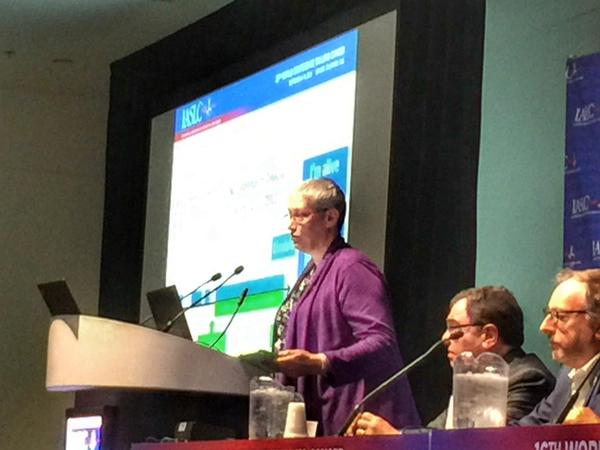
Earlier today (September 6, 2015) I gave this speech at the International Association for the Study of Lung Cancer (IASLC)  World Conference on Lung Cancer in Denver.  I’m pleased at the reception it received.
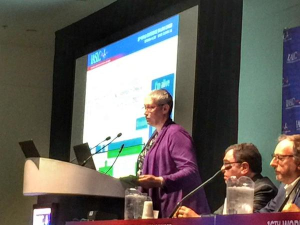
JFD speaking at WCLC2015 press conference

——————————————–


PRC 1

I appreciate IASLC including me in this press conference. They’ve been responsive to lung cancer patients and advocates, and have included the patient voice in several conferences. Patients and advocates participated in the planning process for this World Conference on Lung Cancer, as demonstrated by the number of patient and advocate presentation on the program. This is a first among major oncology conferences, and a step forward for engaged patients.

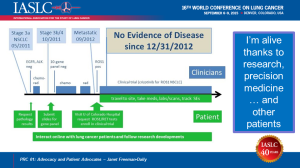
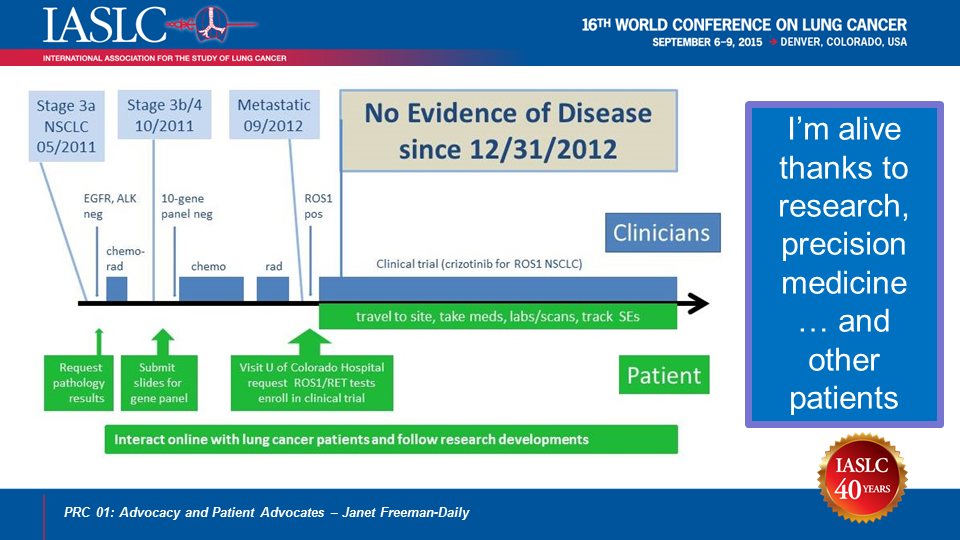
As the slide says, I’m alive thanks to research, precision medicine, and other patients. My lung cancer journey is a good example of the importance of research, hope, and engaged patients and advocates.

In early 2011, I had a nagging cough [hack hack]. To make my husband happy, I went to see my doctor. After two rounds of antibiotics, and weeks of diagnostic procedures, I was diagnosed with advanced lung cancer with a 3-inch tumor in my left lung. I never smoked anything – except a salmon.

My primary tumor and lymph nodes all responded to chemo and radiation, but two months later, I had a new cancerous hot spot by my collarbone. That became a 3-inch mass in three months. I had more chemo, followed by more radiation. A new scan showed all the known tumors were gone or dead. BUT … I had two new tumors in my other lung. I now had metastatic lung cancer. Whenever I stopped treatment, I had a new tumor within two months. My oncologist told me I would be on chemo for the rest of my life. Fortunately, just after I began treatment, a friend and fellow cancer patient recommended I join an online support group for lung cancer patients.

From other patients, I learned about molecular testing, targeted therapy, and clinical trials. I arranged to have my tissue tested, and based on the results, traveled from Seattle to Denver to enroll in a clinical trial. Thanks to this trial, I’ve outlived my original prognosis by years. I recently celebrated my four-year cancerversary, and have had No Evidence of Disease for 32 months and counting. I am not cured, but I am living well with lung cancer.

PRC 2

I am an epatient. Epatients are not just people who search for health information online. The term epatient applies to any patient who is equipped, engaged, empowered, or enabled. These patients can become equal partners in their own care, working together with healthcare providers to improve their outcomes.

In the online lung cancer community of over 20,000 people, I found patients with my type of lung cancer, on the same treatment, who understood exactly what I was feeling and experiencing. They answered questions I didn’t think to ask at doctors appointments while I was still in shock over my diagnosis. They suggested ways to cope with side effects at home. They prodded me to ask my doctor about issues I hadn’t thought were important. They were available in the wee hours when the fear was overwhelming. They shared online information resources from reliable authorities like the National Cancer Institute.

The information I learned online enabled me to become an interactive participant in my care. From other epatients, I learned to ask for my data, including radiology and pathology reports. I learned about treatment options and typical side effects. I learned about new molecular and genomic tissue testing that doctors in my home clinic did not know about. I learned how to find and participate in clinical trials. And I found hope. If I had not had access to other epatients, I would likely be dead now.

Preliminary studies indicate patient engagement and shared decision making can increase patient satisfaction and outcomes and reduce healthcare costs. Activated patients are less likely to be readmitted within 30 days of hospital discharge, less likely to have poor care coordination across healthcare providers, and less likely to lose confidence in their health care system.
PRC 3

Thanks to research and new treatments, more lung cancer patients are surviving longer and learning to live with lung cancer as a chronic illness. As you’ve heard, this disease still kills more people every year than the other top three cancers combined. Yet lung cancer receives fewer federal research dollars per death than any of those cancers. Why is that? Are lung cancer patients not worth saving?

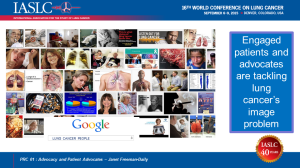
The answer becomes clear when you google the words “lung cancer people.” No throngs of ribboned supporters; few smiling survivors. You see damaged lungs, death … and cigarettes. Lung cancer has an image problem. The first question I hear when I mention my disease is: “Did you smoke?” People blame patients for getting lung cancer. The breast cancer community has changed how the world sees their disease. The lung cancer community must do the same. Two thirds of lung cancer patients – TWO THIRDS — either never smoked, like me, or quit smoking years ago.

Now that more lung cancer patients are benefitting from new treatments, we can speak out to raise awareness of other risk factors such as radon gas, air pollution, and workplace exposure; fight the stigma of lung cancer, and increase research funding so more of us can live. We are telling our stories and experiences through blogs, social media, and support communities. We are sharing our treatment data in online databases, and collaborating with clinicians and researchers via Lung Cancer Social Media (#LCSM) on Twitter.
PRC 4

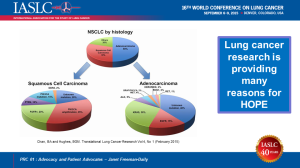
The new treatments and screening opportunities arising from research give patients like me many reasons for hope. Early last year, there were no additional clinical trials for people with my type of lung cancer. Now there are at least four other trials. In fact, there are now over 17 actionable mutations for lung cancer. Patients whose tumors have these genomic mutations have options for either approved treatments or clinical trials. In fact, more new treatments have been approved for lung cancer in the past four years than in the previous four decades.

Innovation in cancer care can help more patients get the best possible treatment with easy-to-access medical records for second opinions; accurate early detection methods; affordable genomic testing; simpler searches for clinical trials; new trial designs for small and remote populations; big data analysis of outliers; and more effective ways to share information and hope among all lung cancer patients as well as the public–including those who are not on the Internet.
PRC 5

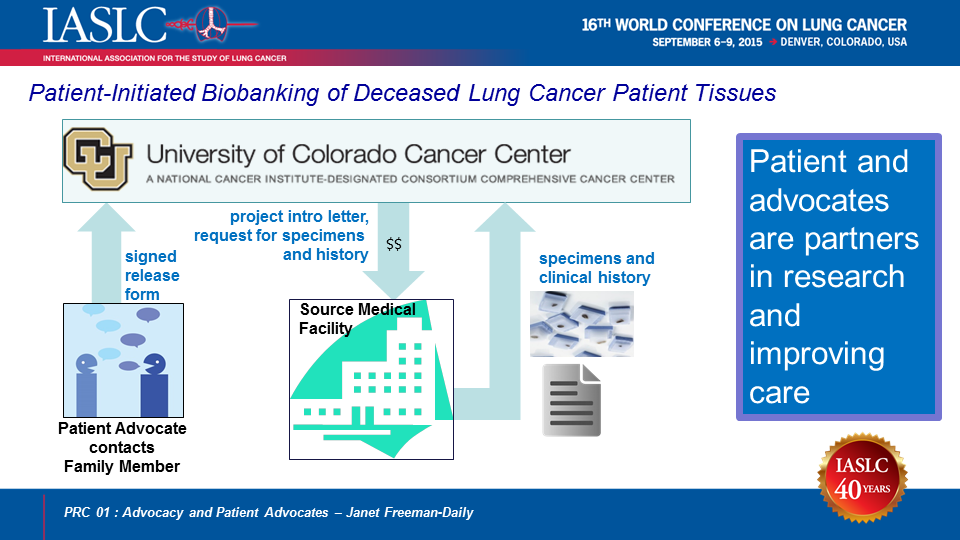
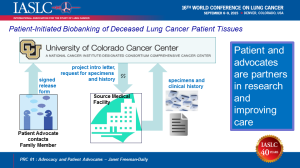
Engaged patients and advocates are working with clinicians and researchers to accelerate research and improve patient outcomes. Last year advocates were instrumental in obtaining Medicare coverage for lung cancer screening, and a group of lung cancer survivors helped change National Comprehensive Cancer Network guidelines for treatment of metastatic lung cancer. Patients and advocates are supporting the “Don’t Guess. Test.” campaign to encourage more patients to get genomic testing. At this conference, patients and advocates will be discussing their involvement in the NCI’s Lung-MAP precision medicine trial, establishment of support groups, a clinical trial to study lung cancer in young adults, and information that helps patients make choices for treatment and survivorship. In just the past two weeks, a research study began at the University of Colorado lung cancer SPORE to work with family members of patients who died of lung cancer to collect archived tumor tissue from community hospitals and provide it to lung cancer researchers so they can continue to provide hope for this disease. I initiated this project as the SPORE’s patient advocate with support of the Addario Patient and Caregiver Advisory Board.

Thank you for your interest in reporting on lung cancer research. Together we can raise awareness, spread hope, fight the stigma of lung cancer, and improve outcomes for all patients.

#PatientsIncluded for @IASLC’s 16th World Conference on Lung Cancer (#WCLC2015)

 IASLC WCLC header 400

This coming week I will be attending the 16th World Conference on Lung Cancer in Denver’s Colorado Convention Center run by IASLC (the International Association for the Study of Lung Cancer). I’m looking forward to live tweeting some sessions (using #WCLC2015), hanging out with fellow patients and advocates, and connecting with many online friends–some I’ve not yet met in person. I’m also giving my first speech as a patient at a medical conference focused on lung cancer, and making some videos with nonprofits and media groups.

This conference is groundbreaking for the “Patients Included” movement–I believe it’s the first time any professional oncology conference has intentionally included the patient voice by scheduling several patient speakers. Registration fees are waived for patients and advocates, the advocacy track has scheduled events each day, and lung cancer survivor Emily Bennett Taylor will be the keynote speaker at the Opening Ceremonies on Sunday September 6.

WCLC is the world’s largest meeting dedicated to lung cancer and other thoracic malignancies. More than 7,000 delegates come from over 100 countries to discuss the latest developments in research. Attendees include clinicians surgeons, medical oncologists, radiation oncologists, pulmonologists, radiologists, pathologists, epidemiologists, basic research scientists, nurses, allied health professionals, advocates and patients.

If you’ll be attending and would like to meet me during the conference, below are some events where you can find me. Amazingly, all of my days begin with activities at 7:30 AM or earlier.

Sunday 9/6 7:30-11:00 AM
5 Card Pancake Stroll
Come walk with Team #lcsm to raise funds for Bonnie J. Addario Lung Cancer Foundation and IASLC.

Sunday 9/7 11:30-12:30
Speaker, WCLC Press Conference (room 108-110-112)
Yes, IASLC included a patient in a press conference—awesome!

Monday 9/7 4-19:00
#LCSM Tweetup at The Corner Office Restaurant (Sponsored by Cancer GRACE)
Meet others who participate in the biweekly Lung Cancer Social Media Chat on Twitter. This is the best place to catch me if you want to meet and chat for a few minutes—I expect to attend 4:30-6:00 PM.

Tuesday 9/8 10:45-12:15
Co-Chair, Oral Session 27: “Care” (rooms 708-710-712)
Together with my co-chair, I will introduce the scheduled speakers.

Wednesday 9/9 14:15–15:45 PM
Speaker, Mini Symposium 27: “Advocacy in Practice”(room 703)
My speech “Supporting Lung Cancer Survivors – Living with and Beyond Lung Cancer” is scheduled for 15:20-15:35. Friend and fellow lung cancer patient CraiginPA will also present in this session.

It’s going to be a great conference! Hope to see you there.

Brain fog: the subtle side of scanxiety

Image credit: Microsoft

Image credit: Microsoft

Tomorrow morning I fly out for another Monday PET-CT scan at University of Colorado (CU) in Denver. Tuesday I start cycle 35 of Xalkori on my clinical trial (cycle = 4 weeks). If my Tuesday clinic visit reports a clean scan, I’ll be almost 30 months NED on this targeted therapy.

Because my injured left shoulder is so inflamed, I asked my oncologist if I should have a CT instead of the usual PET-CT this time (inflammation shows up hot on a PET scan), but he says he will just ignore that shoulder. Since I had a detailed MRI of that area a couple of weeks ago when diagnosing my shoulder problem, I’m not concerned a metatasis might be missed. I do wonder how my shoulder will feel after having my arms over my head in the scanner for over 20 minutes, but that’s not a big concern either.

While at University of Colorado, I’ll also be meeting with a CU communications staffer (to discuss cancer center public relations), a molecular pathologist (to discuss ways to explain benefits of genomic testing), and Lung Cancer SPORE members (to discuss a SPORE project). I’m really enjoying my work and friendships with all of them, and love getting to learn about cutting edge science from those who are doing the research. Alas, Dr. Camidge is away on travel, so I won’t get to work on any videos with him this trip.

Interesting projects are definitely worthwhile distractions at scan time. I’ve been so busy with lung cancer advocacy and travel (26 days out of the last two months) that I haven’t had time to feel any conscious scanxiety. However, I still haven’t packed, completed household pre-trip tasks, or written items with impending deadlines, and I’m moving slower than usual. I find myself having difficulty thinking beyond my next cup of coffee. It’s sunny and clear outside, but gray and fuzzy inside my head. So maybe I’m not yet entirely immune to scanxiety’s influence.

Then again, the brain fog could simply be lack of sleep due to Seasonal Affective Disorder (the sun is up 16 hours of the day right now in Seattle), time zone tango, and travel schedules. The source of the fog doesn’t really matter, I suppose, as long as I warn my family of its presence. Otherwise they may wonder why the dirty dishes are in the microwave instead of the dishwasher.

My drug is a breakthrough!

Woohoo!  My clinical trial drug may get FDA approval soon!   It’s about time.

The clinical trial in which I participate has been running for over three years.  I take Xalkori (crizotinib) for my ROS1-positive non-small cell lung cancer.  Early phase clinical trial results  announced last year show around 72% of patients experienced measurable shrinkage of their tumors, and another 12% achieved stability.  This is remarkable, considering most chemos have a response rate around 20%.

The average crizotinib response lasted about 17 months, with half of the patients still responding when the data was collected for the journal article.  I personally know at least four people (including me) who responses have lasted over two years (two of them are not on the trial).

Today Pfizer announced it had received US FDA “breakthrough” designation for Xalkori treatment of ROS1+ non-small cell lung cancer.  This means it is on the fast track for FDA approval for treatment of ROS1 NSCLC (after already being approved for treatment of a different lung cancer mutation).

My marvelous clinical trial drug may finally get FDA approval.   It’s sort of moot, in a way, because the evidence of its effectiveness is so outstanding that most US insurance companies are already paying for crizotinib treatment of ROS1 NSCLC.  But it is still cool.

Pfizer Receives U.S. FDA Breakthrough Therapy Designation For XALKORI® (crizotinib) For The Treatment Of Patients With ROS1-Positive Non-Small Cell Lung Cancer

Coincidentally, I have my clinical trial appointment today, and I’ll be talking with one of the lead investigators (my oncologist, Dr. Ross Camidge) about what this announcement means for those of us still on the trial.