Did Lung Cancer Claim Your Loved One? Invest 20 Minutes to Help Researchers Find New Treatments!

If your loved one was treated for lung cancer at a community hospital, and has since died, you can help find new lung cancer treatments that might spare other families the anguish you’re feeling.

Lung cancer is the biggest cancer killer. Fortunately, researchers have discovered several new therapies that are helping to turn metastatic lung cancer into a chronic illness instead of an automatic death sentence.  Some of these therapies are effective for 70-80% of patients whose tumors have certain biomarkers .

Unfortunately, not all types of lung cancer have such effective treatments — yet.  Researchers need to find more lung cancer biomarkers and develop more drugs to target them. Discovering these biomarkers and new therapies requires studying LOTS of lung cancer tumor tissue.  If more tumor tissue from different patients were available for researchers to study, we might find new biomarkers and effective targeted therapies faster.

How can I help?

If your loved one was treated for lung cancer at a community hospital, and has since died, you can help by donating your loved one’s archived tumor tissue. 

Researchers usually obtain tumor tissue from lung cancer biopsies and surgeries performed at their academic cancer centers.  However, most lung cancer patients (about 80%) are treated at community and clinics, not academic cancer centers.  Those hospitals generally just archive any tumor tissue that is not needed for guiding patient care, and destroy those tissues five to ten years after the patient has died.  This means a lot of tumor tissue that could be used for finding new lung cancer therapies never gets to researchers.

The National Cancer Institute’s Lung Cancer SPORE at the University of Colorado (I’ll call it CU Lung SPORE for short) aims to help lung cancer researchers find cures faster.  Like other NCI SPOREs, CU has a biorepository (some people may call it a biobank) where they store patient specimens and medical records.  The biobank provides the tissues along with the important clinical background to scientists studying new ways to treat lung cancer, not only from the University of Colorado, but to institutions all around the country. Researchers can search for available specimens and request them for research projects.

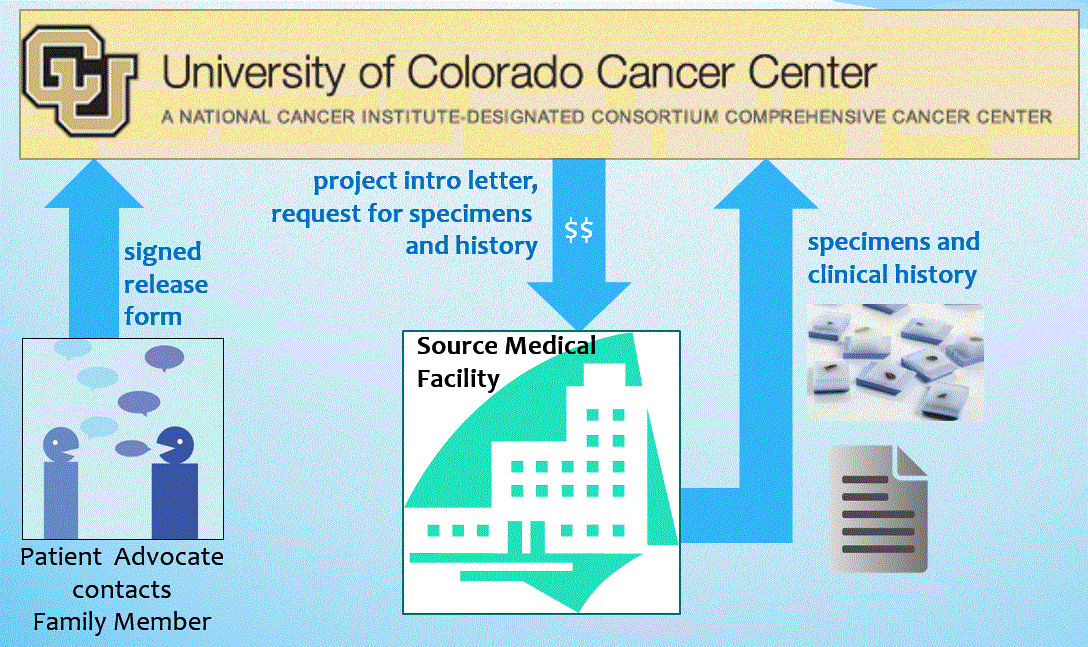
The CU Lung SPORE created a pilot study to collect archived tumor tissue and medical records of deceased lung cancer patients, and place these in their biobank so that researchers can use them.  This study focuses on deceased patients because they have no further need of the tissues (living patients may need their specimens for tumor testing later).  The study needs five to ten more family members to submit signed release forms so we can complete the pilot study and assess whether this a feasible way to gather more lung cancer tumor tissue for research.

HIPAA laws forbid a research center from asking patients or family members about donating tissues and medical records if the patient wasn’t treated at their facility. But advocates (like me) CAN ask.

What do I have to do?

To participate, all you need do is:

  • Download the release form (by clicking on this link Family member Release Form (revised 2016-06-23) and fill in some information about you, your loved one, and where your loved one was treated,
  • Sign the release form, and
  • Mail the completed, signed release form to:
    • Mary K. Jackson
    • Team Manager – Specialized Program of Research Excellence [SPORE]
    • University of Colorado Cancer Center
    • 13001 E 17th Place MS B-189
    • Aurora, CO 80045

Filling in the release form only takes about 20 minutes (assuming you have to look up the contact information for the hospital).  Pretty easy, isn’t it?

What happens next?

The SPORE will contact the hospital where your loved one was treated and request your loved one’s archived tissue and medical records. Once these documents are received at CU, they will be reviewed by the study team, de-identified (which means personally identifying information is removed), and placed in the CU Lung SPORE’s biobank.

THAT’S IT!

PLEASE consider donating your deceased loved one’s archived lung cancer tissue and medical records for research through this project. You can learn more by contacting me (the patient advocate for the CU Lung SPORE) at jfreeman.wa@gmail.com, or the CU Lung SPORE at the address above.

Do it to honor your loved one.  Do it for the next family stricken by lung cancer. Whatever your reason, please do it.  We’ve lost too many to this disease.


Note: This research study’s official project title is “Patient-Initiated Biobanking of Deceased Lung Cancer Patient Tissues” and its study number is COMIRB# 15-1294.  It is not a clinical trial dealing with live patients, so you will not find it listed on clinicaltrials.gov.  
Dear Congress: Please Consider Lifetime Caps and Pre-Existing Conditions Carefully

Dear Congress:
Some voters say they don’t want the government or insurance companies to spend THEIR money on other people’s healthcare.  They think repealing the Affordable Care Act will fix all their healthcare problems.
They probably are not aware that “other people” will likely include them or someone they love at some point.  All of us risk the ravages of accidents, illness, and age, and 39% of US citizens will get cancer in their lifetimes (per the NCI’s current SEER data).
nci-seer-cancer-fact-sheet-2016-all-cancers
Before the ACA was implemented, cancer was a “pre-existing” condition that prevented anyone who’d had it from obtaining health insurance, and most healthcare plans had “lifetime caps” on how much they would spend on individuals.  My exceptionally great employer-provided health plan’s lifetime cap was $250,000 before the ACA.
My insurance company was billed more than $250,000 during my very first year of advanced lung cancer (I was diagnosed May 2011).
If the lifetime cap and pre-existing conditions clauses were in place last year, I would have lost my health insurance, and likely would have no option to buy more. I would have been responsible for paying about $98,000 in 2016 alone in billed healthcare services and treatments (assuming I could still get my targeted therapy cancer drug free through a clinical trial). That’s despite not having other major health issues last year, like hospitalization for pneumonia or cancer treatment side effects.

I know the ACA is not perfect. I applaud any effort that will improve healthcare coverage in the US.  But repealing the ACA without a suitable replacement is not going to solve our health care crisis.

If you allow pre-existing conditions and lifetime caps to be reinstated, you will be forcing an estimated 14,140,254 cancer patients to choose between bankrupting their families, or foregoing treatment (and probably dying).

One of those people will be your constituent … or even someone you love.
Please consider your healthcare options carefully.  The life you save may be your own.  A six-figure salary is peanuts compared to cancer treatment.

#CureChat 1/12: A conversation about precision medicine and clinical trials

curechat-graphic

I am honored that I was asked to be the featured guest for the #CureChat on Twitter this Thursday, January 12th, 2017 at 1 pm ET.  We’ll be talking about precision medicine and clinical trials.  You can read more about it on the Cure Forward blog.  Hope you can join us!

Chat Topics (from the Cure Forward blog):

T1. Janet Freeman-Daily’s Story (my lung cancer story, told 140 characters at a time)

T2. What does the term “precision medicine” mean to you and how does it connect to clinical trials?

T3. Tell us about the ROS1 Mutation.

T4. What were your biggest fears and misconceptions about clinical trials before finding out about them via an online community?

T5. How did it feel to be accepted into a trial? What emotions, and why? And how did you manage them?

T6. What are some of the positive aspects of clinical trials that most people don’t know about?

T7. Please share some online resources where you find trustworthy info for lung cancer and clinical trials.

You can follow the conversation in Twitter by entering “#CureChat” in the search box to filter tweets.  However, if you haven’t joined a tweetchat before, you may find the conversation easier to follow if you use a tool designed for tweetchats, such as tchat.io.  To use tchat.io, do the following:

  • Login to Twitter (you must have a Twitter account to do this)
  • Type “tchat.io” in the URL of your browser, then hit the “enter” key. The tchat.io entry page will appear.
  • Type “#CureChat” in the box that says “enter hashtag,” then left-click on the colored box that says “Start Chatting.” You will be taken to a page that has a big blank textbox at the top, and a list of recent tweets that contain the hashtag “#CureChat” below.
  • Left-click on the link just below the textbox that says “sign in.” A popup window will ask if you want to authorize tchat.io to access to your Twitter account. Left-click on the box that says “authorize app.” You will return to the tchat.io page.
  • Left-click on the link above the textbox that says “hide retweets.” This will eliminate duplicate tweets and make the conversation easier to follow.

Now you can follow the #CureChat conversation on the tchat.io page.  If you want to contribute to the conversation, type your own tweets into the textbox at the top of the page.  Tchat.io will automatically add the hashtag #CureChat to the end of your tweet so your tweet will appear in the conversation.

However you choose to follow the chat, if you want to respond or direct a question to someone in the chat, be sure to include their Twitter handle (e.g., @JFreemanDaily is my handle) at the beginning of your tweet.

Thanks to Liza Bernstein (@itsthebunk) and the Cure Forward team for inviting me to be their guest in this chat.  I look forward to seeing you on Thursday!  I will post the link to the Storify summary of the chat HERE once the Cure Forward team posts it.


More cancer research. More survivors. No stigma.

stigma-4

I want to see cures for ALL cancers.

In most cases, we can’t know for certain what caused an individual’s cancer, meaning we can’t determine exactly what caused their normal cells to mutate and become cancerous. Since we don’t know all the causes, we can’t PREVENT all cancers. All we can do is reduce our risk. Because we all need to eat and breathe, and our world contains toxins known and unknown, we’ve all likely done something that increases our risk of getting cancer.

Smoking is a risk factor for 14 types of cancer, and affects every organ in the body.  I support anti-tobacco campaigns to educate and hopefully prevent more people (especially young people) from consuming any tobacco product. I support compassionate smoking cessation efforts to help people find motivation to quit if they did start.  I hope people who did use tobacco (and those who love them) can forgive and move on to healthier lifestyles.

But I also recognize that tobacco is more addictive than heroin or cocaine.  According to the American Cancer Society, the best way to quit for most people is some combination of medicine, a method to change personal habits, and emotional support.  Unfortunately, many smokers who have the desire and motivation to quit lack the tools and support necessary to quit.

Humans are not perfect. Up to 90% of smokers began before age 18–when we all make risky choices for the wrong reasons–and became addicted.  But we’ve all made decisions that could put our health at risk.  I’ve made my share: pulling all-nighters to study for finals, consuming cola drinks and chocolate for energy during long hours on a tough aerospace proposal, accepting a high-stress job. I knew these weren’t the healthiest choices, but I did them anyway.  Does that mean I deserve a terminal illness?  If a world-class athlete was fatally injured while competing in the Olympics, would we shrug in acceptance because they chose a high-risk sport and thus were asking for death?

To repeat one of my catchphrases:

“Yes, it’s healthier not to smoke, but it’s not a sin that warrants the death penalty.”

Metastatic cancer has killed so many of my friends. I saw their pain, and the anguish of their loved ones, and I find I don’t care what might have caused their cancer.  I don’t want to lose any more people to this beast.

I want the allocation of research funding to reflect the science that has the best of chance of making a difference for cancers that kill people: metastatic cancers.  I want everyone to receive effective treatment for ANY cancer they may have, regardless of why they have the disease, or where they live, or how old they are, or what insurance they have.

Would you want someone to decide whether you deserve healthcare based on YOUR past actions or choices?

End stigma. All cancer patients deserve compassion.

First-ever NCI Facebook Live for Lung Cancer Awareness Month 11/17 8 pm ET

cxzquw0xaaaibeb

Hope you will join the lung cancer community tomorrow 11/17 at 8pm Eastern for the first-ever Lung Cancer Awareness Month Facebook Live event with the National Cancer Institute and the concurrent Lung Cancer Social Media (#LCSM) Chat on Twitter. We’ll be talking about immunotherapy and lung cancer clinical trials.

For more information, check out the Lung Cancer Social Media (#LCSM) Chat blog post for their 11/17/2016 chat.


Involving ROS1-Positive Cancer Patients in ROS1 Research

Hey ROS1ers: This is an IMPORTANT REQUEST!

We all want to find a CURE for our disease, right?

To do this, we need to know how many patients are willing and able to participate in research for cancer driven by ROS1 mutations. The results will hopefully motivate more patients to join us, generate more interest in collaborative ROS1 research, and attract more funding to ROS1 research.

PLEASE COMPLETE THIS BRIEF 10-QUESTION POLL AS SOON AS POSSIBLE. Just click on the link below to get started! It only takes about 5 minutes. Results of the poll will be posted on the ROS1cancer website, and the Bonnie J. Addario Lung Cancer Foundation (ALCF) ROS1 website.

SurveyMonkey Poll: Patient Interest in ROS1 Cancer Research

patients-banding-together-for-research

AND …

If you haven’t already, please complete the ROS1 patient survey on the ALCF ROS1 website. We need more responses–COMPLETE responses (all questions answered)–to have statistically valid data. It’s a long survey (might require an hour), but the length is necessary to accomplish its goals. The survey examines ROS1 patients’ diagnosis and treatment journey, family cancer history, patient exposure to toxic environments and materials, and other factors that might have contributed to the development of ROS1 cancer. A poster about the survey was presented at the IASLC Chicago Multidisciplinary Symposium In Thoracic Oncology in September 2016. The preliminary results of the survey will be presented at the IASLC World Conference on Lung Cancer in Vienna in early December 2016.

Four years on a cancer clinical trial, and still NED–yay for research and hope!

Four years ago today, I took my first dose of crizotinib in a clinical trial for patients who had ROS1-positive lung cancer. My first scan–and every scan thereafter, including this past Monday 10/31– has shown no evidence of disease (NED). Not bad for a metastatic lung cancer patient who previously progressed on two separate lines of combined chemo and radiation.

I’m very grateful for cancer research and the availability of clinical trials. We’ve had more new drugs approved in the past five years than in the previous five decades!

During November, which is Lung Cancer Awareness Month (#LCAM on Twitter), please consider donating to your favorite lung cancer research facility (one option is the Lung Cancer Colorado Fund at the University of Colorado) or a lung cancer advocacy organization that supports research. 

And for a bit of hope, check out the NEW LCAM website, which represents a partnership among 19 lung cancer advocacy organizations led by the International Association for the Study of Lung Cancer (IASLC).

 
lcam-multi-color-logo

HOPE LIVES! More research. More survivors.

Cancer Choices: Quality of Life versus Quantity

Life has an odd way of reinforcing its lessons.

Due to my own lung cancer journey, I’ve learned a lot about the uncertainties of cancer diagnostic procedures and treatment. I’ve learned that cancer is sneaky; sometimes it doesn’t announce itself until it is in advanced stages, doesn’t behave as expected, doesn’t present a clear diagnosis with a “best” treatment option. And I’ve learned the value of making treatment choices that allow the patient to do what matters most to them, rather than prolonging life at any cost. For many patients, qualify of life is more important than quantity of days.

Recently, life gave me the opportunity to apply my hard-won wisdom to my beloved 14-year-old cat, General Nuisance.

General is a fluffy, snuggly ball of love. He has been MY cat since … Read more

img_1484

Lung Cancer Update: August 2016

I haven’t blogged much about my cancer status or advocacy activities in 2016.  Not to worry — I’m still dancing with NED (No Evidence of Disease), still taking Xalkori (crizotinib) for my stage IV lung cancer, and still advocating for improved outcomes and quality of life for lung cancer patients.  Life has just been amazingly, overwhelmingly busy up through July, and my blogging became one of the dropped balls in my juggling act.

How busy, you ask?  Here’s a summary of the past nine months. The numbers are estimates, as I had trouble reading the small print I had to use on my calendar to fit everything in.

  • Traveled 54 days for advocacy and writing
  • Traveled 28 days for my clinical trial in Denver (and got snowed in once)
  • Gave 25 formal presentations or informal talks
  • Presented a poster at a medical conference (in AACR Scientist-Survivor Program)
  • Attended 7 medical conferences
  • Attended a 5-day writers’ retreat (wrote a new short story!)
  • Participated in working groups for 3 healthcare agencies (including the National Cancer Institute)
  • Attended 3 science fiction conventions
  • Worked on 2 patient-initiated research projects (ROS1, and biobanking tissue of deceased patients)
  • Consulted for 2 pharmaceutical companies
  • Moderated a joint #LCSM-National Cancer Institute Google Hangout on Air
  • Advocated at the US Capitol for more healthcare funding
  • Captained a team for a lung cancer fundraising walk
  • Co-moderated biweekly #LCSM twitter chats

And on the personal side …

  • Travelled 33 days with family
  • Purged unneeded books, college class notes, household items and cruft from 3 rooms
  • Helped my son find and move into a new apartment (twice)

Sometimes I was barely home long enough to unpack,  pile my collected travel papers on the floor, repack, and perform a couple of necessary household chores before flying out again.  Glad I’ve had a few weeks at home in July and August to decompress and spend time with my family.

While compiling the statistics for this post, I begin to realize why I’ve been so fatigued. I’ve never been particularly good at taking things slow. The above list demonstrates that I must fine tune my advocacy work in order to focus on my top priorities.  I need to say “no” to some opportunities so that I can have more time to process what I’ve learned and write. Juggling four conferences in April left me drained–one conference a month should do.  As my husband has reminded me more than once, I am a cancer patient as well as an advocate.

I’ve been attempting to exercise regularly, give myself enough hours in bed to feel rested, eat healthy, and stay hydrated.  Over the past nine months, my medical team and I have also made some tweaks to my treatment plan.

Less frequent scans. Sometime last year, I became eligible to increase the time between my scans for the clinical trial, but I was too anxious about my cancer possibly coming back to do it.  However, a long talk with fellow lung cancer activist (and 11 year survivor) Linnea Olson at the World Conference on Lung Cancer in September made me realize I was having a LOT of scans over the past years.  I realized reducing my exposure to radiation was probably a good thing.  So, as of November 2015–at three years of NED–I asked Dr. Camidge to schedule my scans for every sixteen weeks instead of every eight weeks (I wasn’t confident enough to go with every 24 weeks).  I’ve also switched from eyes-to-thighs PET-CT scans to chest and abdomen CT scans, primarily because insurance was denying coverage of the PET-CT scans.

Change of blood thinners.  At the beginning of 2016, I realized the frequent labs required to monitor my warfarin dose would be difficult to accommodate with all my upcoming travel. My Denver and Seattle docs all agreed that my pulmonary embolism (remember that pesky blood clot in my lung’s artery?) probably didn’t represent an increased risk of blood clots from cancer, but instead was just a pile of fibrin sheaths that had sloughed off my power port’s catheter (I’m really good at growing fibrin sheaths).  So we switched me to a different blood thinner (Xarelto) that doesn’t require regular blood tests.  The downside of Xarelto is that it doesn’t have an antidote if I happen to overdose.

Crizotinib is approved! Do I stay in the trial? In March 2016, the FDA approved my clinical drug crizotinib for ROS1-positive lung cancer patients–YAHOO!  This meant I had the option of leaving the trial and eliminating my travel to Denver while continuing to stay on the wonderful drug that’s keeping my cancer in check.  I thought long and hard (with the help of a great blog from my friend Dann Wonser). Eventually decided I wanted to keep seeing one of the world’s top lung cancer docs (Ross Camidge) in Denver, despite the cost and hassle of travel. I love being a part of the University of Colorado (CU) lung cancer SPORE, and I’ve grown close to many people at CU. The trial will likely continue for a few more years; the crizotinib trial for ALK-positive lung cancer started in 2008 and is still ongoing. So. I’ll keep traveling to Denver for the foreseeable future–which is much shorter nowadays than when I was 20.

Regaining my balance.  After my three falls in nine months, I had several sessions of physical therapy to strengthen my leg and core muscles. It improved my balance and helped me get back into exercising.  Alas, I fell again at a conference earlier this month.  **grumble** I’ve become a klutz in my old age.  At least I’m around to see what my “old” looks like.

Dose reduction of crizotinib. I’ve struggled with swelling of my legs and belly–edema, a known major side effect of crizotinib–since my second month on the drug. Alas, it’s gotten worse with time.  As of January, I couldn’t bend my ankle at the end of the day if I didn’t wear my thigh-high compression hose and take a diuretic (Lasix).  My weight can go up by eight pounds in two days solely from water retention. I’m told edema is the reason patients most often cite for stopping crizotinib therapy.  Dr. Camidge first offered me a dose reduction of crizotinib last year (from 250 mg twice daily to 200 mg twice daily), but I didn’t want to reduce the dose while I was also increasing time between scans–much too anxiety-making for me.  However, in July 2016 I’d had enough of puffy feet and legs, and decided to try the lower dose. Dr. Camidge says he wouldn’t lose a second of sleep over the dose reduction, because he’s seen the lower dose work for many patients. I think it’s helping me.  I can always increase the dose again in the future if necessary, although I’d have to leave the clinical trial if I did.

I’m de-ported! I’ve kept my power port while on oral meds, although I only use it for blood draws and scan contrast. The docs have always said it’s my choice, so I’ve left it in because it was easier than getting stuck every month (and my veins tend to misbehave).  At my June 2016 clinical trial appointment, however, my power port decided it would cooperate with neither the blood draw nor the scan contrast. I’ve had the little beastie since December 2011, which is a good long run, but I finally decided it was time to pull it out.  The surgeon who installed it was thrilled to be taking it out of a metastatic lung cancer patient more than four years later. So, as of July 21, I am no longer Borg.  Now that I no longer have a catheter in a vein, I probably won’t be forming piles of fibrin sheaths in my pulmonary artery.  My docs say if my next scan in October shows my pulmonary embolism looks good, I may even be able to go off blood thinners. Wahoo!

Coping with chemobrain.  My continuing fatigue and mental fuzziness are a great frustration. Caffeine and exercise help, but don’t eliminate the problem. I finally asked my oncs what could be done, and they both suggested Ritalin, a stimulant commonly used to increase ability to attend for people who have ADHD.  I take 5 mg twice daily on days when I need energy and focus (especially useful at conferences and speaking events).  However, it masks how tired I truly am, and results in something of a crash when I stop taking it.  I’ll be visiting a neuro-oncologist soon to explore other medication options–Dr. Camidge mentioned Provigil (a narcolepsy drug) and Effexor (an antidepressant) as possibilities, and another patient said she found Concerta (long-acting Ritalin) helpful.

So, that’s what happening with me.  I promise to blog a bit more often so I won’t have as much news the next time.

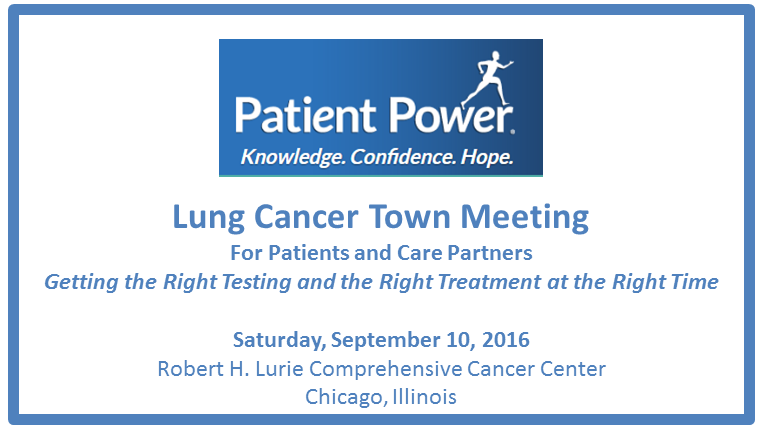
Lung Cancer Town Meeting Sept 10: “Getting the Right Testing and the Right Treatment at the Right Time”

Town Hall graphic
If you or someone you know is a lung cancer patient or caregiver who wants to learn about “Getting the Right Testing and the Right Treatment at the Right Time,” check out this Lung Cancer Town Meeting in Chicago on September 10th (FREE in person or live online). I’ll be hosting several doctors from Northwestern’s Lurie Cancer Center AND my oncologist Dr. Ross Camidge.

AGENDA (Central Time)

9:30 – 10:00 AM Registration | Connecting With Other Lung Cancer Patients and Care Partners
10:00 – 10:45 AM Current and Novel Treatment Options for Lung Cancer
10:45 – 11:30 AM Understanding Biomarker Testing in Lung Cancer
11:30 – 11:45 AM Meet the Patient Panel
11:45 – 12:30 PM Lunch Provided
12:30 – 1:00 PM Resources and Strategies for Living Well With Lung Cancer
1:00 – 2:00 PM Interactive Q&A Session
This in-person town meeting is sponsored by the Patient Empowerment Network through educational grants from Helsinn, Genentech and Novartis, with additional funding from LUNGevity Foundation through an educational grant from Pfizer. It is produced by Patient Power in partnership with the Robert H. Lurie Comprehensive Cancer Center of Northwestern University and LUNGevity.  Thanks to Patient Power for inviting me to host it.
You can register by clicking here.  Hope to see you in Chicago September 10!