A Natural Remedy for Cancer Scanxiety (Almost)

When basking in the wonders of volcanoes, rainforests, and oceans, I can focus on something other than cancer for a while.

When heading to a cancer center for brain and body scans, not so much.

Still, facing the possibility of progression is easier when I’ve been immersed in nature for a few days.  I suspect most cancer patients might benefit from a “nature break” to combat scanxiety before a scan.

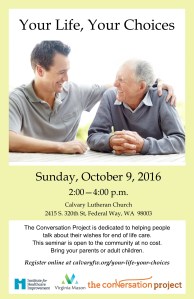
Your Life, Your Choices — A Conversation

your-life-your-choices-poster_10-9-16

If you live in the South Puget Sound area of Washington State, and are interested in starting a conversation with family members about what’s important to you when you think about the end of life (which comes to all of us, though we know not when), please join us on Sunday, October 9, 2016, at Calvary Lutheran Church in Federal Way, Washington, at 2 PM for a free two-hour workshop.  Ann Hagensen, RN, FABC, (Virginia Mason Medical Center) will be presenting materials based in part on The Conversation Project. She will be joined by Karen Freeman Worstell (transformational grief coach and founder of NarrowBridge Solutions), Pastor Lori Cornell (of Calvary Lutheran Church), and myself.

This is a topic of vital interest to me, and not just because I have metastatic cancer.  I have extensive experience exercising durable power of attorney and navigating communications between family members over estate and end-of-life choices. I know friends who had serious accidents or died unexpectedly without having these conversations with their loved ones, and as a result their family members were completely unprepared for the decisions they faced. Because this is so important to me, I serve as an advocate on regional and statewide initiatives to identify and honor patient goals of care and end-of-life wishes.

I hope you’ll join us!

Cancer Choices: Quality of Life versus Quantity

Life has an odd way of reinforcing its lessons.

Due to my own lung cancer journey, I’ve learned a lot about the uncertainties of cancer diagnostic procedures and treatment. I’ve learned that cancer is sneaky; sometimes it doesn’t announce itself until it is in advanced stages, doesn’t behave as expected, doesn’t present a clear diagnosis with a “best” treatment option. And I’ve learned the value of making treatment choices that allow the patient to do what matters most to them, rather than prolonging life at any cost. For many patients, qualify of life is more important than quantity of days.

Recently, life gave me the opportunity to apply my hard-won wisdom to my beloved 14-year-old cat, General Nuisance.

General is a fluffy, snuggly ball of love. He has been MY cat since … Read more

img_1484

Care Partner on Deck

gerry-on-deck

Today hubby Gerry (my care partner) and I had a good start to our morning: we discussed how cancer affects relationships, then reviewed some time-critical household management chores over breakfast. Afterwards, he went out to paint the deck, and I prepared for some medical appointments and errands. Before I left, I poked my nose out the deck door to let him know I was leaving (carefully keeping both cats inside), then closed the door and departed.

After Gerry was through painting the deck, he was greatly surprised to discover his chemo-brained wife had locked the deck door from the inside (as was her routine) while he was outside (which was not routine).

He was alone on a freshly-painted deck at 11 am, ten to fifteen feet off the ground, knowing that I wouldn’t be home for another seven hours.  He tried to get the attention of some workmen two yards away so they could call me, but they couldn’t hear him over their lawnmower.

Ten minutes of staring at the earth motivated his engineering brain to develop a plan that (he hoped) wouldn’t contribute to our medical bills.  I cringed to hear the route my 77-year-old spouse chose to climb down to safety.  I won’t bore you with all the details, but he successfully dealt with the challenge so he could care for me another day.  This evening as the sun was setting, he graciously re-enacted the moment so I could take a picture.

I’m glad this didn’t result in a care partner role reversal.

Happy 50th Anniversary, Star Trek!

Yesterday (September 7, 2016) marked the 50th Anniversary of Star Trek’s first airing. I can’t count the ways in which this show has influenced me.  The biggest conscious influences:

  • encouraged me to pursue a career in science and engineering
  • motivated me to write my own stories
  • helped me to accept that being analytical, making mistakes and expressing emotions are all OK
  • showed people using logic and science to solve difficult problems (yeah, OK, and sometimes emotional convictions, intuition and force–that’s human too)
  • showed me that others also value an upbeat vision of a future based on exploration (concepts as well as new places and people), tolerance, celebrating differences, and the scientific method.

Thanks to Gene Roddenberry and the multitudes of dedicated, creative people who helped bring the world of Star Trek to screens big, small, and flat.

Lung Cancer Update: August 2016

I haven’t blogged much about my cancer status or advocacy activities in 2016.  Not to worry — I’m still dancing with NED (No Evidence of Disease), still taking Xalkori (crizotinib) for my stage IV lung cancer, and still advocating for improved outcomes and quality of life for lung cancer patients.  Life has just been amazingly, overwhelmingly busy up through July, and my blogging became one of the dropped balls in my juggling act.

How busy, you ask?  Here’s a summary of the past nine months. The numbers are estimates, as I had trouble reading the small print I had to use on my calendar to fit everything in.

  • Traveled 54 days for advocacy and writing
  • Traveled 28 days for my clinical trial in Denver (and got snowed in once)
  • Gave 25 formal presentations or informal talks
  • Presented a poster at a medical conference (in AACR Scientist-Survivor Program)
  • Attended 7 medical conferences
  • Attended a 5-day writers’ retreat (wrote a new short story!)
  • Participated in working groups for 3 healthcare agencies (including the National Cancer Institute)
  • Attended 3 science fiction conventions
  • Worked on 2 patient-initiated research projects (ROS1, and biobanking tissue of deceased patients)
  • Consulted for 2 pharmaceutical companies
  • Moderated a joint #LCSM-National Cancer Institute Google Hangout on Air
  • Advocated at the US Capitol for more healthcare funding
  • Captained a team for a lung cancer fundraising walk
  • Co-moderated biweekly #LCSM twitter chats

And on the personal side …

  • Travelled 33 days with family
  • Purged unneeded books, college class notes, household items and cruft from 3 rooms
  • Helped my son find and move into a new apartment (twice)

Sometimes I was barely home long enough to unpack,  pile my collected travel papers on the floor, repack, and perform a couple of necessary household chores before flying out again.  Glad I’ve had a few weeks at home in July and August to decompress and spend time with my family.

While compiling the statistics for this post, I begin to realize why I’ve been so fatigued. I’ve never been particularly good at taking things slow. The above list demonstrates that I must fine tune my advocacy work in order to focus on my top priorities.  I need to say “no” to some opportunities so that I can have more time to process what I’ve learned and write. Juggling four conferences in April left me drained–one conference a month should do.  As my husband has reminded me more than once, I am a cancer patient as well as an advocate.

I’ve been attempting to exercise regularly, give myself enough hours in bed to feel rested, eat healthy, and stay hydrated.  Over the past nine months, my medical team and I have also made some tweaks to my treatment plan.

Less frequent scans. Sometime last year, I became eligible to increase the time between my scans for the clinical trial, but I was too anxious about my cancer possibly coming back to do it.  However, a long talk with fellow lung cancer activist (and 11 year survivor) Linnea Olson at the World Conference on Lung Cancer in September made me realize I was having a LOT of scans over the past years.  I realized reducing my exposure to radiation was probably a good thing.  So, as of November 2015–at three years of NED–I asked Dr. Camidge to schedule my scans for every sixteen weeks instead of every eight weeks (I wasn’t confident enough to go with every 24 weeks).  I’ve also switched from eyes-to-thighs PET-CT scans to chest and abdomen CT scans, primarily because insurance was denying coverage of the PET-CT scans.

Change of blood thinners.  At the beginning of 2016, I realized the frequent labs required to monitor my warfarin dose would be difficult to accommodate with all my upcoming travel. My Denver and Seattle docs all agreed that my pulmonary embolism (remember that pesky blood clot in my lung’s artery?) probably didn’t represent an increased risk of blood clots from cancer, but instead was just a pile of fibrin sheaths that had sloughed off my power port’s catheter (I’m really good at growing fibrin sheaths).  So we switched me to a different blood thinner (Xarelto) that doesn’t require regular blood tests.  The downside of Xarelto is that it doesn’t have an antidote if I happen to overdose.

Crizotinib is approved! Do I stay in the trial? In March 2016, the FDA approved my clinical drug crizotinib for ROS1-positive lung cancer patients–YAHOO!  This meant I had the option of leaving the trial and eliminating my travel to Denver while continuing to stay on the wonderful drug that’s keeping my cancer in check.  I thought long and hard (with the help of a great blog from my friend Dann Wonser). Eventually decided I wanted to keep seeing one of the world’s top lung cancer docs (Ross Camidge) in Denver, despite the cost and hassle of travel. I love being a part of the University of Colorado (CU) lung cancer SPORE, and I’ve grown close to many people at CU. The trial will likely continue for a few more years; the crizotinib trial for ALK-positive lung cancer started in 2008 and is still ongoing. So. I’ll keep traveling to Denver for the foreseeable future–which is much shorter nowadays than when I was 20.

Regaining my balance.  After my three falls in nine months, I had several sessions of physical therapy to strengthen my leg and core muscles. It improved my balance and helped me get back into exercising.  Alas, I fell again at a conference earlier this month.  **grumble** I’ve become a klutz in my old age.  At least I’m around to see what my “old” looks like.

Dose reduction of crizotinib. I’ve struggled with swelling of my legs and belly–edema, a known major side effect of crizotinib–since my second month on the drug. Alas, it’s gotten worse with time.  As of January, I couldn’t bend my ankle at the end of the day if I didn’t wear my thigh-high compression hose and take a diuretic (Lasix).  My weight can go up by eight pounds in two days solely from water retention. I’m told edema is the reason patients most often cite for stopping crizotinib therapy.  Dr. Camidge first offered me a dose reduction of crizotinib last year (from 250 mg twice daily to 200 mg twice daily), but I didn’t want to reduce the dose while I was also increasing time between scans–much too anxiety-making for me.  However, in July 2016 I’d had enough of puffy feet and legs, and decided to try the lower dose. Dr. Camidge says he wouldn’t lose a second of sleep over the dose reduction, because he’s seen the lower dose work for many patients. I think it’s helping me.  I can always increase the dose again in the future if necessary, although I’d have to leave the clinical trial if I did.

I’m de-ported! I’ve kept my power port while on oral meds, although I only use it for blood draws and scan contrast. The docs have always said it’s my choice, so I’ve left it in because it was easier than getting stuck every month (and my veins tend to misbehave).  At my June 2016 clinical trial appointment, however, my power port decided it would cooperate with neither the blood draw nor the scan contrast. I’ve had the little beastie since December 2011, which is a good long run, but I finally decided it was time to pull it out.  The surgeon who installed it was thrilled to be taking it out of a metastatic lung cancer patient more than four years later. So, as of July 21, I am no longer Borg.  Now that I no longer have a catheter in a vein, I probably won’t be forming piles of fibrin sheaths in my pulmonary artery.  My docs say if my next scan in October shows my pulmonary embolism looks good, I may even be able to go off blood thinners. Wahoo!

Coping with chemobrain.  My continuing fatigue and mental fuzziness are a great frustration. Caffeine and exercise help, but don’t eliminate the problem. I finally asked my oncs what could be done, and they both suggested Ritalin, a stimulant commonly used to increase ability to attend for people who have ADHD.  I take 5 mg twice daily on days when I need energy and focus (especially useful at conferences and speaking events).  However, it masks how tired I truly am, and results in something of a crash when I stop taking it.  I’ll be visiting a neuro-oncologist soon to explore other medication options–Dr. Camidge mentioned Provigil (a narcolepsy drug) and Effexor (an antidepressant) as possibilities, and another patient said she found Concerta (long-acting Ritalin) helpful.

So, that’s what happening with me.  I promise to blog a bit more often so I won’t have as much news the next time.

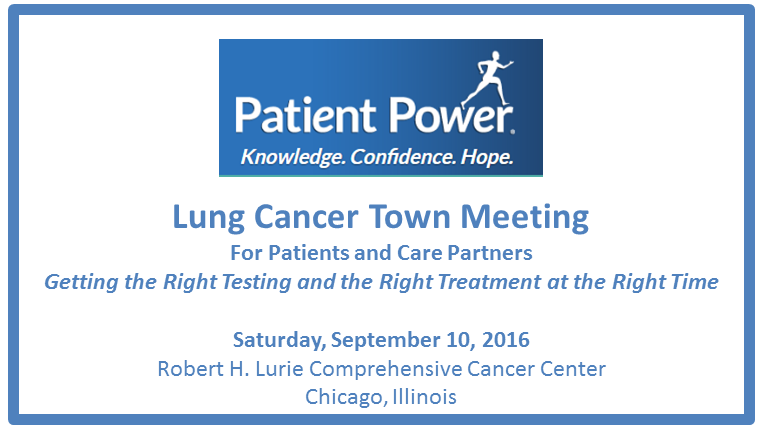
Lung Cancer Town Meeting Sept 10: “Getting the Right Testing and the Right Treatment at the Right Time”

Town Hall graphic
If you or someone you know is a lung cancer patient or caregiver who wants to learn about “Getting the Right Testing and the Right Treatment at the Right Time,” check out this Lung Cancer Town Meeting in Chicago on September 10th (FREE in person or live online). I’ll be hosting several doctors from Northwestern’s Lurie Cancer Center AND my oncologist Dr. Ross Camidge.

AGENDA (Central Time)

9:30 – 10:00 AM Registration | Connecting With Other Lung Cancer Patients and Care Partners
10:00 – 10:45 AM Current and Novel Treatment Options for Lung Cancer
10:45 – 11:30 AM Understanding Biomarker Testing in Lung Cancer
11:30 – 11:45 AM Meet the Patient Panel
11:45 – 12:30 PM Lunch Provided
12:30 – 1:00 PM Resources and Strategies for Living Well With Lung Cancer
1:00 – 2:00 PM Interactive Q&A Session
This in-person town meeting is sponsored by the Patient Empowerment Network through educational grants from Helsinn, Genentech and Novartis, with additional funding from LUNGevity Foundation through an educational grant from Pfizer. It is produced by Patient Power in partnership with the Robert H. Lurie Comprehensive Cancer Center of Northwestern University and LUNGevity.  Thanks to Patient Power for inviting me to host it.
You can register by clicking here.  Hope to see you in Chicago September 10!

My 2016 WorldCon Schedule


Below is my MidAmeriCon II speaking schedule: a couple of cancer panels, a couple of space panels, and a reading (yes, something new). Come find me at the Kansas City Convention Center August 17-21 and say hello!

Living with Cancer
Wednesday 8/17/2016 14:00-15:00, 2206 (Kansas City Convention Center)
$£%* Cancer. Our panel talks about the experience of cancer, how it affected their writing and lives, and how we can support the fan community.
Janet Freeman-Daily, Rosemary Kirstein, Ms Pat Cadigan (M), Priscilla Olson

Reading: Janet Freeman-Daily
Thursday 8/18/2016 16:30-17:00, 2202 (Readings) (Kansas City Convention Center)
Janet Freeman-Daily

Defining Acceptable Risks in Space Exploration
Friday 8/19/2016 11:00-12:00, 2502B (Kansas City Convention Center)
The further we move into deep space exploration the more we have to ask, to what extent it can be risk-free, or at least risks limited. We consider the risks, what can be done to guard against them, and how much risk do humans need to accept — at least in the early stages.
H.G. Stratmann (M), Henry Spencer, Jerry Pournelle, Janet Freeman-Daily, Frank Wu

Space Technology Spinoffs
Saturday 8/20/2016 16:00-17:00, 2210 (Kansas City Convention Center)
There have been some 2,000 technological products, inventions and ideas trasferred from NASA missions to commercial products and services. Of these, many have made life on Earth better in the fields of health and medicine, transportation, public safety, consumer goods, energy and environment, information technology, and industrial productivity. Panelists discuss their favorite examples of space technology spinoffs.
Mrs. Laurel Anne Hill, Les Johnson, Janet Freeman-Daily (M), Joy Ward, Brenda Cooper

Cancer Treatment
Sunday 8/20/2016 10:00-11:00, 3501H (Kansas City Convention Center)
In the last year fandom has lost many good people to cancer – both fans and creators. Many members of our community are currently being treated or are in remission and more people get diagnosed everyday. Our experts have an informal discussion about how cancer is currently treated and what it will look like in the future.
Janet Freeman-Daily, Dr. Ronald Taylor

You can also visit my official schedule page on the MidAmeriCon II website.

Register for the GRACE 2016 Targeted Therapies in Lung Cancer Patient Forum

GRACE EGFR ALK ROS1 Acquired Resistance Forum Faculty 2016-08-20

If you’re a patient or caregiver dealing with EGFR-, ALK-, or ROS1-positive lung cancer, please consider attending the GRACE forum in Denver this August. You’ll learn tons about the latest treatment options and trials, diagnostic tests, and tips for living with cancer as a chronic illness from experts like Dr Ross Camidge (my research oncologist at University of Colorado who started their remote consult program) and Dr Dara Aisner (co-director of CU’s molecular pathology lab that does the tissue testing). Patients Linnea Olson , Tori Tomalia, and Bob Fuerst are on the program, too! If I didn’t have vacation plans with my son, I’d be there for sure.

You can register here: http://cancergrace.org/targeted-therapies-in-lung-cancer-patient-forum-2016-denver-co

#LCSM Chat Topic 6/30: #Cancer Hashtag Communities Talk Moonshot Ideas (Round 2) #cancerchat

As mentioned in a previous blog post (Celebrating Cancer Hashtag Communities and a Moonshot), the online cancer hashtag communities will be discussing ideas for the Cancer Moonshot this week.  The 6/30 #LCSM Chat at 8 PM Eastern will be the second of two chats discussing Moonshot  working group topics for improving cancer research and outcomes.  The 6/27 #BCSM Chat will discuss ideas for three of the seven working groups:  Expanding Clinical Trials, Enhanced Data Sharing, and Precision Prevention and Early Detection.

The 6/30 #LCSM Chat at 8 PM Eastern Time (which occurs the day after the Cancer Moonshot Summits on 6/29) will be a cross-cancer chat about the remaining four Cancer Moonshot Working Group topics:

  • Cancer Immunology and Prevention
  • Tumor Evolution and Progression
  • Implementation Sciences
  • Pediatric Cancer

Participants will use two hashtags for the chat: #LCSM and #cancerchat. Ideas generated during the chat will be submitted online to the Cancer Moonshot.

Our topic questions for this chat:

  • T1: How might we accelerate/improve research into immunotherapy for treatment and prevention of cancer?
  • T2: How might we improve dissemination of info about new approaches for cancer prevention, screening, tx, survivorship?
  • T3: How might we accelerate/improve research into ways that cancer spreads to other parts of the body?
  • T4: How might we accelerate/improve research into drivers and less toxic treatments of pediatric cancers?

We hope you’ll join #LCSM Chat on Thursday June 30 at 8 PM EDT. If you’re new to tweetchats, please read this primer on how to participate in #LCSM Chats.


More detail on the Cancer Moonshot working group topics (from the NCI webpage):

Cancer Immunology and Prevention Working Group
In the past few years, the rapidly advancing field of cancer immunology has produced several new methods of treating cancer, called immunotherapies, that increase the strength of a patient’s immune responses against tumors. Such treatments have led to dramatic successes in some cancers but not others. At the same time, the concept of adjusting the immune response, or immunomodulation, is being extended into cancer prevention, with the goal of developing strategies to spur the immune system to both prevent the development of cancer in the first place and prevent recurrence.

Implementation Sciences Working Group
Studying the impact of cancer on large populations can provide important information that influences practices, policies, and programs that directly affect the health of millions of people each year. To improve cancer outcomes, it is essential to identify and test methods for more effectively disseminating information about new approaches for cancer prevention, risk assessment, screening, prognosis, treatment, and survivorship. Interventions must fit within real-world public health and clinical settings and be accessible and understandable to practitioners and the public.

Tumor Evolution and Progression Working Group
Cancer genomics has yielded a greater understanding of the mutations that occur within cancer cells and their roles in tumor initiation and progression. Concurrent with an increased understanding of cancer genomics, a greater appreciation has developed for the enormous heterogeneity of cancer cells that evolve within a tumor, the metabolic changes in both the cancer cell and immune cells in the microenvironment, and the roles of the non-cancer cellular and molecular components of the tumor microenvironment that both support and suppress tumor progression.

Pediatric Cancer Working Group
Children are not just small adults; their cancers are different in many ways from those in older individuals. Improving childhood cancer outcomes requires both a better mechanistic understanding of cancer in general as well as an understanding of cancer in children specifically. Important issues to address include the molecular drivers of childhood cancer, which are often different from those of adult cancers; the causes of childhood cancer; and the development of therapies that are less toxic to children’s developing bodies.