Speaking at 2014 Stanford Medicine X

I’m looking forward to attending the 2014 Stanford Medicine X Conference (#MedX on Twitter) as an ePatient Delegate September 5-7 on the campus of Stanford University.  The conference, now in its third year, is the leading patient-centered conference on emerging technology and medicine.

This conference will give me an opportunity to meet and interact with other epatients (engaged and empowered patients who participate in their medical care) as well as innovators who are providing the technologies that enable epatients to learn about their health conditions, track their health status, and share their experiences with others.  I hope this will teach me more about how to use social media to provide lung cancer patients with hope and useful information, raise awareness of our disease, and contribute to research and clinical trials.

I will be speaking on the MedX mainstage about “Making Lung Cancer Visible” on Sunday, September 7.  My speech will be in the Ignite format (5 minutes, 20 slides that automatically advance every 15 seconds), which will be a challenge for my chemobrain!  According to the 2014 MedX schedule,  my talk will be the second in a group of epatient talks that start at 10 AM Pacific Time Sunday 9/7; my talk should start around 10:10 AM.

If you’d like to watch my talk live, please sign up IN ADVANCE (FREE!) for the Stanford Medicine X Global Access Program.  This will allow you to watch all MedX events via livestreaming on the Internet.  If you’re unable to watch it live, my talk will eventually be made available on the MedX YouTube channel — I’ll post the link here when it becomes available.

Edit Sep 17, 2014:
Stanford Medicine X talk posted my talk on YouTube — see it here.

Finding My Voice

Tonight (July 31) at 7 PM Pacific Time I will be the first of six speakers sharing our cancer journeys at “Community Voices: Stories of Survival“. My talk titled “Finding My Voice” will tell the story of why and how I became a lung cancer patient advocate. The event will stream live on the Internet tonight, and will be available later as a podcast and video. Thanks to The Story Collider and the online community Smart Patients (who teamed to create this show in San Carlos, California) for inviting me to participate!

Stuart Scott Knows How to Beat Cancer

This year’s ESPY awards honored ESPN anchor Stuart Scott with the Jimmy V Perseverance Award for his ongoing battle with cancer. The intro by Kiefer Sutherland and tribute video are inspiring, but my favorite part is this line in Scott’s acceptance speech:

“When you die, it does not mean that you lose to cancer. You beat cancer by how you live, why you live and the manner in which you live.”

He gets it. And he lives it.

20140729-081017-29417567.jpg

Beyond First Base

Yesterday I played softball.

Nothing formal — a group of friends played a leisurely, good-natured game on a seriously foreshortened backyard diamond after a meeting. It was practice for my 40th high school reunion in August, when 42 of us who grew up together are going to play softball in Tacoma’s Cheney Stadium–home of the Tacoma Rainiers (the Seattle Mariners’ AAA team).

This may not seem like a big deal to you. People play casual softball at family gatherings and summer picnics all the time. So what?

Well, it’s a milestone for me. You see, my body is different now. Yes, I’m two decades older and considerably softer than the last time I hefted a bat. But the real difference is not immediately visible: cancer treatment changed how my body performs.

I was a tomboy, relatively athletic for a girl growing up in the 60s. I could run and jump and throw, and I was pretty fast. As a kid I played sandlot ball with the boys because I “didn’t throw like a girl.” I played softball most every summer after I turned ten. I played the available intramural school sports and lettered in track in the first year it was open to girls. In college, I continued playing intramural sports and spent a year on the women’s club softball team. After graduation, I joined a Masters swim team and hiked with The Mountaineers. Later I ran 5Ks, rode my bike for miles, and played adult slow pitch for several years. I wasn’t truly a “jock,” but I knew how to move.  As I aged, I moved less, and would occasionally allow myself to get sedentary and out of shape, but in a bout of remorse I would get myself back into shape again. I was fit and healthy when I got diagnosed with lung cancer in 2011.

Now? Chemotherapy left me with peripheral neuropathy that occasionally interferes with walking and balance—my feet can’t sense the ground reliably. Radiation to my chest caused scarring and volume reduction in my lungs, so my oxygen level drops when I walk at a modest pace. Radiation to my right collarbone area hit a main nerve bundle, which causes some weakness in my right arm and a risk of damage if I lift too much weight with it. A year of steroids packed on the fat while decreasing my muscle tone. My current targeted therapy causes edema in my legs and hands that affects their movement and comfort. Some combination of side effects keeps my red blood cell count just below normal, which saps my stamina and ability to move quickly. I do exercise regularly on the treadmill and elliptical, but I can’t yet get the pace anywhere close to a brisk walk for more than 30 seconds without breathing fast and hard.

I’m not complaining, mind you–I’m happy to be alive and have a relatively normal life on my current targeted therapy. But I must face reality: the body I have now is not the same one I had Before Cancer.

That’s why that low-key softball game was such a revelation for me. The moment I put the glove on my left hand, my body recalled those days on the softball diamond. After some initial fumbles, I caught the ball easily when it was thrown to me. After a few gentle tosses, I could throw the ball to another and actually hit their glove. After couple of wimpy at-bats, I connected with the ball. And when I ran to first base, I moved faster than a walk. I’m not exactly sure what to call that gait (it wasn’t running, it wasn’t jogging, and it certainly wasn’t graceful), but I got to first base before the ball did, probably due to the good graces of the fielders—thanks, guys, I love you.  For about twenty minutes, I was a softball player again.

When the next batter hit the ball, I just barely made it to second base, but I was safe. I stood tall with both feet on the bag, reveling in my accomplishment as I gasped for air. And it occurred to me that maybe, just maybe, regular training could get me to second base in August without breathing quite so hard. I had been thinking I would only pitch during the game and let others do the batting and running. But maybe I COULD bat, and “run” too–especially since the game rules allow players up to five minutes to get to first base (note to future reunion attendees: Reunion Committee members get to write the rules).

After crossing home plate, I excused myself from the game and sat down to catch my breath. My friends played on. I resolved that I would be on that field in Cheney Stadium as long as my breath and body held out.

I WILL get beyond first base in August. I know there’s no stealing in softball, but to steal a James Bond phrase: there’s no point in living if you can’t feel alive.

20140721-224516-81916172.jpgSee? I DID make it to second base! (Credit: Sandi Allen Estep)

Meeting the Chemist

This post originally appeared July 15, 2014, in ASCO’s cancer.net blog. Reposted with permission.
—————————

My first ASCO Annual Meeting was an educational and exhilarating experience. As a science geek, I loved learning about new cancer treatments from leading researchers. But the highlight for me happened in a noisy back corner of a crowded poster session when I met Dr. J. Jean Cui, the chemist who is saving my life.

A little backstory: I was diagnosed in May 2011 with stage IIIa non-small cell lung cancer (NSCLC). After two series of chemo, two radiation protocols, two recurrences, and promotion to stage IV, I was told I’d be on chemo for the rest of my life. Thanks to “CraiginPA,” who I met in an online support group, I learned about a tumor mutation called ROS1 and arranged to have my tumor tested. I’m now enrolled in the same ROS1 clinical trial as CraiginPA, taking a pill called crizotinib (Xalkori) to suppress my lung cancer. I’ve had no evidence of disease (NED) status since January 2013. I know my cancer will likely return, but for now, life is almost normal.

CraiginPA and I both attended the 2014 ASCO Annual Meeting as patient advocates. We met “in real life” in Chicago the day before the meeting began and attended many sessions together. On the third day, June 1, we went to a lung cancer poster highlights session. Similar to a high-powered science fair, the session featured 25 large posters explaining ongoing studies, each with a researcher standing by to answer questions. One poster described a study of our drug crizotinib for ROS1 in Europe.

While we were tag-teaming the researcher with questions, we noticed two representatives of the pharmaceutical company who makes crizotinib standing nearby. We introduced ourselves and moved to a table to discuss when our trial drug might obtain FDA approval for ROS1.

After several minutes, one of the reps smiled and said, “Jean is here.”

CraiginPA’s face lit up. “She’s the chemist—the lead inventor who developed our drug!”

My geek meter pegged at ecstatic. The chemist who invented the drug that was keeping me alive was HERE!

“If I see Jean, I’ll tell her you’re looking for her,” one of the reps said. They excused themselves to talk to another researcher.

A bit giddy, CraiginPA and I went back to digesting the ROS1 poster. We had started debating where the drug actually bonded with the ROS1 protein on our tumor cells when a smiling young woman approached us.

CraiginPA recognized her instantly. “Jean! So good to see you again.”

I felt like I did when I’d been introduced to idols like Nobel Laureate Physicist Richard Feynman or MD/PhD/Astronaut Story Musgrave. This was not some academic stuck at a bench with glassware and data analysis. This cancer rock star was a real person, and she seemed just as happy to meet us as we were to meet her. How often does a researcher get to see the living, breathing proof that her work saves lives?

We hugged all around and coerced someone into taking a picture with Jean’s smartphone. I couldn’t have grinned any wider.

For the next 20 minutes, Jean fielded our questions about her background, why she chose chemistry as a career, and how her team designed the drug. CraiginPA and I were like two kids getting a peek behind the Wizard’s curtain at the magic of cancer research. We agreed this experience was easily our highlight of the meeting, especially for me since I experienced it with CraiginPA who first told me about this drug.

Later Jean emailed us the picture, along with an invitation to ask her any further questions we might have—a perfect end to an amazing day.

So stop me if you’ve heard this one: a patient advocate, a pharma rep, and a chemist walk into a poster session…

20140715-110726-40046427.jpg

New Take on an Old Excuse

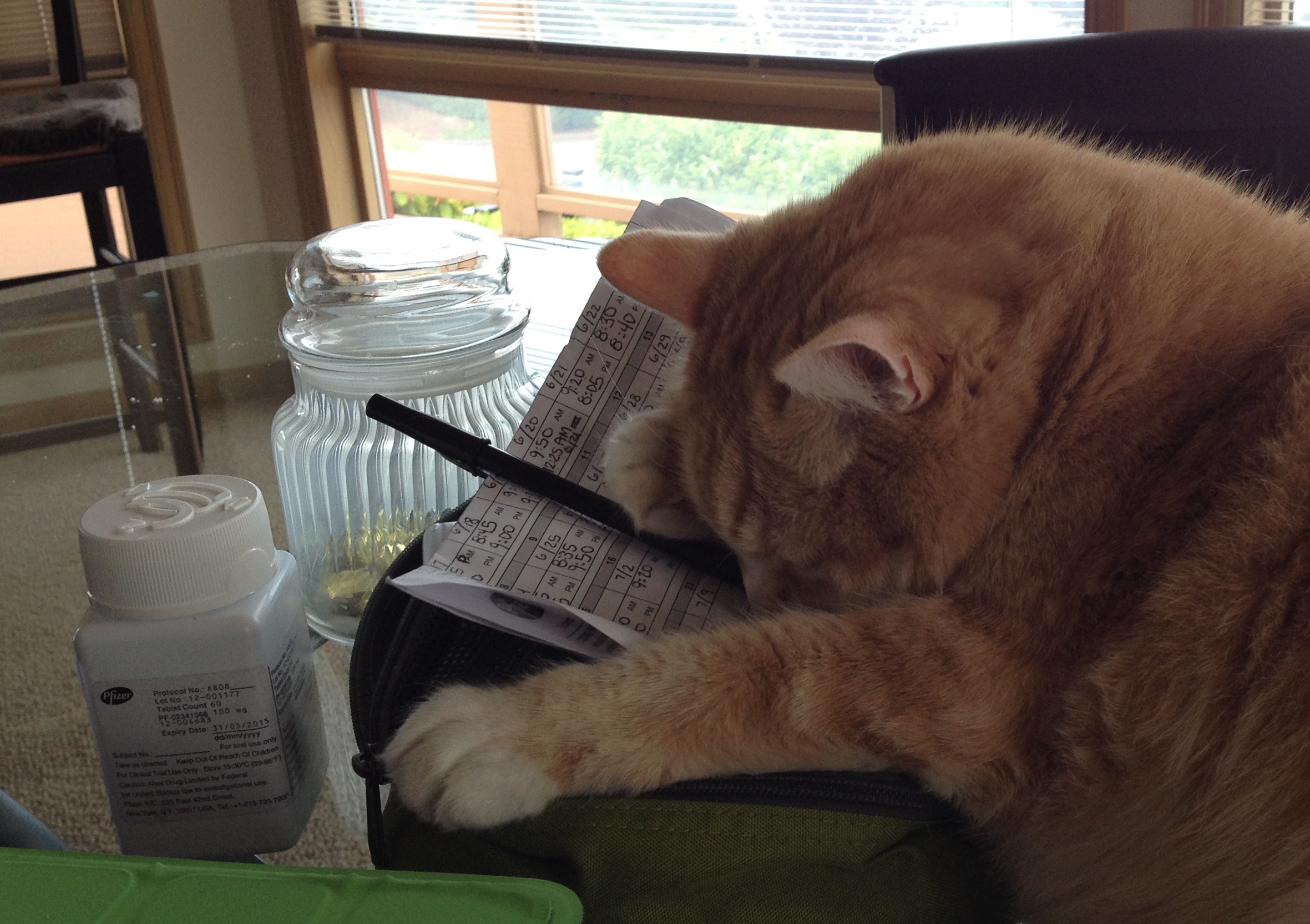
Like many housecats I’ve met, my cats have quirks. Admiral Dufus demolishes cardboard boxes and chews paper, while General Nusiance licks plastic bags.  I don’t know why they do this.  Perhaps they lack certain minerals. Perhaps their tongues like the taste or texture. Perhaps they’re studying how humans react to the behavior of feline companions.

While Admiral’s tendency to shred papers has caused some inconvenience, General’s fondness for licking things has not been an issue.  Until now.

I never told a teacher “the dog ate my homework,” but as of this morning I have to explain to my cancer clinical trial that my log of dosing times for my trial drug may be hard to read because …

 “My cat licked my journal.”

The Downside of Seattle Summer

Summer in northerly US latitudes like Seattle means the sun is up almost 16 hours around the Solstice (June 21-ish). The days are long and usually sunny for a few months.  Our local mountains–especially the volcanoes–are spectacular this time of year.

Mt Rainier greets July (credit: Elizabeth Bourne)

Mt Rainier greets July (credit: Elizabeth Bourne)

The upside of this season for people who have Seasonal Affective Disorder (like me): lots of sunlight to elevate my mood and energy. I’m like the Energizer Bunny on many summer days.  This is a good thing, considering I have a lot of looming deadlines for writing and speaking projects.

The downside: lots of sunlight to keep me awake.  Last night I couldn’t get to sleep before midnight, which is only a couple of hours after dark.  Today the sun rose at 5:15 AM, and I wasn’t far behind it, even though I’d prefer to sleep until 8:00 AM. I honestly do need more than six hours of sleep at night, especially on cancer drugs. Can’t wear an eye mask over my CPAP, and blackout curtains don’t make much sense here when it’s gray so much of the year.  I want to stay sharp, yet caffeine–available on nearly every urban block in Western Washington–is a double-edge sword.

So, I get up and tackle my projects every morning with gusto and grogginess, and hope to collapse for a nap in the afternoons.  Except it’s SUNNY outside, and our yard has fresh raspberries (my favorite!),  and the words in my head are fighting to be born, and look at the MOUNTAINS, and … and …

Apparently I suck at collapsing on cue.

Speaking as a Patient at MedX

Just realized I have a Speaker Profile Page for the 2014 Stanford Medicine X conference. This is really going to happen! Only 69 days to go–I better start writing my speech. And maybe get a professional headshot.

Edited 7/2/2020 to add screen caps of MedX profile:

#JACR Chat 6/26: Patient Perspective on Lung Cancer Screening (#LCSM cohosts)

(This is a reblog of today’s blog on the #LCSM website)

On Thursday June 26, at 12 noon Eastern Time, the Journal of the American College of Radiology (#JACR) tweetchat will discuss the patient’s perspective of lung cancer screening.  It will be hosted jointly by #JACR and #LCSM, using the hashtag #JACR, and will be moderated by Dr. Ruth Carlos (@ruthcarlosmd) of #JACR with guest moderators Ella Kazerooni, MD, and Janet Freeman-Daily (@JFreemanDaily) of #LCSM.  #JACR posted about the chat and provided the following information:

—————————————————

“Ruthie, your dad fell down and now he has cancer.”

My dad had tripped down a short flight of steps to the basement.  In Urgent Care, he received a chest X-ray for shoulder pain, inadvertently detecting his lung cancer.  I was grateful that he accidentally fell, grateful that he received a chest X-ray rather than shoulder X-rays, grateful that I still have my dad, a 70 year old man who smoked two packs a day since he was 18.

The survival rate for early stage lung cancer is nearly 50%.  The survival rate for late stage disease is less than 5%.  The U.S. Preventive Services Taskforce (USPSTF) recommends a more systematic way to screen individuals like my dad:  use low dose computed tomography, also known as low dose CT or LDCT, to find early stage lung cancer.  The National Lung Screening Trial  enrolled more than 53,000 participants in a study. It showed lung cancer screening with LDCT resulted in 20% fewer deaths from lung cancer compared to screening by chest x-ray.  On the strength of these findings, the USPSTF showed strong support and issued a “Grade B recommendation” for lung cancer screening with LDCT, requiring private insurance plans to completely cover this service.  Medicare administrators now are weighing the decision to cover lung cancer screening, balancing the benefits with the unintended harms.

Some of the harms associated with lung cancer screening include “false-positives”—detected nodules or tumors that are actually not cancer.  Low dose CT can also detect abnormalities outside the lungs, such as thyroid nodules or heart problems.  These are called “incidental findings” or “incidentalomas,” most of which are benign.  However, because a small percent of incidentalomas turn out to be potentially harmful, additional diagnostic testing may be required. These additional procedures can lead to increased cost to the patient, even if the screening test is free.  Both false positives and incidentalomas can potentially increase patient anxiety, test-associated radiation, and out-of-pocket costs.

Understanding patient concerns about lung cancer screening is essential to fully implementing this life-saving medical service of LDCT.  Patient-Centered Outcomes Research, or PCOR, focuses on addressing patient questions such as “What can I do to improve the outcomes that are important to me?” and “How can clinicians and the care delivery systems they work in help me make the best decisions about my health?” Per a USPSTF recommendation, the ECOG-ACRIN cancer research group proposes to develop a registry of participants who receive lung cancer screening in order to understand the full patient experience, including what outcomes, benefits and harms are most meaningful to patients, how to consistently communicate these benefits and harms, and how to support patient choice regarding screening. ECOG-ACRIN is one of the National Cancer Trials Network groups launched this year by the National Cancer Institutes. It is implementing PCOR principles in the development phase of the registry to incorporate patient voices and perspectives.

Here are the four questions that will be discussed during the Tweet Chat:

T1: What clinical, psychological and cost outcomes are most important to patients who receive lung cancer screening?  #JACR

T2: Some lung nodules detected by lung cancer screening are “false positives” (not cancer).  What effect would this have on you? #JACR

T3: Lung screening might detect other conditions (e.g., thyroid and heart) needing more tests. What concerns you about this? #JACR

 T4: What aspects of lung screening benefits and harms are difficult to understand? How might understanding be improved? #JACR

If you would like to be considered for a patient advisory panel about lung cancer screening or want to tell us about your experience, email us at lungscreeningregistry@gmail.com.

Moderators for This Chat

@ruthcarlosmd (Ruth Carlos, MD), Deputy Editor for JACR and Co -Chair of the ECOG-ACRIN Patient Centered Outcomes and Survivorship Committee. 

@JFreemanDaily (Janet Freeman-Daily) , cofounder and comoderator for Lung Cancer Social Media #LCSM Chat on Twitter.

Special guest: Ella Kazerooni, MD, Cardiothoracic Division Director and Professor of Radiology at the University of Michigan, is the Vice Chair of the National Comprehensive Cancer Network (NCCN) lung-cancer screening panel.  She recently testified before the Medicare Evidence Development & Coverage Advisory Committee on the value of lung cancer screening and the need for Medicare coverage of LDCT.

Any port in a scan

I’ve had a Bard power port in my upper left chest almost 30 months, since December 2011.  This consists of a small titanium reservoir with a layer of silicone under my skin, connected to a catheter than runs into a vein near my heart.  I originally had it implanted so chemo could be administered through the port, sparing my veins.  While I don’t need it right now to receive treatment–I take my targeted therapy as a pill–the port is accessed every month for my clinical trial blood draws, and every other month to administer contrast and the FDG tracer for my PET-CT scans.

Ports are really convenient.  I don’t have to get poked every month, I can shower and exercise with it (unlike my former PICC line), and after so many months, the scar from the implant surgery isn’t even noticeable.  All that’s visible are three tiny bumps on a slightly raised, faintly bluish area under the skin. The only accommodation it requires is a small pad between it and my seatbelt when driving.  I’ve heard of people keeping a port for several years.

Here’s the hitch.  My port has misbehaved fairly often since it was implanted. I am apparently very good at growing a fibrin sheath over my port’s catheter. When a sufficiently long fibrin sheath , similar to the stuff in blood clots, forms over the catheter, it’s impossible to draw blood–the suction from the blood draw pulls the loose flap of the sheath over the tip of the catheter and closes it off.  The problem seems to be worse if I’m dehydrated.

To keep the port accessible, it gets flushed with drano on average every 1.5 months. No, not Drano the household chemical.  Drano is my not-so-affectionate name for TPA (sometimes called Cathflo), a chemical which dissolves the fibrin sheath and clears the catheter. Typically, a small amount of TPA (just enough to fill the catheter but not go into the bloodstream) is injected and left in the catheter for about 30 minutes, then withdrawn.  Usually this clears the port, although sometimes I’ve had the stuff left in overnight to clear a particularly persistent blockage–one interventional radiology xray showed I had a sheath about two inches long at the tip of my catheter. Well, everybody needs a skillset.

The fibrin sheath also sucks up the FDG tracer used for PET scans, so I often have a very bright spot on my scan right at the tip of my catheter.  The radiologist can see the catheter in the associated CT scan, so he knows that hot spot is just the fibrin sheath, but sometimes I wonder if that spot could overshadow a tiny cancer nearby.

I’ve considered having the port removed surgically and just tolereating the monthly needle pokes for my labs and scans, but to be honest, my veins aren’t very cooperative nowadays either. I’m going to keep the port in as long as the drano can keep it functional.  I just plan to drink a few quarts of water the day before it’s used so I’m well hydrated, and show up early for lab work in case my port needs a dose of drano.

My monthly labs today required more than the usual amount of blood. However, my port worked perfectly! I felt like celebrating, so I ordered a grande soy mocha at the clinic’s coffee stand.

I forgot to say “half-decaf.”

I expect to get an amazing amount of work done this morning and early afternoon. Just don’t expect much from me after 3 PM.