Why I’m Behind on My Patient Advocacy Projects

Today is a relatively typical day.  I’ve been up for 2.5 hours.  I haven’t tackled any major projects yet. Why?

6:50–7:20 AM
Wake up a few minutes before the alarm, take anti-reflux pill, check email, get up, step on scale, be bummed (again) about my post-cancer-treatment weight gain, resolve to spend at least 30 minutes on the treadmill this afternoon, brush cats

7:20-8:20 AM
Get dressed, help with family breakfast, help son get ready for school, help hubby with shopping list, eat breakfast (had to wait an hour after taking anti-reflux pill), log food intake in LoseIt! (only 360 calories for breakfast–yay!), take cancer pills, check Twitter, pet cats

8:20-8:45 AM
Load dishwasher, have several writing ideas flood into my head while washing big pots, clean up mess I made on the counter while distracted by writing ideas, realize my chemobrain has forgotten all writing ideas, play with cats

8:45-9:20 AM
Check Facebook while drinking milk/coffee, look at pile of urgent family paperwork, decide I should start on a lung cancer advocacy article, go see what cat is playing with, write blog post instead (with feline oversight)

But the day is young, the cats are now napping, and coffee is kicking in.  I still have hope I shall actually accomplish something today.

Oh, look, the hummingbird feeder is empty …


Finding My Voice

Tonight (July 31) at 7 PM Pacific Time I will be the first of six speakers sharing our cancer journeys at “Community Voices: Stories of Survival“. My talk titled “Finding My Voice” will tell the story of why and how I became a lung cancer patient advocate. The event will stream live on the Internet tonight, and will be available later as a podcast and video. Thanks to The Story Collider and the online community Smart Patients (who teamed to create this show in San Carlos, California) for inviting me to participate!

Meeting the Chemist

This post originally appeared July 15, 2014, in ASCO’s cancer.net blog. Reposted with permission.
—————————

My first ASCO Annual Meeting was an educational and exhilarating experience. As a science geek, I loved learning about new cancer treatments from leading researchers. But the highlight for me happened in a noisy back corner of a crowded poster session when I met Dr. J. Jean Cui, the chemist who is saving my life.

A little backstory: I was diagnosed in May 2011 with stage IIIa non-small cell lung cancer (NSCLC). After two series of chemo, two radiation protocols, two recurrences, and promotion to stage IV, I was told I’d be on chemo for the rest of my life. Thanks to “CraiginPA,” who I met in an online support group, I learned about a tumor mutation called ROS1 and arranged to have my tumor tested. I’m now enrolled in the same ROS1 clinical trial as CraiginPA, taking a pill called crizotinib (Xalkori) to suppress my lung cancer. I’ve had no evidence of disease (NED) status since January 2013. I know my cancer will likely return, but for now, life is almost normal.

CraiginPA and I both attended the 2014 ASCO Annual Meeting as patient advocates. We met “in real life” in Chicago the day before the meeting began and attended many sessions together. On the third day, June 1, we went to a lung cancer poster highlights session. Similar to a high-powered science fair, the session featured 25 large posters explaining ongoing studies, each with a researcher standing by to answer questions. One poster described a study of our drug crizotinib for ROS1 in Europe.

While we were tag-teaming the researcher with questions, we noticed two representatives of the pharmaceutical company who makes crizotinib standing nearby. We introduced ourselves and moved to a table to discuss when our trial drug might obtain FDA approval for ROS1.

After several minutes, one of the reps smiled and said, “Jean is here.”

CraiginPA’s face lit up. “She’s the chemist—the lead inventor who developed our drug!”

My geek meter pegged at ecstatic. The chemist who invented the drug that was keeping me alive was HERE!

“If I see Jean, I’ll tell her you’re looking for her,” one of the reps said. They excused themselves to talk to another researcher.

A bit giddy, CraiginPA and I went back to digesting the ROS1 poster. We had started debating where the drug actually bonded with the ROS1 protein on our tumor cells when a smiling young woman approached us.

CraiginPA recognized her instantly. “Jean! So good to see you again.”

I felt like I did when I’d been introduced to idols like Nobel Laureate Physicist Richard Feynman or MD/PhD/Astronaut Story Musgrave. This was not some academic stuck at a bench with glassware and data analysis. This cancer rock star was a real person, and she seemed just as happy to meet us as we were to meet her. How often does a researcher get to see the living, breathing proof that her work saves lives?

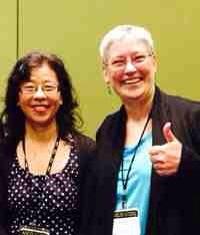
We hugged all around and coerced someone into taking a picture with Jean’s smartphone. I couldn’t have grinned any wider.

For the next 20 minutes, Jean fielded our questions about her background, why she chose chemistry as a career, and how her team designed the drug. CraiginPA and I were like two kids getting a peek behind the Wizard’s curtain at the magic of cancer research. We agreed this experience was easily our highlight of the meeting, especially for me since I experienced it with CraiginPA who first told me about this drug.

Later Jean emailed us the picture, along with an invitation to ask her any further questions we might have—a perfect end to an amazing day.

So stop me if you’ve heard this one: a patient advocate, a pharma rep, and a chemist walk into a poster session…
20140715-110726-40046427.jpg

The Downside of Seattle Summer

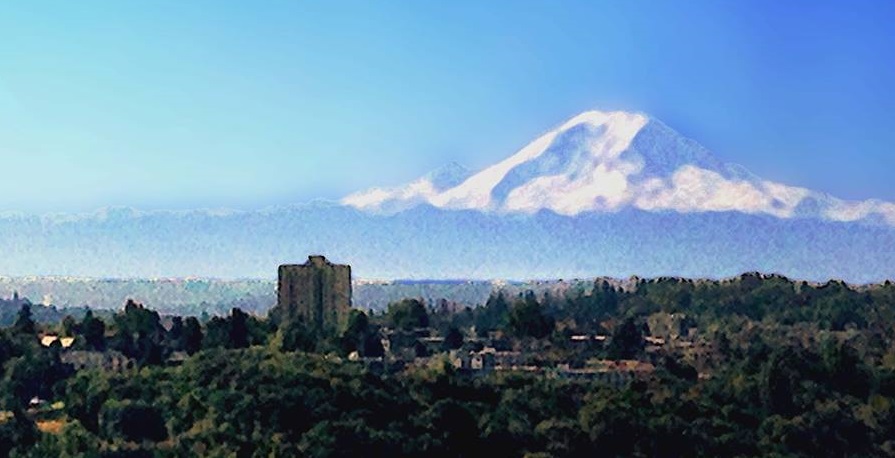
Summer in northerly US latitudes like Seattle means the sun is up almost 16 hours around the Solstice (June 21-ish). The days are long and usually sunny for a few months.  Our local mountains–especially the volcanoes–are spectacular this time of year.

Mt Rainier greets July (credit: Elizabeth Bourne)

Mt Rainier greets July (credit: Elizabeth Bourne)

The upside of this season for people who have Seasonal Affective Disorder (like me): lots of sunlight to elevate my mood and energy. I’m like the Energizer Bunny on many summer days.  This is a good thing, considering I have a lot of looming deadlines for writing and speaking projects.

The downside: lots of sunlight to keep me awake.  Last night I couldn’t get to sleep before midnight, which is only a couple of hours after dark.  Today the sun rose at 5:15 AM, and I wasn’t far behind it, even though I’d prefer to sleep until 8:00 AM. I honestly do need more than six hours of sleep at night, especially on cancer drugs. Can’t wear an eye mask over my CPAP, and blackout curtains don’t make much sense here when it’s gray so much of the year.  I want to stay sharp, yet caffeine–available on nearly every urban block in Western Washington–is a double-edge sword.

So, I get up and tackle my projects every morning with gusto and grogginess, and hope to collapse for a nap in the afternoons.  Except it’s SUNNY outside, and our yard has fresh raspberries (my favorite!),  and the words in my head are fighting to be born, and look at the MOUNTAINS, and … and …

Apparently I suck at collapsing on cue.

Speaking as a Patient at MedX

Just realized I have a Speaker Profile Page for the 2014 Stanford Medicine X conference. This is really going to happen! Only 69 days to go–I better start writing my speech. And maybe get a professional headshot.

Edited 7/2/2020 to add screen caps of MedX profile:

The Power of Lung Cancer Social Media (#LCSM)

Today the Seattle Times published a guest op-ed piece co-authored by myself and Renée Klein, the President and CEO of the American Lung Association (ALA) of the Mountain Pacific.  You can read it here: Medicare should cover low-dose CT screening for lung cancer.

While I hope you’ll read it, that’s not why I’m blogging today.  I’m blogging because I want you to know something.

This op-ed piece was made possible by the power of Lung Cancer Social Media (#LCSM).

When I proposed co-authoring this piece to Renée, she enthusiastically agreed. However, we only had two days and 650 words in which to write it.  I knew the piece required a lot of facts to support the opinion, but which facts about lung cancer screening with low dose CT would have the most impact? Which facts were the most current?  How should we structure the facts to make our point within word count? And where on the web were the sources? The Seattle Times required links to sources before they would accept the piece.

The Lung Association had several necessary facts collected with source citations on one of their webpages.  Their researchers found a few more.  The rest were scattered all over the web. I didn’t have much time to find them, especially when I didn’t know which sources we needed yet.

As I sat staring at a blank Word document trying to compose my thoughts, a fellow founding member of the #LCSM Chat, Deana Hendrickson (@LungCancerFaces), texted me about another subject.  Then it hit me.  I had at my literal fingertips a ready-made community of passionate lung cancer patient advocates and healthcare professionals, each of whom had already demonstrated their desire to see Medicare cover lung cancer screening with low dose CT.  In fact, the #LCSM community had created a change.org petition on this subject in February.

So I made use of those connections. I sent emails and Twitter direct messages to other #LCSM Chat regulars: thoracic surgeon Dr. David Tom Cooke (@UCD_ChestHealth), radiation oncologist Dr. Matthew Katz (@subatomicdoc), and fellow advocates Deana, Laronica Conway (@louisianagirl91), and Andrea Borondy Kitts (@findlungcancer).  Even though they were located thousands of miles from me and were busy with their own jobs and lives, they all responded within an hour. Over the next 24 hours, they helped brainstorm the structure of the piece, provided links to sources they knew, and waded through Google for the additional facts needed to round out the argument.  Andrea carried the research one step further by discussing a difficult point with the lead author of a relevant journal article–he just happened to be in a meeting she attended that afternoon– and feeding me answers in real-time texts.  All of them also reviewed rough drafts and added insightful comments.  It’s as if we were intended to work this project together at that particular time.

Because of  the #LCSM community, my co-author, and my writing critique group (who just happened to be meeting the night I completed the first draft), 23 citations were thoroughly researched and four drafts including the final were completed in less than two working days.

I am amazed and humbled by the dedication displayed every day by the #LCSM community in the fight against lung cancer.

Thanks, everyone.  It truly takes a village.

Enjoying the Fall

Fall announces itself softly
with drifting leaves
in freshened breeze
before the rain

I’m enjoying this fall season more than any other I remember.  The contrasting foliage, quiet fog blankets, torrential rainstorms, and southbound vees of Canada geese seem new and wondrous to me.

I kinda missed the last two falls due to distractions.  Two years ago, I was dealing with the side effects of concurrent chemo-radiation therapy combined with news that I had progressed to metastatic lung cancer.  Last year, after another recurrence despite second line chemo and more radiation, I was scrambling to find a clinical trial.  Being focused on questions of life and death overshadowed little things like the changing of leaves.  It also fueled an awesome case of writer’s block.

I’m hoping to make good use of these cool gray days to rebuild my strength, read good books, declutter the house, and write.  A lot of writing.  I’m years behind on writing.

My productivity is boosted by using my lightbox to counter any drift towards Seasonal Affective Disorder, and nibbling dark chocolate now and then.  I’d love to include the Seattle addiction (coffee) in my regimen, but it disagrees with my cancer pills. I’ll trade being less alert for more alive any day.

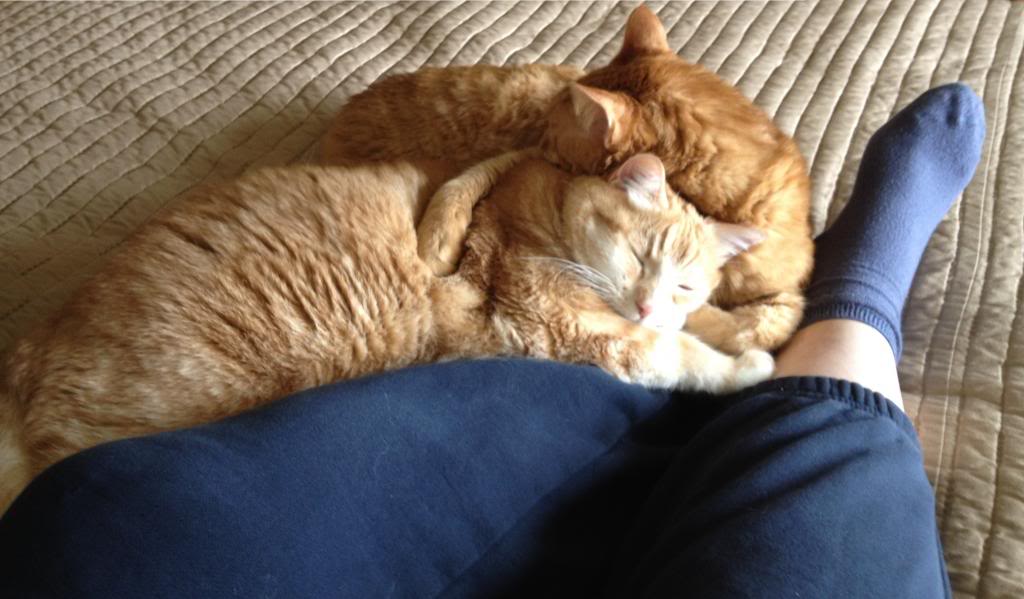
Feline overlords Admiral and General are doing their part by keeping my feet warm.  Well, at least one foot.

Feelings … Nothing More Than Feelings

This morning as I pulled into my garage after a quick errand, a favorite 80s song came on the radio: “Same Old Lang Syne” by Dan Fogelberg. Although I had a list of chores to tackle, nothing was urgent. I turned off the car and settled with my newly-acquired Starbucks smoothie to listen for a few minutes.

The song tells of a musician who encounters his old lover in a grocery store on a snowy Christmas Eve. Its imagery is very poignant: joy at an unexpected meeting, reminiscing over drinks in her car, trying unsuccessfully to talk about how they truly felt, going their separate ways. I’ve had one or two similar experiences in my life. As the music was ending, I found myself awash in regret and loss for the characters, and for me.

And then … I felt exhilaration. Not because the song was sad, but because I FEEL — intensely, overwhelmingly, to the exclusion of everything else, if only for a moment. Because I am still alive to feel it. Because emotions are part of this human experience.

And without lung cancer, I might never have appreciated that.

Inspired, I grabbed my purse and smoothie and hurried in to write. What a great way to start the day!

My Worldcon Schedule

Over Labor Day weekend, I’ll be a program participant at LoneStarCon 3, the 71st Annual World Science Fiction Convention in San Antonio, Texas. I usually sit on hard science panels at conventions. Here’s my schedule for this Worldcon. Hope to see some of you there!

The Practice of Space Medicine
8/29 Thursday 15:00 – 16:00
Whether you’re suffering from a case of Andorian shingles or just a mild version of numb tongue, you can be sure that our panelists have a higher patient survival rate than Dr. McCoy. What really happens when you have the flu in space?

Scientific Literacy vs Human Knowledge
8/30 Friday 13:00 – 14:00
The entirety of human knowledge is growing constantly. How can we even decide what the baseline of scientific literacy should be? What’s the process by which the baseline changes?

The Future of Medicine
8/30 Friday 18:00 – 19:00
What ever happened to farmacology? Is the futue of medicine all about genetics? Our panelists will predict the future for you.

Can Machines be Conscious?
8/31 Saturday 13:00 – 14:00
Inventing a better Türing test: neuroscientists are coming up with new definitions of consciousness. They also seek to determine how to measure consciousness.

Using Philosophy to Analyse a National Health Service
8/31 Saturday 15:00 – 16:00
Health is important, but health systems are often criticized, sometimes with good reason. Perhaps philosophy is needed to make premises clearer? Who should be treated, how, and where? Is “more health for the money” valid, or should we consider quality? What are the technology challenges, like ICT? Can we treat more old people at home? Should the patient just be patient, or become a stakeholder?

Stroll with the Stars Sunday – Alamo edition
9/1 Sunday 09:00 – 10:00
The Sunday Stroll with the Stars will head towards the Alamo, a few short blocks away. It will be led by Alamo aficionado and LoneStarCon 3 Chair Randall Shepherd. Meet Randy in the lobby of the Marriott Rivercenter for his personal tour of this famous Texas garrison. Visiting the Alamo is free; note that you will not be able to take photos inside parts of the Alamo.

Cutting Edge Cancer Research
9/1 Sunday 13:00 – 14:00
A look at what is currently possible in the field in combating cancer.

Article on Alzheimer’s disease research

My article “Preserving the Memory” appears in the July/August 2009 issue of Analog Science Fiction and Fact.   Thanks to Dr. Thomas D. Bird, Professor of Medicine and Neurology at the University of Washington and Chief of their Division of Neurogenetics, for reviewing the article for accuracy.  He said he thought it was “a good review of the state of the art” in Alzheimer’s disease (January 2009).