My Worst Speech EVER

Last night I gave the worst speech of my life.  Everything that could go wrong, did.

I misunderstood the start time, and arrived late to the venue. Many of the seats in the once-filled room were now empty. People were partying audibly in the hallway.  I walked out onto the empty stage and discovered the fly of my pants was open.  I turned around to zip it, and when I turned back, a large potted plant blocked me.  I stepped around the plant to start speaking, and immediately began stammering nonsense.  An audience member in the front row imitated me and laughed. I finally found my words, but they were somewhere in the middle of my talk– everything was out of sequence.  I couldn’t find my place in my notes. Another audience member began lecturing about what I was doing wrong, and I had to ask him to be quiet so I could continue.  As I spoke, people stood up and walked out.  When I finished, none of the few remaining attendees clapped or looked at me.  I walked out of the building to find people on the street commenting to each other about how bad my speech had been.

I completely failed to deliver an effective speech.  And …

The world did not end. Life continued.

Living with metastatic cancer gives one a different perspective about small things like failure.  I don’t want to waste precious time fretting over what hasn’t gone right in my life.

Failure won’t kill me. It just teaches me what to do better the next time.

Like not having spicy barbeque sauce on a snack before bed.  It gives me weird dreams.  I’d rather not have that dream again.*
*Added that last sentence about 5 hours after the original post — evidently people didn’t catch my hint that this was a dream.  Sorry I was too subtle.  I don’t often hear that adjective applied to me!

Finding My Voice

Tonight (July 31) at 7 PM Pacific Time I will be the first of six speakers sharing our cancer journeys at “Community Voices: Stories of Survival“. My talk titled “Finding My Voice” will tell the story of why and how I became a lung cancer patient advocate. The event will stream live on the Internet tonight, and will be available later as a podcast and video. Thanks to The Story Collider and the online community Smart Patients (who teamed to create this show in San Carlos, California) for inviting me to participate!

Stuart Scott Knows How to Beat Cancer

This year’s ESPY awards honored ESPN anchor Stuart Scott with the Jimmy V Perseverance Award for his ongoing battle with cancer. The intro by Kiefer Sutherland and tribute video are inspiring, but my favorite part is this line in Scott’s acceptance speech:

“When you die, it does not mean that you lose to cancer. You beat cancer by how you live, why you live and the manner in which you live.”

He gets it. And he lives it.

20140729-081017-29417567.jpg

Beyond First Base

Yesterday I played softball.

Nothing formal — a group of friends played a leisurely, good-natured game on a seriously foreshortened backyard diamond after a meeting. It was practice for my 40th high school reunion in August, when 42 of us who grew up together are going to play softball in Tacoma’s Cheney Stadium–home of the Tacoma Rainiers (the Seattle Mariners’ AAA team).

This may not seem like a big deal to you. People play casual softball at family gatherings and summer picnics all the time. So what?

Well, it’s a milestone for me. You see, my body is different now. Yes, I’m two decades older and considerably softer than the last time I hefted a bat. But the real difference is not immediately visible: cancer treatment changed how my body performs.

I was a tomboy, relatively athletic for a girl growing up in the 60s. I could run and jump and throw, and I was pretty fast. As a kid I played sandlot ball with the boys because I “didn’t throw like a girl.” I played softball most every summer after I turned ten. I played the available intramural school sports and lettered in track in the first year it was open to girls. In college, I continued playing intramural sports and spent a year on the women’s club softball team. After graduation, I joined a Masters swim team and hiked with The Mountaineers. Later I ran 5Ks, rode my bike for miles, and played adult slow pitch for several years. I wasn’t truly a “jock,” but I knew how to move.  As I aged, I moved less, and would occasionally allow myself to get sedentary and out of shape, but in a bout of remorse I would get myself back into shape again. I was fit and healthy when I got diagnosed with lung cancer in 2011.

Now? Chemotherapy left me with peripheral neuropathy that occasionally interferes with walking and balance—my feet can’t sense the ground reliably. Radiation to my chest caused scarring and volume reduction in my lungs, so my oxygen level drops when I walk at a modest pace. Radiation to my right collarbone area hit a main nerve bundle, which causes some weakness in my right arm and a risk of damage if I lift too much weight with it. A year of steroids packed on the fat while decreasing my muscle tone. My current targeted therapy causes edema in my legs and hands that affects their movement and comfort. Some combination of side effects keeps my red blood cell count just below normal, which saps my stamina and ability to move quickly. I do exercise regularly on the treadmill and elliptical, but I can’t yet get the pace anywhere close to a brisk walk for more than 30 seconds without breathing fast and hard.

I’m not complaining, mind you–I’m happy to be alive and have a relatively normal life on my current targeted therapy. But I must face reality: the body I have now is not the same one I had Before Cancer.

That’s why that low-key softball game was such a revelation for me. The moment I put the glove on my left hand, my body recalled those days on the softball diamond. After some initial fumbles, I caught the ball easily when it was thrown to me. After a few gentle tosses, I could throw the ball to another and actually hit their glove. After couple of wimpy at-bats, I connected with the ball. And when I ran to first base, I moved faster than a walk. I’m not exactly sure what to call that gait (it wasn’t running, it wasn’t jogging, and it certainly wasn’t graceful), but I got to first base before the ball did, probably due to the good graces of the fielders—thanks, guys, I love you.  For about twenty minutes, I was a softball player again.

When the next batter hit the ball, I just barely made it to second base, but I was safe. I stood tall with both feet on the bag, reveling in my accomplishment as I gasped for air. And it occurred to me that maybe, just maybe, regular training could get me to second base in August without breathing quite so hard. I had been thinking I would only pitch during the game and let others do the batting and running. But maybe I COULD bat, and “run” too–especially since the game rules allow players up to five minutes to get to first base (note to future reunion attendees: Reunion Committee members get to write the rules).

After crossing home plate, I excused myself from the game and sat down to catch my breath. My friends played on. I resolved that I would be on that field in Cheney Stadium as long as my breath and body held out.

I WILL get beyond first base in August. I know there’s no stealing in softball, but to steal a James Bond phrase: there’s no point in living if you can’t feel alive.
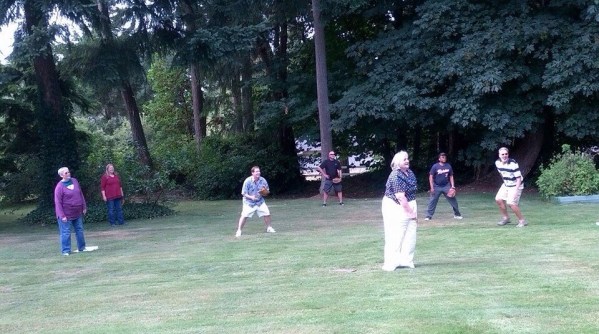
20140721-224516-81916172.jpgSee? I DID make it to second base! (Credit: Sandi Allen Estep)

The Downside of Seattle Summer

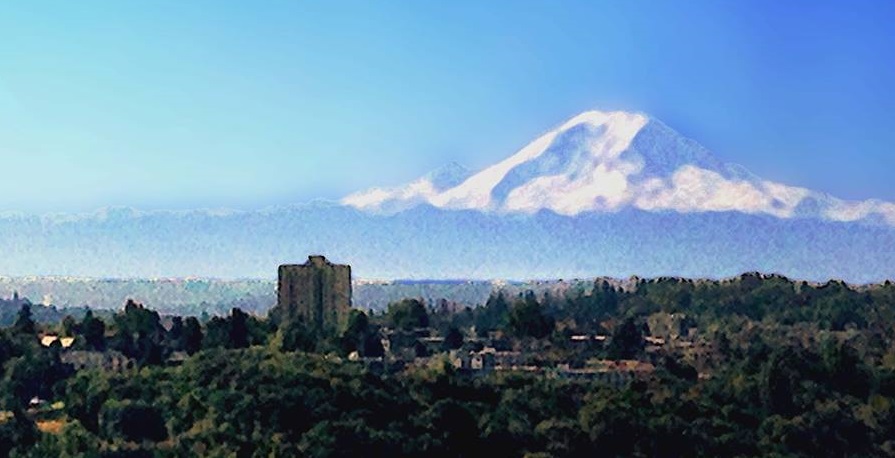
Summer in northerly US latitudes like Seattle means the sun is up almost 16 hours around the Solstice (June 21-ish). The days are long and usually sunny for a few months.  Our local mountains–especially the volcanoes–are spectacular this time of year.

Mt Rainier greets July (credit: Elizabeth Bourne)

Mt Rainier greets July (credit: Elizabeth Bourne)

The upside of this season for people who have Seasonal Affective Disorder (like me): lots of sunlight to elevate my mood and energy. I’m like the Energizer Bunny on many summer days.  This is a good thing, considering I have a lot of looming deadlines for writing and speaking projects.

The downside: lots of sunlight to keep me awake.  Last night I couldn’t get to sleep before midnight, which is only a couple of hours after dark.  Today the sun rose at 5:15 AM, and I wasn’t far behind it, even though I’d prefer to sleep until 8:00 AM. I honestly do need more than six hours of sleep at night, especially on cancer drugs. Can’t wear an eye mask over my CPAP, and blackout curtains don’t make much sense here when it’s gray so much of the year.  I want to stay sharp, yet caffeine–available on nearly every urban block in Western Washington–is a double-edge sword.

So, I get up and tackle my projects every morning with gusto and grogginess, and hope to collapse for a nap in the afternoons.  Except it’s SUNNY outside, and our yard has fresh raspberries (my favorite!),  and the words in my head are fighting to be born, and look at the MOUNTAINS, and … and …

Apparently I suck at collapsing on cue.

Sunshine, Baseball, and Video

This morning I awoke to learn I’d been on the news at 6:15 AM.  The local NBC affiliate, King 5, included excerpts from my interview yesterday in their coverage of the Lung Force Turquoise Takeover and art unveiling in Seattle. You can see the clip here. Wonder why I kept looking at the ceiling?

We had a gorgeously clear 80-degree day today in the Pacific Northwest–perfect for a ball game.  Fellow lung cancer patient Gwynne Cleveland (@GB2C on Twitter) and I worked the Lung Force table at a Seattle Mariners day game, recruiting walkers for the inaugural Lung Force Walk in Seattle on June 7.  Shirt sleeve weather in May is a rare treat around here, although the breeze on the shaded concourse drove us both into sweaters.

Back home, as I hear the birdsong in the fading sunlight and spectacular sunset, two questions pop into my mind:

Why do birds sing at dusk?

Is it the same reason lung cancer patients blog?

Third Time’s a Charm

Today I celebrate my three-year cancerversary. It was May 10, 2011, when biopsy results confirmed my lung cancer diagnosis.

My life has evolved quite a bit since that day. My first cancerversary in 2012 fell two days after my sixth (and last) dose of second line chemo, and a month before my second series of radiation treatments. I was stage IV, continually felt like I had the flu, and though hopeful, didn’t feel much like celebrating. My second cancerversary in 2013 fell sixth months into my current clinical trial. I had achieved No Evidence of Disease (NED) and focused on enjoying life, but was nearing the timeframe when others who took the same experimental drug typically progressed. I flew to Denver every 4 weeks for trial check-in, juggled side effects of treatments past and present, and felt anxious about the future.

My third cancerversary is different. Life no longer revolves around cancer treatment. I’m 17 months NED in my clinical trial, and the drug’s side effects are minimal. My visits to Denver every other month seem almost routine, with only a hint of scanxiety. I’m exercising most days, rebuilding my fitness level, and starting to lose the 60 pounds gifted to me by various cancer treatments. Physically, I’m less a cancer patient and more an out-of-shape fifty-something.

My life still revolves around lung cancer, but not in the same way. I’m busy most days with lung cancer patient advocacy. In addition to writing this blog for over a year, I moderate Lung Cancer Social Media (#LCSM) chats on Twitter and work with lung cancer nonprofits, healthcare professionals, researchers, and patient advocates to raise awareness and support of lung cancer issues such as benefits of mutation testing, screening with low dose CT, living with metastatic cancer as a chronic illness, and the need for increased research funding.

To celebrate this cancerversary, my husband and I spent a quiet vacation week in Whistler BC. The drive from Vancouver along Howe Sound into the volcanic coastal range (via Sea to Sky Highway) showcased Mother Nature at her finest. I enjoyed exploring Whistler Village and surrounds as well as writing. As I watched the snowboarders walking down from the Blackcomb gondola, I did feel a twinge of regret that I can no longer ski. However, I later reveled in the warm sun as I walked the mile around Lost Lake (2200 feet elevation!) at a moderate pace, with only a few stops–I could not have done that in 2011, 2012, or 2013.

So life has returned to an acceptable state of normality. At this point in time, a headache is just a headache—it doesn’t automatically trigger anxiety about brain mets. I look forward to seeing my son graduate from college next May. I accepted a commitment in fall 2015 without first asking if I’d be alive on that date. I know my targeted therapy cancer pill likley will fail me someday, but I now can go weeks without thinking about that.

As Trillian says in Hitchhiker’s Guide to the Galaxy:
“We have normality. I repeat, we have normality. Anything you still can’t cope with is therefore your own problem.”


Howe Sound, British Columbia


Sea to Sky Highway, British Columbia

Lost Lake Outflow near Whistler BC

Trial Travel Notes to Self (March 2014 edition)

I still travel to Denver every eight weeks for my clinical trial appointment. On each visit, I refine my travel skills. Here’s what I learned (or relearned) this time:

1. Denver employs hidden moisture vacuums in airport jetways.

2. Dodge Avengers are built for people shorter than me.

3. Weather Channel three-day forecasts for Denver aren’t sufficiently fine tuned to indicate whether it will snow when I leave the hotel.

4. Hospital cafeteria hours don’t necessarily mesh with radiology schedules.

5. No matter how many times I push the button, MY car key will not unlock a rental car.

6. To avoid repeating #5, review #4 and pack a snack.

7. If one must sleep in the MRI machine, don’t snore loud enough to jerk awake.

8. While waiting to get scan results, plan something distractingly fun. Trying to verify tomorrow’s weather report on clinic wifi does not qualify.

9. No matter how calm and relaxed I may be, and what arsenal of sleep medicines I may possess, I won’t fall asleep at a reasonable hour the night before a scan.

American Lung Association Unveils LUNG FORCE Initiative

On January 29, the launch event for the American Lung Association’s new national LUNG FORCE initiative occurred in Seattle.  As stated on the LUNG FORCE website, “LUNG FORCE is a new national movement led by the American Lung Association with a singular mission: to unite women to stand together against lung cancer and for lung health.” ALA chose to focus on women because market research indicated that was the best way to break the stigma of lung cancer and bring it into public awareness. ALA’s aim for LUNG FORCE is to raise money for lung cancer research, education and advocacy. They are extremely responsive to the patients’ voice and are genuinely interested in promoting the concept that ANYONE who has lungs can get lung cancer, and NO ONE deserves to die from it.

Seattle is the launch city for the first LUNG FORCE Walk. I’m on the Patient-Survivor-Family Cabinet of the ALA’s Mountain Pacific chapter in Seattle. This chapter also has a Medical Professionals Cabinet, among them oncologist Dr. Howard (Jack) West, Medical Director of Thoracic Oncology at Swedish Medical Center and Founder of cancerGRACE.org (who was unable to attend the kickoff due to horrendous traffic); Dr. David K. Madtes. Director of the Lung Cancer Early Detection & Prevention Clinic at Seattle Cancer Care Alliance (an NCCN facility); and Dr. Steven Kirtland, Medical Director of the Thoracic Oncology Program at Virginia Mason Medical Center (and, coincidentally, my pulmonologist). We also have a cabinet of women business leaders.

I’m thrilled that an established, large national public health organization has chosen to join the effort to eliminate the stigma of lung cancer, educate people about symptoms, champion early detection, and promote research funding. Although ALA has long had a strong anti-smoking program, they are acutely aware of the need to keep it separate from LUNG FORCE to avoid promoting further stigma. I’m hopeful ALA is the Big Dog that will tip the scales and finally bring lung cancer into the public’s awareness.

And yes, the munchies were yummy!

Thanks to Hello Robin, Cupcake Royale, Trader Joes, and st. clouds restaurant for donating refreshments, and glassbaby for donating the meeting space.


Patients and Doctors Who Spoke at Seattle LUNG FORCE Kickoff 29-Jan-2014. I’m second from the left; my pulmonologist Dr. Steven Kirtland is third from right.

This 17-minute video captures the presentations at the kickoff event. I was the last of three patients who spoke at the event.

Alive for Thanksgiving

Today those of us in the USA celebrate Thanksgiving.  I have much for which to be thankful.

I’m thankful I beat the lung cancer odds and lived to see this day. No matter how much longer I may have, each day is a gift.

I’m thankful for my family (whether related by blood, marriage, or adoption)—husband, children, siblings, nieces and nephews, cousins, and companion animals. I’m grateful for the time I get to spend with each of you.

I’m thankful for my friends, who became family through shared interests and experiences. You bring me joy whenever we’re together.

I’m thankful for the beauty and majesty of the Pacific Northwest, and the wondrous, awesome, fascinating universe in which it fits.  I never tire of learning how it all works.

I’m thankful for the arts.  They stimulate my senses and inspire my imagination, often when I most need it.

I’m thankful to have a home and enough resources to live comfortably. I know many people locally and globally are not so lucky.

I’m thankful to live where I’m allowed to say what I think freely.

I’m thankful for the researchers, healthcare professionals, organizations and techies that made it possible for me and other patients to live another day.

I’m thankful for people who care for lung cancer patients.  If a friend or loved one has metastatic lung cancer, ask if you can help them learn about mutation testing, targeted therapies, and clinical trials. You might help buy them more time. And more time is precious.

Happy Turkey Day, everyone!