Crizotinib (Xalkori) approved for ROS1-positive NSCLC!

The anticancer pill I take in my clinical trial, Xalkori (generic name crizotinib), was approved today by the FDA for my type of lung cancer: ROS1-positive non-small cell lung cancer.  I’m one of the 50 patients whose results were included in the clinical trial data.

In addition to being happy that I found an effective treatment for my lung cancer–I’ve had No Evidence of Disease for 36 months and counting–I feel proud to be part of the research that is making new cancer treatments available for more patients.

Precision medicine, targeted therapies, and clinical trials are awesome.

————————-
Edit 2016-03-11 2 PM to add:

Some people have asked what this approval means to my participation in the clinical trial.

The short answer:
Nothing has changed for me. I’m still in the clinical trial, and I still get my drug free (but have to pay for my travel).

The long answer:

Last April, Xalkori for ROS1+ NSCLC received “breakthrough” FDA designation, which is one type of accelerated FDA approval. The accelerated approval process allows the FDA to grant approval before a Phase 3 clinical trial is completed, but still requires a Phase 3 trial to be completed eventually. So my clinical trial must continue until the Phase 3 trial is complete, or the FDA will pull its approval of Xalkori for ROS1 NSCLC.

Xalkori originally received breakthrough designation for ALK+ NSCLC, and was granted FDA approval through the accelerated process in August 2011 (the fastest drug approval to date). The Xalkori for ALK+ NSCLC phase 3 clinical trial still continues over four years later. So I suspect my clinical trial will be continuing for some time.

However, even if I left the clinical trial, Xalkori is already covered by most insurance plans, and today’s FDA approval means pretty much all plans will cover it. However, the copays vary considerably.  Some plans cover it as a pharmacy benefit with a substantial out of pocket expense.  Others cover it as a medical expense, with a standard deductible.  I haven’t checked to see how (or if) my plan covers it.

I plan to stay in the clinical trial at the University of Colorado for the forseeable future.  I like having regular access to some of the top experts in the world on ROS1 cancer and molecular testing for precision medicine.  My writing income goes to fund their Lung Cancer Colorado Fund for lung cancer research.  I also participate in their research as a patient advocate on the NCI-sponsored CU lung cancer SPORE (Specialized Program for Research Excellence) and get to learn about cutting-edge cancer research, which satisfies the geek in me. Besides, I’ve grown fond of several people I’ve come to know at CU.  It’s become a second home of sorts.

So, yeah, this approval does not change my treatment. But hopefully it will make the treatment more available to more patients ASAP.

A Crowning Achievement

Here’s an example of technology making a huge positive difference in healthcare, with very little fanfare.

While waiting for the dentist to see me during my recent checkup, I asked the hygienist if they had an old printer running a large print job–I could hear a continuing buzz from somewhere in the office.  I was imagining a 1970’s style printers with those spiky little wheels feeding long continuous sheets of paper and a dot-matrix ink cartridge zipping back and forth, like those that ran our card batch jobs during my college days (yeah, I’m that old).

Turns out, it wasn’t an OLD printer.  She took me into the next room and showed me a device the size of a microwave.

My dentist can now create a custom crown using a 3D printer during one office visit. The system designs the crown using 3D imaging to ensure a good fit in your mouth–no more temporary, ill-fitting crowns.  More on the process is here.

3D crown printing

So we have a new variation on Precision Medicine–custom crowns designed while you wait.  Technology is so cool.

image from “New At The Dentist: 3D Printing Dental Crowns While You Wait


Tropical Sniffles, or Under the Wonderful Weather

 The night before we left for our Hawaiian vacation, I had developed a stuffy nose and sore throat, and slept only three hours because I couldn’t breathe through my CPAP.  On the plane, I went through an entire pack of Kleenex.  In the Kapaa condo, I collapsed at 8 PM with a fever, but awoke at 1:30 AM with screaming sinuses.  To avoid waking hubby, I hung out in the darkened bathroom playing Whirlyword on my phone with tissue stuffed up my nose for two hours.  I finally got back to sleep around 3:30 AM.

This morning, I awoke to guava juice, sunshine, tropical breezes, a balcony overlooking a lovely garden, and the crow of Kauai roosters.  If I’ve got to be sick, this is the sickroom I want!

  
Today was a Kauai afternoon with 3 generations of family, good Hawaiian food, whales breaching offshore, the sound of crashing waves below, and a stellar sunset. I just sat in a corner of the lanai and soaked it all in while life happened all around me.

  
 I am sated.  Sometimes it’s enough to just BE.

————–

Thanks to Steve and Gerry for crowdsourcing the blog title

2015 in review

The WordPress.com stats helper monkeys prepared a 2015 annual report for this blog.

Here’s an excerpt:

The concert hall at the Sydney Opera House holds 2,700 people. This blog was viewed about 60,000 times in 2015. If it were a concert at Sydney Opera House, it would take about 22 sold-out performances for that many people to see it.

Click here to see the complete report.

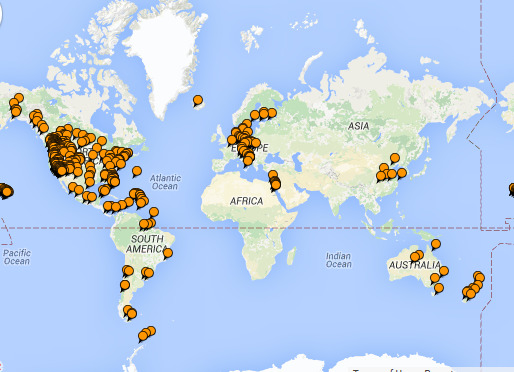
Oh, the places I’ve been … (Dec-2015 version)

Today, since my to-do list is overflowing, I avoided doing anything productive and instead marked places I’ve been on the TripAdvisor.com map. According to them, I’ve seen 26% of the world. I’ve visited all 7 continents — although I did not set foot on Antarctica soil, sailing within sight of penguins on shore still counts, right? However, I’ve barely seen anything of Asia and Africa–obviously I have more traveling to do before I rest.

Places I've been (on TripAdvisor map) 2015-12-29

I guess I also need to write more travelogue posts, too …

Gratitude, Year Four

What does it mean to be thankful when you have metastatic lung cancer?

Four years ago on Thanksgiving, my extended family gathered for a somewhat somber meal. I had been diagnosed with advanced lung cancer the previous May, and despite aggressive treatment, the cancer had spread further. Although the tumors in my left lung and between my lungs were shrinking due to chemo and radiation, the new mass at the base of my neck was starting to threaten my carotid artery. I could see it growing week by week. I felt flashes of hope mingled with panic, anger and regret. Lung cancer is the biggest cancer killer for both men and women and the survival rate for metastatic disease is less than 5 percent. My presence at future family gatherings was far from assured.

This year, I am immensely grateful to have seen three more Thanksgivings and to have no evidence of disease for three years and counting.

I’m grateful for the support I’ve received from so many throughout my cancer journey. I’m grateful for compassionate … READ MORE

Profiles in Lung Cancer – Day 21: Dr. Ross Camidge “Progress will come from changing the way we think about cancer”

PROFILES IN LUNG CANCER
Lung Cancer Awareness Month 2015

D. Ross Camidge, MD, PhD  “Progress will come from changing the way we think about cancer”
Director of the Thoracic Oncology Clinical and Clinical Research Programs, University of Colorado

I am incredibly fortunate to have Dr. Ross Camidge as my lung cancer oncologist, clinical trial researcher, advocacy cheerleader, and friend. He goes above and beyond to help lung cancer patients better understand their options and find hope.  And he adores his two small daughters.

Camidge and daughtersA sample of the hope Dr. Camidge offers shows in his “User’s Guide to Oncology” presentation.  He explains the basic of cancer in understandable language, talks about how to sort through information available online and elsewhere, shares do’s and dont’s of cancer care, and offers some patient inspiring stories.  I’m honored that he chose mine as one of them.

Oh, and he has an awesome British accent.

What is your connection with lung cancer?

The first lung cancer patient I remember was called John and he was a plumber in Edinburgh in Scotland. He had never smoked and was one of the first people to go on an EGFR inhibitor in a trial and had a great and long lasting response. He was the nicest of people and introduced me to all his tradesmen friends and I will be forever grateful to him for getting me on the inside track for fixing up my ‘fixer upper’ at the time. We didn’t know about EGFR mutations at that point but it was enough for me to see the potential and the need for breakthroughs in this common serious disease. Now, 15 years later, I run the lung cancer program at the University of Colorado Cancer Center where I am a physician and a clinical and translational researcher.

What does your typical day look like?

Get up before my wife and daughters, try not to wake them on my way out to work. If its a clinic day (two days a week) talk through the plan for every patient with the nurse practitioner, fellow, clinic nurses, schedulers and medical assistant before the first patient arrives. Then jump in and about eight hours later talk through it all again and see how well the battle plan stood up when the enemy (the cancer) was actually engaged. Do follow up emails, calls, dictations, etc. Go home and put one of our two daughters (5 and 3) to bed (pajamas, clean teeth, story), alternating nightly, with my wife doing the other one. Have dinner. Watch variably trashy movie (‘While We’re Young’ with Ben Stiller and Naomi Watts last night was really very touching. ‘Enders Game’ was less touching but still fun the night before). Go to sleep. On a non-clinic day, it is similar but the middle bit involves lots of meetings and emails and phone calls, with senior and  often junior faculty here and around the country and the world (I mentor a lot of bright young things), drug companies and various educational/advocacy groups trying to move clinical and translational research on new treatments for lung cancer forward.

What might we not know about you?

I am grossed out by slugs. Oh, and I taught myself to juggle while revising for my Royal College of Physicians exams in the UK many years ago and still occasionally do it to keep my children amused.

What do you want us to know about lung cancer?

Progress will come from changing the way we think about cancer as much as through specific drug or molecular breakthroughs.  A lot of the advances I have been fortunate enough to be involved with have come from not being shy about defining the edges of human knowledge, and then pushing on through.

What brings you hope?

Seeing the courage, dignity, love and humor of people who triumph over cancer simply by being themselves regardless of whether the cancer gets better or worse.

——–
Each day during Lung Cancer Awareness Month (November), a lung cancer blogger will share a brief profile of someone involved with lung cancer. The person profiled might be a patient, caregiver, advocate, researcher, or healthcare provider.

Yesterday’s post was on Lisa Buonnano’s blog “Faith, Family & Friends.”

Tommorow’s post will on Lisa Goldman’s blog Every Breath I Take.

All profiles can be found the day after posting on the #LCSM Chat blog at http://lcsmchat.com/. A list of links to all the profiles on the original bloggers’ pages can be found at on the #LCSM Chat site on the Profiles in Lung Cancer page.

Profiles in Lung Cancer – Day 2: Deana Hendrickson

PROFILES IN LUNG CANCER
Lung Cancer Awareness Month 2015

Deana Hendrickson, Lung Cancer Advocate
Co-founder of #LCSM Chat (Lung Cancer Social Media) on Twitter
Twitter handle: @LungCancerFaces
Deana Hendrickson

What is her connection with lung cancer?
Deana’s mother, Rita Stein, was diagnosed with stage 3b lung cancer in June 2012. During Rita’s treatment (concurrent chemo and radiation for 6 weeks) Deana found herself spending a great deal of time in waiting rooms, infusion centers, and unfortunately, her mother’s hospital room. In order to pass the time, Deana began to post lung cancer awareness messages on Twitter, which led to “meeting” other advocates, patients, and physicians on social media. When Deana’s mother died in April 2013, she continued her advocacy, in part, to help her heal from the terrible ordeal of losing her NED (no evidence of disease) mother to treatment complications.
Deana helped found #LCSM Chat (Lung Cancer Social Media) on Twitter, and does whatever she can to raise money and awareness, mixed with a little bit of outrage, on behalf of lung cancer patients and their families. As Deana says, “My mom survived the Holocaust, living in a DP (refugee) camp for two years, and the death of my dad after 53 years of marriage. She never backed down from a challenge. In her honor and memory, neither will I.”

What is her typical day like?
She’s online either connecting with lung cancer patients, caretakers and their families, or on Twitter promoting #LCSM Chat and lung cancer awareness.

What might you not know about her?
Much to the chagrin of her ever-patient husband of 31 years, Deana is a veteran animal rescuer, devoted dog mommy, and crazy cat lady. She’s also mom to two adult children, who thankfully do not live at home!

What does she want you to know about lung cancer?
Smoker, former smoker, never smoker: no one deserves lung cancer. #NoStigma

What brings her hope?
Survivors who are *living* with advanced lung cancer. Deana envisions a world where lung cancer is a chronic disease, one that is detected early for the majority of patients, rather than a life-limiting condition.

——–
Each day during Lung Cancer Awareness Month (November), a lung cancer blogger will share a brief profile of someone involved with lung cancer. The person profiled might be a patient, caregiver, advocate, researcher, or healthcare provider.

Yesterday Tori Tomalia profiled Melissa Crouse on her blog “A Lil’ Lytnin Strikes Lung Cancer.”

Tommorow’s post will be on Lisa Goldman’s blog Every Breath I Take, where she will profile Bonnie Addario.

All profiles can be found the day after posting on the #LCSM Chat blog at http://lcsmchat.com/. A list of links to all the profiles on the original bloggers’ pages can be found at on the #LCSM Chat site on the Profiles in Lung Cancer page.

Tips for Coping with Cancer: Make a “Grateful” List

In 2013, the website Moments A Day posted a lovely list to help moms remember why they’re grateful for the irritations in their life. It’s a great example of recognizing that how we choose to think about events can make a difference in how we view life.

Grateful from MomentsADay_com

Cancer patients occasionally need similar reminders. Some days we may have difficulty seeing the upside of anything, especially when in active treatment, experiencing unpleasant side effects, or facing cancer progression. On such days, we need to be creative and write a list  … READ MORE

This post was first published on my Cure Today blog on 14-Oct-2015.

Psychology Today groks cancer as a chronic illness

Love this article!  It captures the feeling of living with metastatic cancer as a chronic illness instead of a terminal disease.  I may not have to write a book on the subject if more good articles like this one get published.

The New Cancer Survivors via Psychology Today