A moment in my cancer history

Thirteen years ago today, I experienced a revival of hope. In mid September 2012, I had learned my cancer had grown despite two different lines of chemotherapy plus radiation. But on this date, the University of Colorado notified me that my tumor tissue tested positive for a gene rearrangement called ROS1, and I was eligible for a clinical trial of the targeted therapy pill crizotinib. I had options again!

Today I’m still on the same daily pill. Cancer research is awesome.

News I did not want to hear

Dr. D Ross Camidge is many things.

He’s a world famous lung cancer doctor. He’s an expert in my rare type of cancer (ROS1+ lung cancer). He is the person who started the oncology remote second opinion program at University Of Colorado. He is on the scientific advisory board of the nonprofit I cofounded (The ROS1ders). He is a principal investigator on the clinical trial that saved my life. I’m proud to say he is a personal friend.

On Monday September 8 I learned he is also a person living with lung cancer.

I applaud him for going public with his story. It also breaks my heart.


https://news.cuanschutz.edu/cancer-center/ross-camidge-lung-cancer-diagnosis

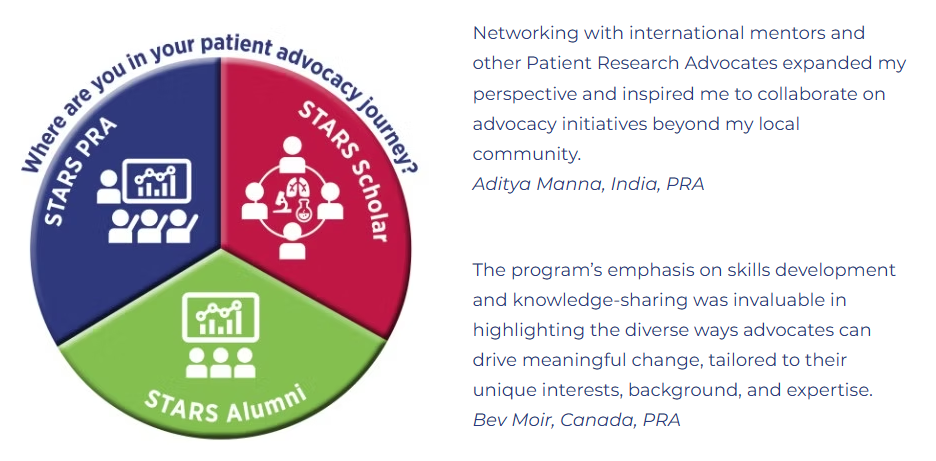
Amp up your lung cancer patient advocacy! Apply for the STARS Program

Take steps to amp up your lung cancer patient advocacy! Applications are now open for the 2025 IASLC STARS PRA & Scholar Programs. STARS (Supportive Training for Advocates on Research and Science) can help you develop and enhance research advocacy skills needed to provide a patient perspective to research.

If you or a loved one has been affected by lung cancer, and you are an active lung cancer patient advocate, you are eligible to apply. Learn more on the STARS website.

How Is Artificial Intelligence used in Cancer Research?

There’s still time to register for the STARS Webinar on “Advancing Trustworthy Artificial Intelligence for Cancer Research.” Hope you’ll join us tomorrow, Thursday, August 29 at 3 pm MDT (Denver time). Once you register, the Zoom link will be emailed to you.

https://www.iaslc.org/meetings-webinars/advancing-trustworthy-artificial-intelligence-cancer-research

Why don’t people trust medical science?

I’ve been thinking about why some people don’t trust medical science and doctors in the US (and, increasingly, globally).

I’m not talking about issues with the medical system like ethical lapses, insurance snafus, cost, poor communications, malpractice, politicization, etc. I want to talk about issues with science.

I think a major source of distrust in medical science lies in the fact that no two human bodies are exactly alike–not even two identical twins. Stay with me on this one–it takes a while to explain.

For some medical procedures, like setting a broken bone, results are pretty predictable for the vast majority of people. However, when it comes to more complicated health issues like cancer and viruses, it’s less certain that medical science can generate specific results due to variations in the human body, nuances in the disease, and the fact that we don’t know everything about how the body or the disease works. (I’ve got 13 years as a cancer patient to support me on this).

The scientific process of discovery is the same in all areas of science, but the level of evidence available and predictability of results can vary depending on what’s being studied. In the engineering world where I was trained, once a physical law (e.g., the behavior of gravity on earth) has been confirmed by many observers, one can rely on it to remain true–at least until new data suggests the law may need to be revised.

The same is not true in medical science.

In medical science (particularly in drug development), a response to treatment in one person does not guarantee the same response will occur in another person who has the same condition. A person’s response can vary due to differences in the body, the environment, other health issues, or even the treatment process. This is why anecdotal evidence is not considered reliable evidence in medical science (although an individual response might indicate something is worth studying). A treatment must produce a similar response in many people to be considered effective–and even then, it may be effective only in people with certain characteristics. Based on decades of cancer research and treatment, claims of “This cancer treatment is guaranteed to work for EVERYBODY!” should generate significant skepticism.

If a hundred studies in engineering produce the same result, we trust the result will be true for all future studies. However, if a medical treatment is effective for 100 people, it still might not be effective for the 101st person. In the case of viruses (which mutate and may have as yet unknown effects on the body), medical evidence can tell you whether a vaccine can reduce your risk of getting infected/sick/dying from the virus, but it’s rare to get exactly the same results for all people.

People want science to be absolutely true, like engineering. When you turn on your stove, you trust it will generate heat for cooking. If it doesn’t work, it’s the machine’s fault, not the science.

But in medicine, the thinking is different. “The doctor said this treatment could keep me from getting sick. I still got sick. The treatment didn’t work, the doctor doesn’t know what they are talking about, the science is bad.”

Perhaps the lack of certainty makes medical science untrustworthy to some. And therefore “science” itself is bad.

How to fix this? Still thinking on that.

Register Now for July 15, 2023 GRACE Targeted Therapies in Lung Cancer Patient Forum

This year’s Targeted Therapies in Lung Cancer Patient Forum is happening online Saturday June 15, and it’s FREE! Great way to learn about current treatment options for those eligible for targeted therapy.

This signature, live, virtual, interactive patient education event includes presentations and panel discussions covering general subjects relevant to all targets as well as breakout sessions on specific mutations of lung cancer. Save your spot here: [https://give.cancergrace.org/…/targeted…/e490332](https://t.co/8TDXsdjyp5)

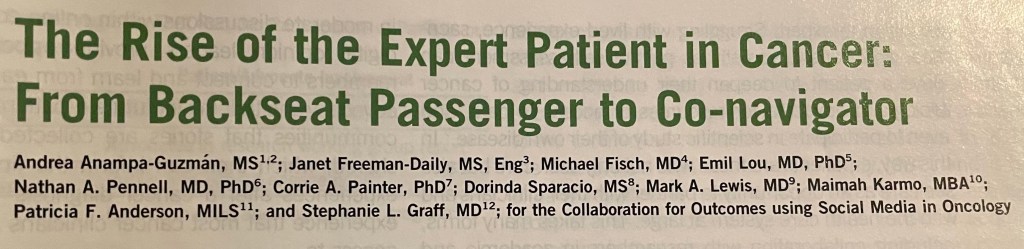
Achievement Unlocked: cancer patient research advocate as co-first author of journal article

Proud to have co-authored this print article about expert patient contributions as educators, advocates, and research partners! Thanks to Collaboration for Outcomes using Social Media in Oncology (COSMO) for the opportunity.

You can read the full article online here: https://ascopubs.org/doi/full/10.1200/OP.21.00763

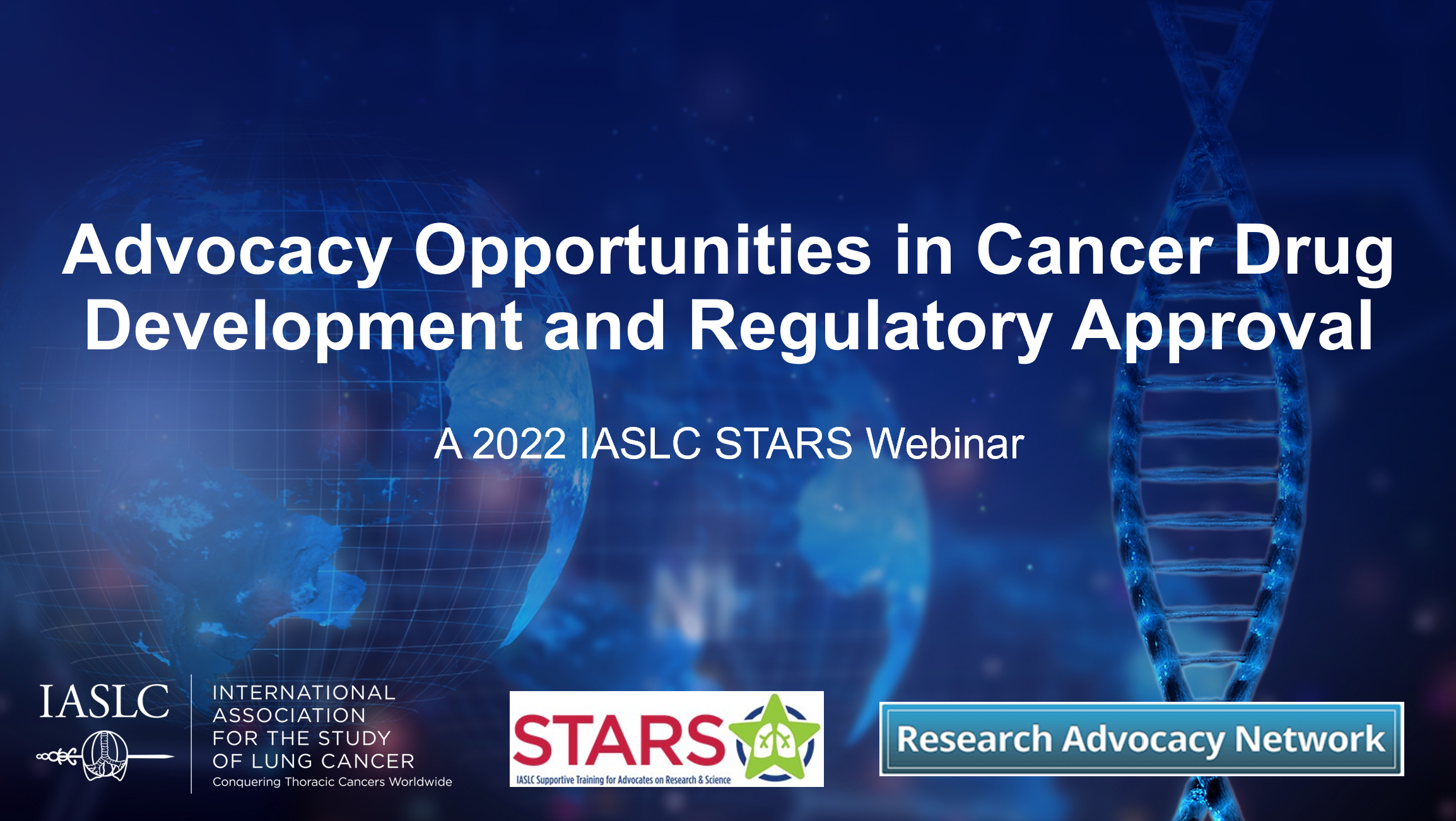
IASLC STARS offers webinar for advocates on drug development process

The IASLC STARS program invites STARS alumni and anyone interested in cancer research advocacy to join us for a webinar about cancer drug development. 

When:               Monday August 29, 2022, at 11:00AM Eastern Time

Title:                Advocacy Opportunities in Cancer Drug Development and Regulatory Approval

Speakers:          Upal Basu Roy, PhD, MPH,
Executive Director of Research, LUNGevity Foundation
Janet Freeman-Daily, MS, Eng
cancer research advocate and STARS staff (moderator)

Languages:        English, with transcript translated into Spanish after the event

Learning objectives:

  • Acquire a high-level understanding of the drug development process and timeline
  • Identify differences in global regulatory approval pathways and how they impact drug access
  • Identify advocacy opportunities throughout the drug development process

Register (it’s FREE) at https://us06web.zoom.us/webinar/register/WN_EmO7XBH6SdqDgHfDA0DLQQ
After registering, you will receive a confirmation email containing information about joining the webinar.
Reach out to advocacy@iaslc.org for more information.

The International Association for the Study of Lung Cancer (IASLC) offers webinars, training and networking opportunities to lung cancer research advocates through its Supportive Training for Advocates in Research and Science (STARS) program.  Thank you to our STARS partner Research Advocacy Network and our 2022 STARS sponsors Lilly, Bayer, BMS, and Genentech for supporting this event!

Eleven Years and Counting …

Today marks 11 years since I was first diagnosed with advanced lung cancer.

Eleven years with the mostly deadly cancer. Imagine that!

When I was diagnosed, my life expectancy was 2 years on the outside, and that was higher than the average because I was relatively young and otherwise healthy. The majority of lung cancer patients died within a year of diagnosis.

Thanks to online patient communities, targeted therapies, biomarker testing, clinical trials, and dedicated clinicians like Dr. Ross Camidge, whose smiling face appears next to mine in this picture, I’m still here. These things, along with additional new treatments like immunotherapy, new biomarkers, lung cancer screening, and ongoing medical research are changing the face of lung cancer. The expected survival of advanced lung cancer patients has risen by several YEARS since I was diagnosed.

Today, I’m grateful. Grateful for the medical research and treatments that have kept me alive with a good quality of life. Grateful for the additional time I’ve had with my family and this amazing universe. Grateful for finding a new purpose as a lung cancer research advocate collaborating on The ROS1ders, IASLC Supportive Training for Advocates on Research and Science (STARS), and other projects. And especially, I’m grateful for the wonderful friends and colleagues I’ve met along the way.

My prayer is that someday ALL people will have ready access to effective treatments and compassionate care for their health conditions, no matter what they look like, where they live, how much money they have, or how others believe they should be treated.

ACTION ALERT! Please help increase federal research funding for lung cancer. #LCSM

GO2 Foundation for Lung Cancer (with the support of the entire lung cancer community) has submitted an appropriations request of $60M in the FY23 Defense Appropriations Bill with a goal to increase funding for the Department of Defense Lung Cancer Research Program (DOD LCRP) to $60M from its current $20M. The entire lung cancer community is joining forces to make it happen!

It takes only a couple of minutes to make your voice heard. But when all our voices join together, it becomes a ROAR.

Please click the link below and follow the instructions to tell your US Senator & Representatives to support $60 million for federal lung cancer research in 2023. Tell your friends & family. Please share widely on all your social media platforms.

HURRY! The House letter deadline is April 26 and Senate letter deadline is May 12, so don’t wait. 

Click here: Act NOW to request $60 million for #lungcancer research