My Orycon 2013 Science Panels

I’m going to Orycon 35, a science fiction convention held November 8-10, 2013, in Portland, Oregon. The programming folks have dreamed up some interesting science panels! I’m especially looking forward to the panel Jay Lake and I are doing on “Living with Late Stage Cancer,” which was very well received at the World Science Fiction Convention in San Antonio last August. If you’re attending Orycon, I hope you’ll attend one of my panels or find me in the halls (I’m not a night owl nowadays, so I’ll be scarce at parties).

The Science of Funding Science
Fri Nov 8 4:00pm-5:00pm (Alaska)
Are we missing out on gaining knowledge because of political correctness?

Living With Late Stage Cancer
Fri Nov 8 5:00pm-6:00pm (Alaska)
What it’s like to live from scan to scan, how we learn about different treatment options, coping when treatment fails, and answering questions from the audience.

Would you go to a doctor whose professors were witch doctors?
Sat Nov 9 10:00am-11:00am (Idaho)
What medicine has gotten right and wrong over the eons.

Do we all really need to know calculus?
Sat Nov 9 1:00pm-2:00pm (Alaska)
Is it really necessary for everyone to graduate from high school knowing physics? How much math do we really use on a daily basis?

I want to get my science on?
Sat Nov 9 4:00pm-5:00pm (Alaska)
Where does the lay person keep up with the latest developments

Ask Dr. Genius: Ad-Lib Answers to Audience Questions
Sat Nov 9 5:00pm-6:00pm (Alaska)
No, really, they’re real scientists, honest. Bring your science questions, and if they don’t have an answer they’ll make something up, and it might even be sort of right.

Cancer sucks-is there hope?
Sun Nov 10 11:00am-12:00pm (Alaska)
New insights into cancer provides glimmers of hope for victims and their families. How are new treatment options shaping up? How soon can we hope for a cure?

Midi-chlorians? Really?!
Sun Nov 10 1:00pm-2:00pm (Alaska)
Best and worst science in the movies.

Dealing with “Why?”

Some cancer patients become obsessed with the WHYs:  Why do I have cancer?  Why now?  Why me? Why is it in my lung instead of somewhere easier to treat?

If I spent time pondering all the WHYs, I would have less time for LIVING with cancer.

One good thing cancer has done for me is clarifying what’s important. “Important” is spending quality time with family and friends, being kind to and doing something useful for others, appreciating the natural world, learning to be a better person, and taking care of myself as best I can. I am curious by nature, and love to learn the whys of the universe. Yet, in the case of my cancer, the answers would have no beneficial impact on my treatment or what I do with the time I have left.  It’s like being obsessed with a good whodunit novel–nice to know the ending, but who shot JR makes no difference in real life.

I probably will never know exactly when, how or why I developed the type of lung cancer I have, or why it behaves the way it does. And I’m OK with that.

Enjoying the Fall

Fall announces itself softly
with drifting leaves
in freshened breeze
before the rain

I’m enjoying this fall season more than any other I remember.  The contrasting foliage, quiet fog blankets, torrential rainstorms, and southbound vees of Canada geese seem new and wondrous to me.

I kinda missed the last two falls due to distractions.  Two years ago, I was dealing with the side effects of concurrent chemo-radiation therapy combined with news that I had progressed to metastatic lung cancer.  Last year, after another recurrence despite second line chemo and more radiation, I was scrambling to find a clinical trial.  Being focused on questions of life and death overshadowed little things like the changing of leaves.  It also fueled an awesome case of writer’s block.

I’m hoping to make good use of these cool gray days to rebuild my strength, read good books, declutter the house, and write.  A lot of writing.  I’m years behind on writing.

My productivity is boosted by using my lightbox to counter any drift towards Seasonal Affective Disorder, and nibbling dark chocolate now and then.  I’d love to include the Seattle addiction (coffee) in my regimen, but it disagrees with my cancer pills. I’ll trade being less alert for more alive any day.

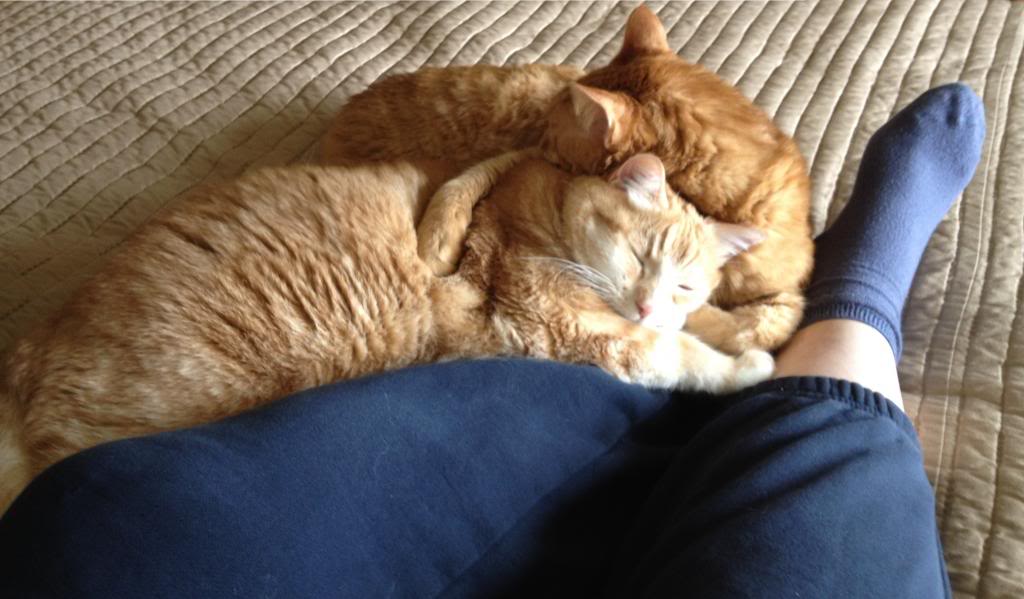
Feline overlords Admiral and General are doing their part by keeping my feet warm.  Well, at least one foot.

Gratitude and Stewardship

I’m grateful to be here.  Actually, I’m grateful to be anywhere.  I’m grateful to be alive.  The fact that I’m alive is a modern-day medical miracle.

In May of 2011, after a few months of a persistent cough, I was diagnosed with pneumonia caused by advanced lung cancer.  No, I never smoked anything except a salmon.  Five months after diagnosis, despite chemo and radiation, the cancer spread outside my chest and I was given at most two years to live.  A year later, after more treatment and another recurrence, I learned my cancer had a rare mutation.  Last October, I found a clinical trial that could treat that mutation with an experimental pill, and I flew to Denver to get it.  In January, I achieved the dream of all metastatic cancer patients: No Evidence of Disease.  My cancer is no longer detectable.

I am overwhelmingly grateful for everything and everyone that has brought me to this state of grace: medical science that discovered new ways to treat my condition, insurance that paid for most of my care, family and friends who supported me, a knowledgeable online lung cancer community, and all the prayers and good wishes lifting me up throughout my cancer journey.  Thank you.  I am truly blessed.

I am not cured. The trial drug only suppresses my cancer, and I have some permanent side effects.  I’ll be in treatment for the rest of my days.  Clinical trials will hopefully keep me feeling comfortable and capable for many months – even years. I am satisfied with living however long I might have.

Being given a second chance at life tends to give one a different perspective.  Colors are brighter.  A warm breeze rustling the trees makes the whole day worthwhile. Time spent with family and friends becomes precious.

A second chance at life also makes one introspective.  Why was I spared when others died?  Why does my mutation have an effective treatment when others don’t?  Why am I able to see one of the best lung cancer doctors in the world when many patients can’t afford proper treatment?

Why am I still here? What purpose does the universe have for me?

Part of the answer to why I’m still here is, I am blessed with gifts that help me survive my cancer journey.  I’m able to understand the medical science and my treatment.  I’m able to explain what I’ve learned.  And I’m able to advocate for myself with healthcare providers.

Yet I am just a steward of these gifts that were bestowed on me. Understanding my gifts has led me to a new purpose: I am here to help other lung cancer patients. I strongly feel this is my calling in the time I have left.

Lung cancer has a stigma attached to it.  Few people know that 80% of those newly diagnosed with lung cancer are nonsmokers or never smokers.  There is more to lung cancer than just smoking.  Yet we are the lepers of the cancer community. 

For this reason, some are ashamed to admit they have lung cancer.  Most don’t know about the new treatments like the one I’m taking–even some doctors don’t know. Patients don’t know where to turn for answers. 

Lung cancer patients need more than compassion. They need information.  They need HOPE.

After considerable thought, I decided the best way to use my gifts was to go public about my lung cancer. At first, I only shared my story online with friends and lung cancer communities.  Eventually I started blogging (which is essentially a journal open to the world on the Internet) and began speaking publicly about my cancer.

Going public with my lung cancer experience has already had an impact. As I’d hoped, it shows patients that people can live with metastatic lung cancer, and encourages them to ask questions about their treatment. 

But going public has also brought completely unexpected benefits. It helps families understand what their loved ones who have lung cancer are experiencing. It gives hospital chaplains insight into their patients’ needs and feelings. It demonstrates to doctors that patients can be partners in their own care. It reveals to researchers how their work makes a difference in the lives of real patients.

In addition, I’ve realized a personal health benefit in sharing the gifts I was given to steward. Having a purpose gets me through the tougher parts of cancer treatment.  It won’t heal my cancer, but it does help me live a healthier, happier life.

And it all started with being grateful that I’m alive.

Finding Good Biomedical Science Articles

Every day patients with cancer and other health issue turn to the Internet to learn about symptoms, causes, and treatments for their conditions. Consumers have many good options for consulting “Dr. Google.” Some websites (like mayoclinic.com) have outstanding credentials for providing medical information. Other sites like PubMed are good places to search for biomedical journal articles.

But not all online biomedical journal articles contain good science.

Science magazine–a premier, peer-reviewed science journal–recently conducted an experiment in which a correspondent submitted a biomedical research paper to open access journals for publication. Open access journals rely on author fees rather than subscriptions. The paper announced a new treatment for cancer derived from lichens. Its science and conclusions were clearly flawed, which should have been caught by each journal’s peer review process. Yet many of the journals published the flawed paper anyway.

This is why I stick to PubMed and journals of demonstrated quality as sources for biomedical articles. It isn’t a foolproof method for finding good science, but it’s better than just googling a topic. You simply can’t believe every headline or abstract you read.

Scanxiety, Round 30 (ish)

Tomorrow I’ll have a PET-CT scan plus a brain MRI to determine if my cancer has recurred. I’ve had around thirty scans of one type of another since my cancer journey began twenty-nine months ago. In my current clinical trial, I have a PET-CT every eight weeks and a brain MRI every six months.

You’d think scans would be old news to me by now. In some ways, they are. This past week was pretty normal in most respects, without undue anxiety or sleeping problems. My scanxiety’s been lessening as I accrue more months of NED (No Evidence of Disease) on Xalkori. Life continues to inch towards normalcy. At times I even forget that I have metastatic lung cancer.

I’m not totally immune to scanxiety, however. It finally hit me yesterday evening. When packing for my flight to my clinical trial in Denver, my brain seemed to fight me every step of the way. When hubby came home after working late, I couldn’t shift gears to get my packing prep out of his way. When I finally got to bed, I didn’t fall asleep for hours. When driving to the airport this morning, my mind kept wandering to somewhere other than the highway in front of me. When going through airport security with my oxygen concentrator, I couldn’t help remembering I was a lung cancer patient traveling for treatment.

Despite all that, I’m more hopeful than I’ve ever been going into a scan. I know I’ll likely have to deal with active lung cancer again eventually. Hopefully I’ve finally trained October not to bring me a recurrence (it has the past two years).

Feelings … Nothing More Than Feelings

This morning as I pulled into my garage after a quick errand, a favorite 80s song came on the radio: “Same Old Lang Syne” by Dan Fogelberg. Although I had a list of chores to tackle, nothing was urgent. I turned off the car and settled with my newly-acquired Starbucks smoothie to listen for a few minutes.

The song tells of a musician who encounters his old lover in a grocery store on a snowy Christmas Eve. Its imagery is very poignant: joy at an unexpected meeting, reminiscing over drinks in her car, trying unsuccessfully to talk about how they truly felt, going their separate ways. I’ve had one or two similar experiences in my life. As the music was ending, I found myself awash in regret and loss for the characters, and for me.

And then … I felt exhilaration. Not because the song was sad, but because I FEEL — intensely, overwhelmingly, to the exclusion of everything else, if only for a moment. Because I am still alive to feel it. Because emotions are part of this human experience.

And without lung cancer, I might never have appreciated that.

Inspired, I grabbed my purse and smoothie and hurried in to write. What a great way to start the day!

Lung Cancer Social Media (#lcsm) Tweetchats

The next lung cancer social media tweetchat will be Thursday September 26, at 5 PM Pacific. It will be moderated by oncologist Dr. Jack West. The topics this time (as posted by Dr. West here) will be:

1) What are leading barriers to clinical research? Which ones might be addressed by connecting members of the lung cancer community online?

2) Can patients & caregivers share data, e.g., Patients Like Me, to facilitate better understanding & generate more interest from pharma companies in studying lung cancer patient groups (potentially narrow ones like those with ROS-1 rearrangements)?

3) Can we lower barriers by making it easier for patients to learn about & travel to participate in trials? Share air miles to help people travel for trials? Offer housing as a network? Telemedicine visits to minimize travel?

Below is an introduction to tweetchats, #lcsm and how to participate. Hope you will consider participating!

What is an #lcsm tweetchat?

On Twitter, the hashtag #lcsm stands for Lung Cancer Social Media. People use that hashtag in tweets every day to flag tweets that talk about lung cancer treatment, research, funding, or patient issues.

An #lcsm tweetchat is a set time when people interested in lung cancer are all on twitter at the same time with a moderator (for #lcsm, that’s Dr. Jack West) to chat about lung cancer. The tweetchat lasts one hour. All tweets that include the #lcsm hashtag during the specified hour will be included in the tweetchat transcript.

Hundreds of #lcsm tweets will be tweeted during the chat. Participants in the tweetchat have included researchers, oncologists, palliative care specialists, surgeons, advocates, counselors, caregivers, family members, and patients who are working or coping with lung cancer.

When and where does the #lcsm tweetchat take place?

The next #lcsm tweetchat will be held Thursday, September 26, at 8 PM Eastern, 5 PM Pacific. After that date, the intent is to hold #lcsm tweetchats every other Thursday at that same time (8 PM Eastern, 5 PM Pacific).

What does a tweetchat look like?

You can see the content of the first four #lcsm tweetchats here:

July 25, 2013
August 8, 2013
August 22, 2013
September 5, 2013

What will people talk about in the tweetchat?

Most of the chat will focus on the questions posed by moderator Dr. Jack West. He usually posts the topics on cancergrace.org several days before the chat.

You will also see tweets that introduce participants and acknolwedge the presence of other participants. Occasionally someone will pop in and ask whatever question is on their mind, but due to the rapid pace of the chat, questions unrelated to the topics might not get answered.

How do I participate in a tweetchat?

You will need a Twitter account to view or participate in the tweetchat.

Although you can follow this chat on Twitter by filtering for the #lcsm hashtag, you’ll find it much easier to keep up by following it on a dedicated webpage. To do this:

1. Enter the URL “tchat.io” in your browser

2. Enter in the hashtag #lcsm in the box on the screen, and click “Start Chatting”

3. Click on “Sign in to get an in-page tweet box” just below the white box, then click “Authorize App” on the next screen to login to Twitter. You’ll then be redirected back to the tchat.io page. This will allow you to type your tweets in the textbox at the top of the page, and the #lcsm hashtag will be automatically added to the tweet to make sure your tweet gets included in the chat.

4. Click on “hide retweets” (just below the blue “Tweet” bar). Many participants will retweet parts of the chat; hiding retweets will make it easier to identify tweets with new content.

Everyone introduces themselves at the beginning. Those who are just lurking enter a tweet that says only “#lcsm” to announce their presence.

Dr. West then presents topics for discussion and assigns each topic a number (T1, T2, etc.). Once he tweets a topic, people respond to it with comments and questions. It helps others track the conversation if you put the topics number at the beginning of your tweet.

Changing My Mind: Cancer Side Effects, Phase 2

Cancer and its treatments cause cognitive and psychological changes for some patients. Even if we aren’t aware of a physical reason for it, it’s just as real as neuropathy and tissue damage.

The cognitive side effects of cancer treatment are known in the media as “chemobrain,”
though the symptoms can be caused by more than just chemotherapy. My cognitive symptoms are typical: problems with memory, attention, multitasking, word finding. I not only can’t remember details of an event, I don’t remember the event even happened. I lose track of what I intend to say in the middle of a sentence. When my son steps into the room to ask me a question, just noticing his presence is enough for me to lose track of what I’m typing. I tell my husband to give me a banana, when what I tried to ask for was milk.

Some changes wax and wane with treatments. The prednisone taken for lung inflammation gives my entire family a new appreciation of “Roid Rage.” The gabapentin taken for nerve pain and sleep serves me brain fog with breakfast.

Some changes can be due to the cancer itself. Tumors and blood clots in the brain or lungs can reduce oxygen supply to the brain and interfere with brain function. I’ll deal with that if it happens to me (knock on my wooden head).

Some changes which I had attributed to treatment-related fatigue persist even as fatigue improves. My patience runs thinner than it did before cancer treatment. Sometimes I become irritable or angry for no discernible reason. Towards the end of the day, I have more difficulty seeing the other side of a disagreement or bestowing benefit of the doubt. I generally try to be home and winding down by 8 PM so I don’t “hit the wall” and run out of positive energy amidst unsuspecting people.

Some cognitive changes are positive ones. My cancer journey gives me a greater understanding of those who face challenges navigating physical barriers, communicating thoughts clearly, or remembering instructions for a task. When someone with a chronic illness tells me they don’t have the energy for some activity, I know exactly what they’re talking about.

The largest change I see in me is … a change in perspective. I feel a drive to LIVE each day, not just let it meander by me. I’m more inclined to be choosy about how I spend my remaining time (however long that might be) and with whom I spend it. I’m less willing to be with people who dwell on small talk, speak ill of others frequently, or lack compassion. I seek out positive, creative people who are willing to reveal their true selves, share mutual interests, and strive to make a difference in the world. That’s the kind of person I want to be.

So, cancer is changing my mind. I’m living more consciously than ever before. Bi-monthly PET scans remind me the Fates could cut my lifeline at any moment. I intend to make that lifeline as strong and as shiny as possible, for as long as possible.

Making Space and Losing Memories

Today my college and grad school textbooks become property of Friends of the Library. I hope they find another loving home while raising funds for library activities.

The books were cleared out to make space for exercise equipment, which helps me combat the side effects of cancer treatment and helps other family members stay healthy. I’m not using the books, and if I hold onto them too long, they’ll become obsolete and useless to anyone else (if they haven’t done so already).

I know I will never have cause to do complex variable calculus, satellite design, digital signal processing, systems engineering, microwave remote sensing or data fusion again. However, it’s still hard to let go of those books. It’s like shutting a door on twenty years of my life.

Part of me fears that when my cancer progresses and my brain gets fuzzier, I will forget my years of aerospace engineering. Not all of it was good, but lots of it was fun. I’m feeling anticipatory grief. Guess I need to find a less bulky way to stimulate my recall of those times.

Just as I have to clear physical space to help my physical body cope with lung cancer, I must clear mental space for new activities that support me in this phase of my life. Now writings on cancer genetics, cell biology, and new treatment discoveries fill my thoughts and give me hope.

The decluttering continues.