
It’s only taken me fifteen years, but I’m finally tackling that last piece of my estate plan: the “cheat sheet” for my family/personal representative that tells where to find assets, who to contact, what online accounts to shut down, passwords, etc (and a note about my end-of-life and memorial service preferences). No matter how long I plan to be around, it’s good to know I’m making things a bit easier for whoever may be left behind.
Home » The Bright Side (Page 6)
Category Archives: The Bright Side

Tweets for #LCAM2013 Week 3 — Hope for Lung Cancer Patients
For Lung Cancer Awareness Month (#LCAM2013), the #LCSM team compiled a list of tweet-sized lung cancer facts – one tweet for each day in November. We ask all #LCSM participants and lung cancer advocates to tweet the fact of the day at noon Eastern time (9 AM Pacific) to help with trending. You can come here to copy the tweet of the day, or if you prefer, you can retweet the fact after @LCSMChat tweets each day at 11:55 AM Eastern Time.
Our tweets for the third week of Lung Cancer Awareness Month (#LCAM2013) focus on HOPE for lung cancer patients: early detection, advances in treatment, personalized medicine, and research results. For Week 1 tweets, click here. For Week 2 tweets, click here. Facts for all weeks of #LCAM2013 are collected here.
HOPE FOR LUNG CANCER PATIENTS
November 18 tweet
National Lung Screening Trial showed low-dose helical CT scans can lower mortality from #lungcancer at least 20%. #LCAM2013 #LCSM
National Cancer Institute. (n.d.). National Lung Screening Trial (NLST). Retrieved 17-Nov-2013 from http://www.cancer.gov/clinicaltrials/noteworthy-trials/nlst.
November 19 tweet
Newly-diagnosed #lungcancer patients should consider getting a second opinion about diagnosis and treatment. #LCAM2013 #LCSM
Seattle Cancer Care Alliance. (n.d.). For Newly Diagnosed: Seeking a Second Opinion. Retrieved 17-Nov-2013 from http://www.seattlecca.org/newly-diagnosed-second-opinion.cfm.
November 20 tweet
Lobectomy performed by video assisted thoracoscopic surgery results in shorter hospital stay, quicker recovery. #LCAM2013 #LCSM
Swanson, SJ et al. (2012 Apr). Video-assisted thoracoscopic lobectomy is less costly and morbid than open lobectomy: a retrospective multiinstitutional database analysis. The Annals of Thoracic Surgery; 93(4):1027-32. http://www.ncbi.nlm.nih.gov/pubmed/22130269
Nicastri, DG et al. (2008 Mar). Thoracoscopic lobectomy: report on safety, discharge independence, pain, and chemotherapy tolerance. The Journals of Thoracic and Cardiovascular Surgery; 135(3):642-7. Retrieved from http://www.ncbi.nlm.nih.gov/pubmed/18329487.
November 21 tweet
Patients whose #lungcancer tumors had driving mutations and who received targeted therapy live longer. #LCAM2013 #LCSM
Kris, M.G. et al. (2013, Oct 29). “Treatment with Therapies Matched to Oncogenic Drivers Improves Survival in Patients with Lung Cancers: Results from The Lung Cancer Mutation Consortium (LCMC).” 15th World Conference on Lung Cancer, Sydney, Australia: Abstract PL03. Read abstract here.
November 22 tweet
Patients with #lungcancer who participate in #cancer clinical trials live longer. #LCAM2013 #LCSM
Chow, CJ et al. (2013 Apr). Does enrollment in cancer trials improve survival? Journal of the American College of Surgeons 216(4):774-80. Retrieved from http://www.ncbi.nlm.nih.gov/pubmed/23415510.
November 23 tweet
Immune-based therapy and clinical trials show potential for #lungcancer treatment. #LCAM2013 #LCSM
National Cancer Institute. (n.d.) Expanding the Playing Field: Immune-Based Therapy Shows Potential for Lung, Other Cancers. Retrieved 17-Nov-2013 from http://www.cancer.gov/clinicaltrials/results/summary/2012/PD-1-immunotherapy0612.
Gillis, Bonnie. (2013 Sep 29). PD-L1 Inhibitor Delivers Rapid, Durable Responses in Advanced NSCLC. Retrieved 17-Nov-2013 from http://www.onclive.com/conference-coverage/ecco-esmo-2013/PD-L1-Inhibitor-Delivers-Rapid-Durable-Responses-in-Advanced-NSCLC
November 24 tweet
Palliative care improves survival and quality of life for advanced #lungcancer patients. #LCAM2013 #LCSM
National Cancer Institute. (n.d.). Palliative Care Improves Survival, Quality of Life in Advanced Lung Cancer. Retrieved 17-Nov-2013 from http://www.cancer.gov/clinicaltrials/results/summary/2010/early-palliative-care0910.
Share this:
Why I’m in a Clinical Trial
The fact that I’m alive is a modern-day medical miracle. And I owe it to clinical trials.
In early 2011, I was in good physical shape, slightly overweight, eating healthy and exercising regularly. After I tolerated a nagging, slight cough for a few months without any relief from antibiotics, my doctor ordered a chest x-ray. Before I’d left the lab, she ordered a CT scan. Before I arrived home from the clinic, she called: the radiologist saw a mass in my lung. Two days later, a Friday, I saw a pulmonologist who performed a biopsy. He called me Tuesday evening, May 10, 2011, with the news: at age 55, as a never smoker, I had lung cancer.
Scans and tests over two weeks rendered a diagnosis of stage IIIA non-small-cell adenocarcinoma complicated by obstructive pneumonia. I was not a candidate for surgery, but the oncologist considered me curable. My tumor didn’t have either the EGFR or ALK mutations. After ten days in the hospital and weeks of IV antibiotics, I recovered enough to get radiation therapy and low-dose chemotherapy, followed by one full dose of chemo (my side effects were too severe to allow me to have more chemo). I finished first-line treatment in early August 2011.
My post-treatment CT scan in late September 2011 showed the lymph nodes were almost completely clean, and the tumor had shrunk by over 90%. I thought I had a great chance at a cure. In the next two weeks, I underwent several tests to determine if I was healthy enough to have the lung removed. One of the tests was a PET scan, which found a hot spot on my right front collarbone. A few days, later two lymph nodes were removed in an open biopsy and found to be more of the same cancer. I was now stage IV–metastatic lung cancer. No lung surgery for me. The radiation oncologist advised waiting rather than radiating because I’d had a large volume of lung zapped already. My oncologist also advised waiting a few months before starting a new chemo to give my body time to recover.
I decided to learn more about treatment options during those few months. From my participation in the Inspire.com Lung Cancer Support Community, I’d learned about the Lung Cancer Mutation Consortium Protocol clinical trial, which tested for ten mutations in lung cancer tumors. I had lots of slides courtesy of my two new tumors; testing for more mutations sounded hopeful, and I liked the idea of contributing in some small way to the science looking for a lung cancer cure. I searched for the trial on clinicaltrials.gov and emailed its contact person at the University of Colorado in Denver. I couldn’t travel to Denver (my pulmonologist thought my hollow tumor might cause a collapsed lung if I flew), but UC accepted me into the trial and tested my tissue anyway. A few weeks later I received a call from the head of the trial, Dr. Paul Bunn: I had none of the ten mutations.
In two months, a visible 3-inch tumor grew by my right collarbone in the area where the lymph nodes had been removed. I had a CT scan the day after Christmas, met with my oncologist to discuss treatment, and had a power port installed. After six rounds of chemo over five months, CT and brain MRI scans showed all my original tumors were gone, no new tumors had appeared, and the collarbone tumor had shrunk over 90%. We decided to go for a possible cure with more radiation. Six weeks later, my Sep 2012 PET-CT scan showed the original tumors were gone and the collarbone tumor was dead. However, I had two new nodules suspicious for cancer, this time in my right lung. Twice now I’d recurred within two months after finishing treatment. What to do next?
Someone on the Inspire.com forum suggested that because I was a young, healthy, never smoker with adenocarcinoma, I fit the profile of patients who had new mutation called ROS1. The poster was in a ROS1 clinical trial in Boston, but the trial was also at University of Colorado. I asked my oncologist about ROS1 testing, but he hadn’t heard of it (the research had been published just nine months earlier). While visiting family in Denver, I arranged to meet with Dr. Bunn and learned UC now tested for new mutations, including ROS1 and RET, and that my tumor had a 10-20% chance of having one of them. I agreed to let UC test my remaining slides.
I had a biopsy a week later. The pulmonologist said he got a good sampling of the larger nodule but couldn’t find any cancer cells. We decided to wait a month and do another CT scan to see if either nodule grew. The very next day, an email from Dr. Bunn told me I tested positive for ROS1. UC had an opening in a clinical trial that involved a pill called Xalkori, which targeted cells having the ROS1 mutation. Since I didn’t have a biopsy confirming cancer, Dr. Bunn offered to hold a trial slot for me pending results of my next scan.
My October 2012 chest CT showed the smaller nodule grew nearly 50% in one month. I called UC the next morning and started the process to apply for the ROS1 clinical trial. They agreed to consider me without a biopsy. I scrambled to collect all my medical files and scan CDs. Five days later I flew to Denver for two weeks, hoping I’d pass the screening and be accepted into the trial. I took my first Xalkori pill November 5, 2012.
For the next sixty days, I flew to Denver every two weeks, departing Seattle on Monday and returning home Wednesday. I had blood and urine tests every visit, along with other tests (like EKGs and eye exams), and a clinic visit at whichI met with the doctor to review test results and discuss symptoms. I then flew home with two weeks worth of pills. The first PET-CT scan on New Years Eve showed my two lung nodules were gone and no new hot spots—my first clean scan in 20 months of lung cancer. The side effects I experienced were far easier than either chemo had been. I had my life back.
After the first scan, my visits to UC shifted to every four weeks; after ten drug cycles, they shifted to every eight weeks. Now at UC visits I have blood work, a PET-CT scan, a visit with my UC oncologist Dr. Ross Camidge, and a brain MRI every six months. I have blood work done at my home clinic in off months.
I am not cured–the Xalkori only suppresses my cancer. However, Dr. Camidge has a plan for treating my recurrences. It’s an odd existence, living from scan to scan. I’ll be in treatment for the rest of my days. Yet I’m hopeful that if/when each clinical trial stops working, a better one will be waiting for me. Maybe they’ll find a cure for me before I die.
And in the meantime, I’m living.
Share this:
Enjoying the Fall
Fall announces itself softly
with drifting leaves
in freshened breeze
before the rain
I’m enjoying this fall season more than any other I remember. The contrasting foliage, quiet fog blankets, torrential rainstorms, and southbound vees of Canada geese seem new and wondrous to me.
I kinda missed the last two falls due to distractions. Two years ago, I was dealing with the side effects of concurrent chemo-radiation therapy combined with news that I had progressed to metastatic lung cancer. Last year, after another recurrence despite second line chemo and more radiation, I was scrambling to find a clinical trial. Being focused on questions of life and death overshadowed little things like the changing of leaves. It also fueled an awesome case of writer’s block.
I’m hoping to make good use of these cool gray days to rebuild my strength, read good books, declutter the house, and write. A lot of writing. I’m years behind on writing.
My productivity is boosted by using my lightbox to counter any drift towards Seasonal Affective Disorder, and nibbling dark chocolate now and then. I’d love to include the Seattle addiction (coffee) in my regimen, but it disagrees with my cancer pills. I’ll trade being less alert for more alive any day.
Feline overlords Admiral and General are doing their part by keeping my feet warm. Well, at least one foot.
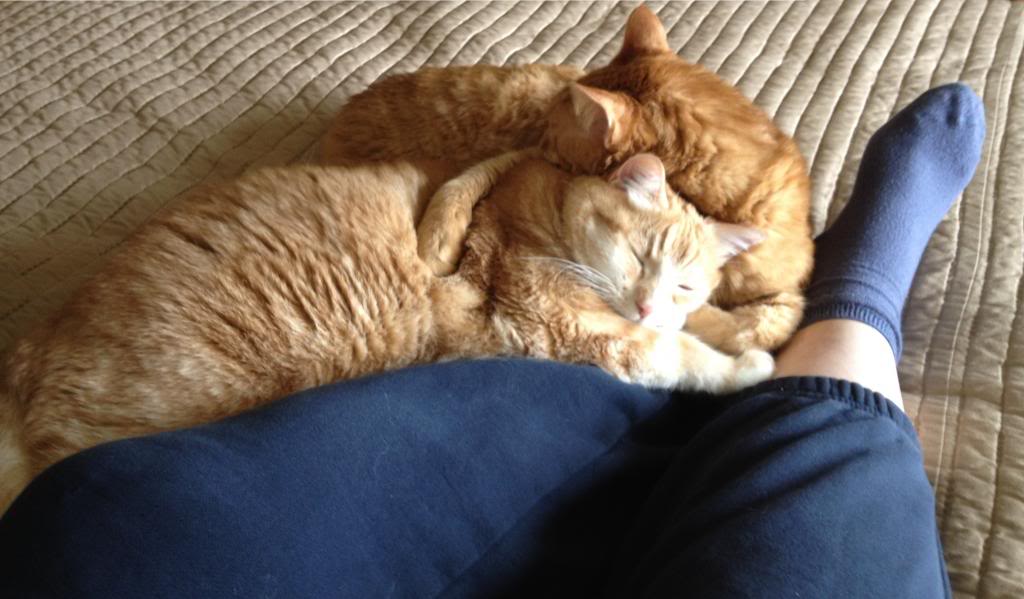
Share this:

Gratitude and Stewardship
I’m grateful to be here. Actually, I’m grateful to be anywhere. I’m grateful to be alive. The fact that I’m alive is a modern-day medical miracle.
In May of 2011, after a few months of a persistent cough, I was diagnosed with pneumonia caused by advanced lung cancer. No, I never smoked anything except a salmon. Five months after diagnosis, despite chemo and radiation, the cancer spread outside my chest and I was given at most two years to live. A year later, after more treatment and another recurrence, I learned my cancer had a rare mutation. Last October, I found a clinical trial that could treat that mutation with an experimental pill, and I flew to Denver to get it. In January, I achieved the dream of all metastatic cancer patients: No Evidence of Disease. My cancer is no longer detectable.
I am overwhelmingly grateful for everything and everyone that has brought me to this state of grace: medical science that discovered new ways to treat my condition, insurance that paid for most of my care, family and friends who supported me, a knowledgeable online lung cancer community, and all the prayers and good wishes lifting me up throughout my cancer journey. Thank you. I am truly blessed.
I am not cured. The trial drug only suppresses my cancer, and I have some permanent side effects. I’ll be in treatment for the rest of my days. Clinical trials will hopefully keep me feeling comfortable and capable for many months – even years. I am satisfied with living however long I might have.
Being given a second chance at life tends to give one a different perspective. Colors are brighter. A warm breeze rustling the trees makes the whole day worthwhile. Time spent with family and friends becomes precious.
A second chance at life also makes one introspective. Why was I spared when others died? Why does my mutation have an effective treatment when others don’t? Why am I able to see one of the best lung cancer doctors in the world when many patients can’t afford proper treatment?
Why am I still here? What purpose does the universe have for me?
Part of the answer to why I’m still here is, I am blessed with gifts that help me survive my cancer journey. I’m able to understand the medical science and my treatment. I’m able to explain what I’ve learned. And I’m able to advocate for myself with healthcare providers.
Yet I am just a steward of these gifts that were bestowed on me. Understanding my gifts has led me to a new purpose: I am here to help other lung cancer patients. I strongly feel this is my calling in the time I have left.
Lung cancer has a stigma attached to it. Few people know that 80% of those newly diagnosed with lung cancer are nonsmokers or never smokers. There is more to lung cancer than just smoking. Yet we are the lepers of the cancer community.
For this reason, some are ashamed to admit they have lung cancer. Most don’t know about the new treatments like the one I’m taking–even some doctors don’t know. Patients don’t know where to turn for answers.
Lung cancer patients need more than compassion. They need information. They need HOPE.
After considerable thought, I decided the best way to use my gifts was to go public about my lung cancer. At first, I only shared my story online with friends and lung cancer communities. Eventually I started blogging (which is essentially a journal open to the world on the Internet) and began speaking publicly about my cancer.
Going public with my lung cancer experience has already had an impact. As I’d hoped, it shows patients that people can live with metastatic lung cancer, and encourages them to ask questions about their treatment.
But going public has also brought completely unexpected benefits. It helps families understand what their loved ones who have lung cancer are experiencing. It gives hospital chaplains insight into their patients’ needs and feelings. It demonstrates to doctors that patients can be partners in their own care. It reveals to researchers how their work makes a difference in the lives of real patients.
In addition, I’ve realized a personal health benefit in sharing the gifts I was given to steward. Having a purpose gets me through the tougher parts of cancer treatment. It won’t heal my cancer, but it does help me live a healthier, happier life.
And it all started with being grateful that I’m alive.
Share this:
Feelings … Nothing More Than Feelings
This morning as I pulled into my garage after a quick errand, a favorite 80s song came on the radio: “Same Old Lang Syne” by Dan Fogelberg. Although I had a list of chores to tackle, nothing was urgent. I turned off the car and settled with my newly-acquired Starbucks smoothie to listen for a few minutes.
The song tells of a musician who encounters his old lover in a grocery store on a snowy Christmas Eve. Its imagery is very poignant: joy at an unexpected meeting, reminiscing over drinks in her car, trying unsuccessfully to talk about how they truly felt, going their separate ways. I’ve had one or two similar experiences in my life. As the music was ending, I found myself awash in regret and loss for the characters, and for me.
And then … I felt exhilaration. Not because the song was sad, but because I FEEL — intensely, overwhelmingly, to the exclusion of everything else, if only for a moment. Because I am still alive to feel it. Because emotions are part of this human experience.
And without lung cancer, I might never have appreciated that.
Inspired, I grabbed my purse and smoothie and hurried in to write. What a great way to start the day!
Share this:
A Measure of the Seasons
Today is our family’s Cider Making Day, one of several at our home.
Apple harvest in our Western Washington home orchard runs August to October. We have six varieties of apples that ripen at different times. Yesterday hubby Gerry and son David harvested about 60% of our Elstar and 50% of our Liberty apples, and collected apples dropped from the Chehalis and Spartan trees. About 100 pounds of these will go to the local foodbank. We’ll use the rest for cider and storage.
The first step in making apple cider at our house is washing off kaolin clay, a natural mineral Gerry sprays on our apples to make them less attractive to apple maggots and coddling moths. Next, we quarter the apples and cut out any bad spots (some maggots and moth larvae still sneak in)—this takes the two of us two to five hours, depending on how much cider we want to make and how much trimming the apples need. Gerry and David then press the cider outside in a custom-built wooden cider press. The product tastes amazingly like eating a fresh, tree-ripened apple. We’ll have gallons to last us through the coming year.

Washing apples for cider

The cider press
Making apple cider is a measure of the seasons in our house – we’ve been doing it about 15 years, since the trees Gerry planted in 1994 started bearing enough fruit. Over the past 29 months, it’s become a measure of my cancer seasons as well.
In September 2011, I had recently finished my first line of treatment (seven weeks of concurrent chemo and radiation). I was tired and weak. Instead of standing at the sink to cut apples, I had to sit on a stool, and I only lasted about an hour or two. I had a recurrence in October 2011. It was a terrible shock.
In September 2012, I had recently finished my second line of treatment (five months of chemo followed by six weeks of radiation). I was fatigued, but able to soldier through an entire batch of cider apples while sitting. I had a recurrence in September 2012. It was an unpleasant surprise, but I had a plan, and entered my current clinical trial shortly afterwards.
In September 2013, I’m in my third line of treatment (just finished my tenth month on Xalkori). My legs, feet and hands are achy from cumulative neuropathy and edema from treatments past and present, but I have energy and can once again stand at the sink and enjoy cutting apples while discussing matters great and small with my mate for hours. My next scan in is October. If I have another recurrence (and it will happen eventually), I know I’ll either have local treatment of the metastasis, or switch to another trial at University of Colorado.
Next year, my family will make apple cider again. Life goes on.
Share this:

Coping with Side Effects
I have a 20-pound lifting limitation on my right arm from radiation damage. My right brachial plexus — the nerve bundle that controls the right arm — took a full dose hit last summer.
I take an engineering approach to such limitations. I find myself looking at boxes I need to move and thinking, “If I take out these books, then the box is only 40 pounds, and if I divide that by two arms …”
I do not tell my radiation oncologist about these moments.
I hope he’s not reading my blog today.
Share this:
Still Dancing — OK, Walking — with NED
My August 12 PET-CT scan still shows No Evidence of Disease (NED). Woohoo! Having completed 10 cycles on Xalkori without progression, I now go to Denver at 8-week instead of 4-week intervals for my ROS1 clinical trial, and have labs drawn at my home clinic between Denver visits.
I have muddled my way through hamstring rehab and am back to VERY basic strength training with light aerobic exercise on the recumbent bike and treadmill. The best description I can find for my state of fitness is “wimpy.” If I walk one city block here at sea level at a moderate pace (about 2.5 mph), my breathing speeds up a good bit and my heart rate rises to 140! I have to use an oxygen compressor to walk in Denver without gasping or stopping after 500 feet. The persistent Xalkori-induced edema isn’t helping.
The physical therapist tells me it will take a looooong time to rebuild the muscles that have atrophied due to disuse and cancer treatment. I made sure she gave me clear guidelines about pacing my recovery, because, as you all know, I’m SO good at taking things slow.
I’ve developed something called “trigger finger” in my hands, and the oncologist says he doesn’t think it’s related to taking Xalkori (although edema might play a role). Because of this and some other issues, I’ve scheduled an appointment with my primary care doctor to discuss whether my thyroid is starting to misbehave in response to the radiation dose it received last year. However, other non-cancer conditions could cause my symptoms, too. Rather than diagnose myself (I know, I know — why stop now?) I’ll hear what my PC doc thinks.
So, here I am, just taking life slow, glad I’m around to enjoy the magnificent Pacific Northwest summer. I’ll be speaking at the World Science Fiction Convention in San Antonio this year over Labor Day, then mostly hanging around the house attempting to declutter and find the floor of my den once again.
Wait …
Wouldn’t it be wonderful if I could actually HIKE somewhere next year? Or take a cruise in the Mediterranean? Or …
Share this:
Moves in the Cancer Endgame
My dad taught me to play chess when I was small. I learned the game fast, and could soon beat other kids older than me. However, when I faced an opponent who was much more skilled than I, my attention eventually wandered. I lost the endgame because I’d lost patience.
A chess game transitions to the endgame when few pieces are left on the board. Whatever strategy positioned pieces prior to the endgame becomes irrelevant. The pawns, which initially were the least powerful pieces, become important.
Recently I was playing a much more highly-rated player online (thank you, Nancy Kress) and realized something in my attitude had changed: I had developed patience for the endgame. Even though I had been outmaneuvered and did not possess enough pieces to win, I kept looking for my next move. I wanted to keep the game going as long as possible.
Metastatic lung cancer is a tough opponent, and the odds favor it winning. Several powerful treatments didn’t finish it off. I haven’t many therapy pieces left. But I keep searching for my next move, even if it can’t give me victory. Clinical trials are now my best pieces in the cancer endgame. I want to keep playing — and living — as long as I can.
Cancer taught me patience for the endgame. Maybe someone else will learn from how I played.
 Gray Connections