The International Association for the Study of Lung Cancer (IASLC) is celebrating its 50th Anniversary! As part of the #IASLC50 celebration, the Lung Cancer Considered podcast takes a look at the past, present & future of the organization. In this episode, host @StephenVLiu focuses on the IASLC today and some of the ongoing efforts of the IASLC & its members. W/@ChristianRolfo, @JFreemanDaily & Dr. Emily Stone: https://bit.ly/LCC50IASLC#LCSM
For more information about the IASLC STARS program, visit iaslc-stars.org.
There’s still time to register for the STARS Webinar on “Advancing Trustworthy Artificial Intelligence for Cancer Research.” Hope you’ll join us tomorrow, Thursday, August 29 at 3 pm MDT (Denver time). Once you register, the Zoom link will be emailed to you.
The IASLC STARS (Supportive Training for Advocates on Research and Science) webinar will include a sampling of patient advocate research abstracts presented at the 2023 IASLC World Conference on Lung Cancer (WCLC23) in Singapore. A live Q&A session will follow, moderated by lung cancer patient and research advocate Janet Freeman-Daily. The speakers are Mentors for the 2023 IASLC STARS program:
• Upal Basu Roy, PhD, MPH, Executive Director of Research at LUNGevity Foundation • Andrew Ciupek, PhD, Associate Director of Clinical Research at GO2 for Lung Cancer • Jill Feldman, MS, lung cancer patient and research advocate • Anne-Marie Baird, PhD, president of Lung Cancer Europe (LuCE) • Lillian Leigh, JD, lung cancer patient and policy advocate
Educational Objectives:
Highlight range of research conducted by lung cancer research advocates and advocacy organizations.
Demonstrate effective communication of research topics to a broad audience.
Increase patient research advocates’ understanding of research abstract format and content presented at conferences.
Raise awareness of research advocates contributions to improving patient care and outcomes.
Live interpretation will be offered in these languages:
Chinese (Mandarin)
French
German
Greek
Japanese
Spanish (Latin America/neutral)
The webinar will be recorded and available for viewing afterwards in each offered language.
Cancer research advocacy encompasses several types of activities and a broad range of skills. The needs of the lung cancer patient population alone are HUGE, and no one person or organization has the time, skills, or bandwidth to address them all. The featured image on this post is a range of tall mountains for a reason.
I believe that the only way to stay engaged in cancer research advocacy over the long haul is to employ skills you enjoy using on projects that have personal meaning for you. I try to focus on activities that allow me to use my unique skills and (hopefully) improve outcomes for the greatest number of patients.
Some activities require multiple hours every week–these are my primary projects. Some have intense demands of several hours over a few days or weeks; examples are advisory boards, preparing a talk, grant reviews, or journal articles. Others may only require an hour or two each month, such as a serving as a patient advocate for a research committee.
To give you a sense of what one cancer research advocate’s activities might be, I’ve listed below those in which I’m currently involved. If this looks like a lot, please keep in mind that each advocate has a unique set of health and personal circumstances that influence how much of their energy and other resources they are able to give to advocacy. In my case:
I am retired, no longer have children at home, and have the luxury of choosing what I want to do with my time.
I’m on a cancer therapy that has tolerable side effects and leaves me with energy to do more than focus only on my own healthcare.
I get to use skills I enjoy (e.g., writing, speaking, analyzing), work with smart people who are dedicated and compassionate, and learn about subjects I love (science and technology).
The connections and reputation I’ve developed over ten+ years of lung cancer patient advocacy have brought me opportunities about which I wasn’t even aware when I first began advocacy work.
Primary Projects (several hours every week)
The ROS1ders nonprofit (co-founder, president, and board chair) A global group of patients and caregivers living with ROS1+ cancer that seeks to improve outcomes for all ROS1+ cancers through community, education, and research.
IASLC STARS program (co-developer and consulting staff)* STARS aims to increase the number of patient research advocates (PRAs) equipped to provide accurate scientific translation and patient perspective for lung cancer research and policy.
Advisory Panels
Fred Hutch/UW/Seattle Children’s Cancer Consortium External Advisory Board*
National Cancer Institute (NCI) PE-CGS Network External Advisory Panel
International Association for the Study of Lung Cancer (IASLC), Patient/Survivor member
American Society of Clinical Oncology (ASCO), Patient Advocate member
American Association for Cancer Research (AACR), Affiliate member
——————————-
Disclosures
When advocates provide value to projects, I believe they should be paid for their time, just as any other professional would be. I receive compensation for some activities (such as an honorarium for speaking); these are marked with an *. If an organization requires me to travel for a meeting, I receive compensation for travel expenses and often free conference registration.
Sorry I haven’t posted much in the past few years. It’s not because I’m sick — I still have no evidence of disease on scans after 10 years on the same targeted therapy for my ROS1+ cancer. It’s because I’ve been busy with living and with research advocacy projects.
Research advocacy brings the patient voice to research. By sharing the patient perspective with those engaged in cancer research, research advocates help keep research focused on what matters to patients with the goal of improving outcomes for patients.
For those interested in what research advocacy looks like, here’s an example.
If you’re an established lung cancer patient advocate and are interested in learning more about research advocacy, please consider applying for the IASLC STARS program.
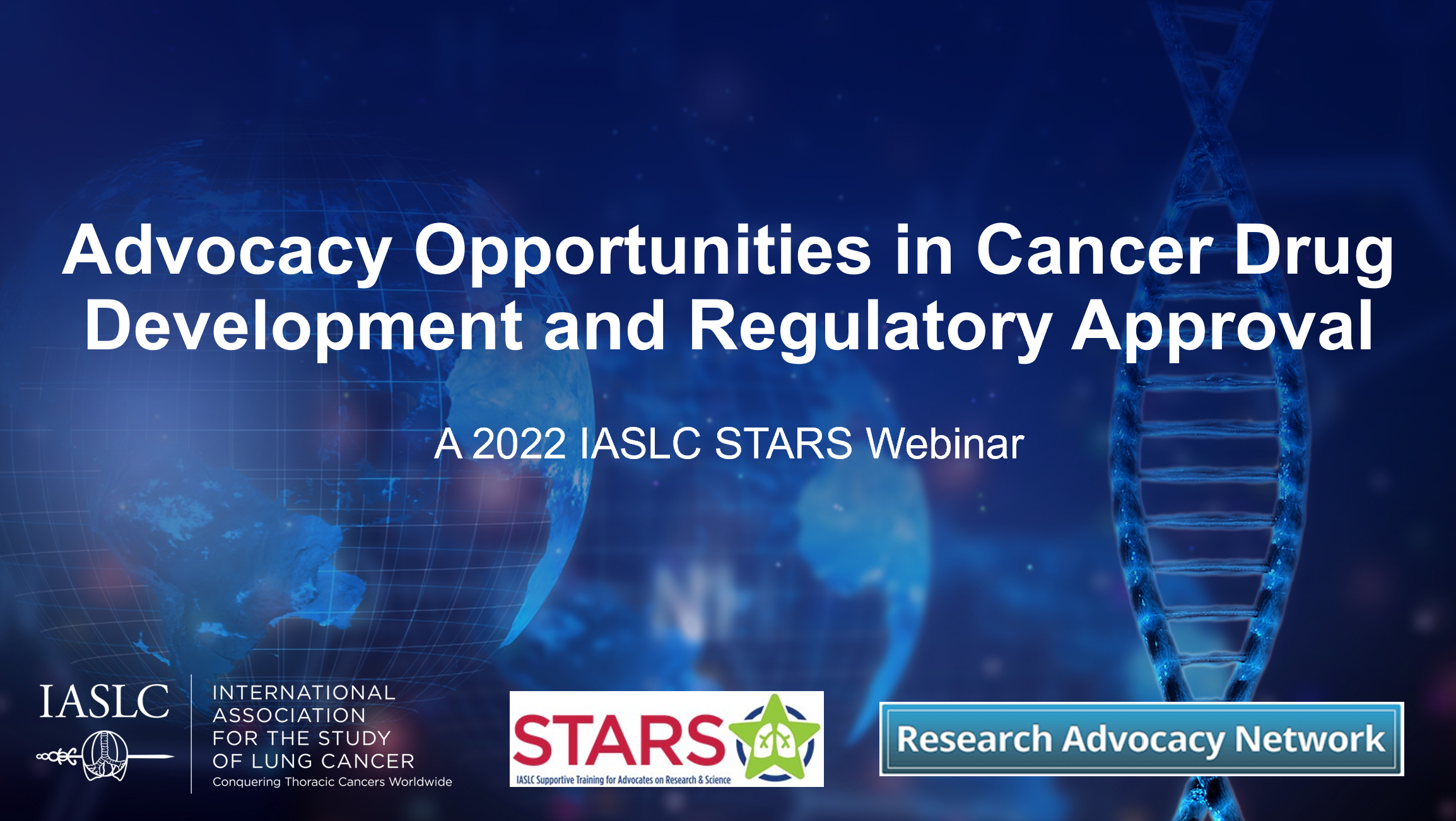
The IASLC STARS program invites STARS alumni and anyone interested in cancer research advocacy to join us for a webinar about cancer drug development.
When: Monday August 29, 2022, at 11:00AM Eastern Time
Title: Advocacy Opportunities in Cancer Drug Development and Regulatory Approval
Speakers: Upal Basu Roy, PhD, MPH, Executive Director of Research, LUNGevity Foundation Janet Freeman-Daily, MS, Eng cancer research advocate and STARS staff (moderator)
Languages: English, with transcript translated into Spanish after the event
Learning objectives:
Acquire a high-level understanding of the drug development process and timeline
Identify differences in global regulatory approval pathways and how they impact drug access
Identify advocacy opportunities throughout the drug development process
The International Association for the Study of Lung Cancer (IASLC) offers webinars, training and networking opportunities to lung cancer research advocates through its Supportive Training for Advocates in Research and Science (STARS) program. Thank you to our STARS partner Research Advocacy Network and our 2022 STARS sponsors Lilly, Bayer, BMS, and Genentech for supporting this event!
This presentation was given on April 6, 2022, by Janet Freeman-Daily (a lung cancer patient research advocate) at the IASLC 2022 World Conference on Lung Cancer (#WCLC22) in Vienna, Austria during the “Social Media + Communications Workshop.”
In May 2011—over 10 years ago–I was diagnosed with advanced lung cancer. At that time, chemo and radiation were the only approved first line treatments for advanced or metastatic lung cancer. Despite undergoing chemo and radiation (twice), my cancer spread to my other lung and became metastatic. I was not inspired by the five-year survival rate for metastatic lung cancer patients back then—it was around 2%.
However, in early 2011 a small clinical trial for a targeted therapy pill called crizotinib (trade name Xalkori) had begun for ROS1 positive (ROS1+) lung cancer. This cancer is driven by an acquired alteration in the ROS1 gene. This pill that sounded like an alien seemed to inhibit ROS1+ cancer in about 80% of people in the trial. That was amazingly effective for a cancer drug!
In the fall of 2012, I arranged to have my tumor tissue tested and discovered my cancer was ROS1+. I mentioned the clinical trial option to my oncologist, and he recommended I join the trial (even though it required travel) because the preliminary trial results looked promising. All he could offer me otherwise was a lifetime on a chemo that didn’t make me feel much like living.
I enrolled in the trial in Denver, Colorado—over 1000 away from home—on November 6, 2012, and hoped for the best.
I’m still here thanks to research. Today marks 9 years since I took my first crizotinib pill. I have had No Evidence of Disease (meaning no cancer shows up on any scans) ever since. Although I’m incredibly grateful to be alive and have a relatively normal life with tolerable side effects, I’m always looking over my shoulder. No one can tell me if I’m cured, because few others have been on the drug this long. Most patients find their cancer eventually becomes resistant to crizotinib and their cancer resumes growing. The population of ROS1+ patients is relatively small (only 1-2% of lung cancer patients have ROS1+ cancer), so research on our type of cancer is sparse. We have some clinical trials in process, but no second line targeted therapy has yet been shown effective enough to obtain any government approval.
That’s why Lisa Goldman, Tori Tomalia (may she rest in peace) and I–all people who had ROS1+ lung cancer–decided to do something about it. In the spring of 2015 we created a Facebook group for patients and caregivers dealing with ROS1+ cancer, and eventually formed a nonprofit known as The ROS1ders. Our mission is to improve outcomes for all ROS1+ cancers through community, education, and research. We have almost 800 members spanning 30+ countries, and are considered experts in our disease by some of the top oncologists in the world. We’ve already helped create new models of ROS1 cancer that researchers have used in published research.
We’re now planning a research roundtable in December to explore ways to collect real-world data on ROS1+ cancers, and will be hosting a ROS1 Shark Tank event next spring that will award two $50,000 seed grants for new ROS1 projects. We’re aiming to raise $100,000 this year to fund our work.
Cancer research advocacy is my passion. I’m able to use my skills and time to help make a difference for hundreds of other people living with ROS1+ cancers. It’s a purpose that keeps me going despite the ever-present specter of potential recurrence.
I know there are many worthy charities asking for money this time of year. Any small amount you can give will help accelerate research for hundreds of ROS1ders worldwide who, like me, are dying for more treatment options.
Show your appreciation for an individual who goes above and beyond to make a difference in the lives of those affected by lung cancer. If you know a hero who has inspired change, exemplified compassion or brought newfound hope to you or someone you care for, share their story by submitting an essay nomination for the 2021 Lung Cancer Heroes® awards. This is only the second year this award has been offered.
Are interested in discussing an ASCO poster with a lung cancer scientist?
The IASLC STARS program, KRAS Kickers, and LUNGevity have partnered with GRASP (Guiding Researchers and Advocates to Scientific Partnerships) to offer lung cancer poster reviews at ASCO 2021. GRASP is a grass-roots advocacy effort that started in the breast cancer community.
In the GRASP format, a scientist discusses posters with a small group of patient advocates and an experienced research advocate. Virtual GRASP sessions will take place the week after the official ASCO meeting with six different sessions over the course of two days.
To take advantage of this opportunity for the 2021 ASCO Annual Meeting, please join GRASP (it’s free!) and then go to GRASP advocate registration to register one of the five lung cancer poster sessions on selected topics. Please also consider signing up for one of the optional GRASP training sessions (May 26 and 27).
If you have any questions, please contact Julia Maues julia@graspcancer.org, patient advocate and cofounder of GRASP.
We look forward to seeing you at a poster session!












 Gray Connections