My 2014 Stanford Medicine X Experience (Sep 4-7)

I’m in Palo Alto, CA for four days attending the Stanford Medicine X (#MedX) conference, which focuses on emerging health-care technology and patient-centered medicine. The first day was a pre-conference workshop on Partnering for Health in clinical trials.

I’m having a blast! It’s like a giant TweetUp of patient advocates, healthcare providers, and technology innovators. I’ve met a dozen people that I’d previously only known online. Several of them are patients who are healthcare bloggers and tweetchat moderators like me and have diseases different than mine (diabetes, arthritis, lupus, other cancers, etc.) My roommate is a delightful young pre-med student who happens to love chocolate, and who has had no sense of smell for as long as she can remember (which is fortuitous, considering one of my Xalkori side effects).

Presentations and panels address the evolving nature of healthcare, with a strong emphasis on patient involvement. Some topics:
–How to include the patient voice when designing clinical trials
–How do patients who are not tech savvy (“no smartphone patients”) obtain medical records and learn about their disease?
–Technology to assist those with disabilities
–New apps and devices for improving outcomes (e.g., a device that tracks when bedridden patients need to be turned to avoid bedsores)
–The value of relationships in promoting health
–Training medical students and doctors to incorporate empathy in patient care and ask the patient what is important to them
–Patients self-tracking their health data (e.g., diabetes blood levels and insulin doses)
–Which metrics to use when choosing a doctor, and where to find them, and new ways to gather the info

At least half the people in the audience are interacting with their smartphones, laptops and tablets during the event. I can see how all the online activity is extending the reach of the conference, which is also being streamed live (except when the server crashes from overwhelming demand). It is fascinating to watch the presentations and simultaneously read a very active #MedX Twitter stream that summarizes, critiques and expands on what is being said.

I’ve seen some cool vendor demos also, like 3D printing of medical models and devices:

IMG_6646.JPG

My speech is tomorrow (Sunday September 7) at 10:10 AM PDT. Hope you’ll be watching via Medicine X Global Access! If you miss it, it will be posted online eventually.

I fly to Denver Sunday evening for my eight-week scan on Monday. I must admit this conference is a great scanxiety distraction.

Relax, Recoup and Regroup

Today is my day to relax, recoup and regroup.  Just for today.

Yesterday I pitched, hit, threw, and ran (a very short distance) in a relaxed, laughter-filled softball game at my 40th high school reunion in Tacoma’s Cheney Stadium.  Both during the game and the reunion dinner in the evening, I had a chance to visit with people who grew up with me.  I appreciated renewing and reinforcing friendships, especially since I likely will not be around for my 50th reunion.  As the “Faithful Scribe” of the Reunion and Softball Committees, it was a wonderful to see so many people enjoy the months of work that went into making these events happen.  I was also surprised (and pleased) to learn how many classmates have been following my lung cancer journey on my blog.  It was a terrific day!

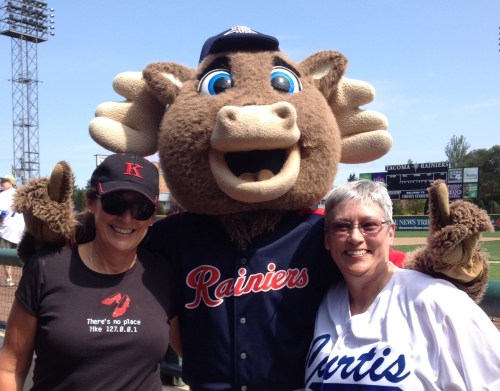
My sister Karen and me with Rhubarb, mascot of Tacoma Rainiers Baseball in Cheney Stadium

Now that the reunion is over, I’ve hit a turning point in the summer.  The looming deadlines imposed by outside events and projects have been met.  In addition to helping plan my high school reunion, I have been up to my eyeballs in lung cancer patient advocacy projects over the past three months:  working on the first-ever LUNG FORCE walk, collaborating with a group of metastatic patients on changes in lung cancer treatment guidelines, attending the big ASCO clinical oncology meeting in Chicago, preparing and giving speeches at conferences and events, writing articles and guest blog posts, and generating panel proposals about lung cancer for upcoming medical conferences.  Somewhere in there, I wrote blog posts, contributed to #LCSM Chat activities, researched new lung cancer developments, and communicated online with others in the lung cancer community.  I’m reminded why I’ve been feeling stressed this summer!

So, just for today, I’m resting up from all that exercise and socializing at the reunion, as well as reviewing what I want to do next.  I still have a long list of projects that don’t have externally-imposed deadlines.  I don’t handle pressure as well as I did before cancer (not that I handled it particularly well before) and need to wind down a bit and set priorities before jumping back into action.

And I MUST jump back into action.  I feel a pressing need to complete family and advocacy tasks ASAP, while I am able.  Even though I’m feeling pretty good right now, I can’t forget that my cancer might recur at any time, and people—including my friends—are dying of this disease every day.

But for now, I’ll bask in the fact that I just wrote blog post #100 for Gray Connections.

Tomorrow hubby Gerry and I start cleaning out the garage for the first time in 22 years.  No stress there.

Pondering Resources for Affordable Healthcare

I’ve been thinking about the US healthcare system thanks to a fascinating Facebook discussion with other Stanford Medicine X epatients.  Each of us are too familiar with the strengths and weaknesses of the US healthcare system and its mix of insurers: Medicare, employers, and private insurance companies.

My focus is this:  whatever healthcare system we decide to have in the US, we need to be able to pay for it.  The reality is that healthcare resources are not unlimited.

Whether or not a healthcare system is government run and/or devoted to serving the good of all people, the resources required to operate the healthcare system are driven by a free market.  Governments and nonprofits fund only a small percentage of healthcare research and development.  Healthcare providers still choose what type of work they want to do and where they want to live in order to enjoy life and perhaps support a family.  For-profit companies still choose when and how to develop and manufacture drugs and technology, which are required to provide treatment and services. The government can’t afford to fund and/or control all these resources completely (even if some think it should).

Even if healthcare were universally acknowledged (and it isn’t) to be a basic human right, any comprehensive healthcare system will still have to ration healthcare services such as time with providers, technology, and treatments.  As a metastatic cancer patient, I am acutely aware of the rising cost of cancer care.  The drug keeping me alive would cost about $10,000 per month if I weren’t getting it free in a clinical trial.  Even if we acknowledge that everyone deserves to receive the treatments they need, we simply can’t afford to treat everyone with leading edge medical care at those prices.

A good example of this quandary is the new drug Sovaldi, which offers a breakthrough and long-awaited cure for Hepatitis C.    More than 3.2 million people are chronically infected with hepatitis C virus in the US.  A cure with Sovaldi currently costs about $84,000 per person.  A little math shows curing all the US patients would cost around $270 billion–and the cure is not permanent (people can get reinfected with the virus). Having health insurance cover that $270 billion could break the healthcare system and put premiums out of reach for many, no matter whether the system is structured as private pay, single payer (government health system), or a mixture of the two. So who gets the treatment?

Other countries with single payer, government-funded health plans solve this problem by limiting services they cover.  For instance, the National Health Service in the UK will not pay for the lung cancer drug, crizotinib (approximately $10k/mo), even though the drug can give a small population of lung cancer patients years of quality time.  When the government must consider how to use its resources to provide the best care for the nation as a whole, they decided the cost to keep that small group of cancer patients alive for only a year or two is too high.  So people who can afford crizotinib in the UK pay privately, creating a two-tiered health system.

You can’t duck the issue by simply saying, “Get rid of the gatekeeper insurance companies.”  Because healthcare resources are limited, and provided by a market economy, SOMEONE or SOMETHING is going to be the gatekeeper.  Who should it be?  Insurance companies? Government?  Healthcare providers?  Medical societies? Pharmaceutical companies?  Companies that manufacture generic drugs?  Research institutions?  Individuals?

To me, the most important questions are these:

1. What guidelines should our healthcare system use to determine who gets healthcare, so that everyone is treated in the same fair and ethical manner?

2. Who gets to make and enforce those decisions?

You might want to learn more about these questions.  The next person who declares bankruptcy due to a health crisis such as a heart attack or metastatic cancer may be you.  Or your child.

My Worst Speech EVER

Last night I gave the worst speech of my life.  Everything that could go wrong, did.

I misunderstood the start time, and arrived late to the venue. Many of the seats in the once-filled room were now empty. People were partying audibly in the hallway.  I walked out onto the empty stage and discovered the fly of my pants was open.  I turned around to zip it, and when I turned back, a large potted plant blocked me.  I stepped around the plant to start speaking, and immediately began stammering nonsense.  An audience member in the front row imitated me and laughed. I finally found my words, but they were somewhere in the middle of my talk– everything was out of sequence.  I couldn’t find my place in my notes. Another audience member began lecturing about what I was doing wrong, and I had to ask him to be quiet so I could continue.  As I spoke, people stood up and walked out.  When I finished, none of the few remaining attendees clapped or looked at me.  I walked out of the building to find people on the street commenting to each other about how bad my speech had been.

I completely failed to deliver an effective speech.  And …

The world did not end. Life continued.

Living with metastatic cancer gives one a different perspective about small things like failure.  I don’t want to waste precious time fretting over what hasn’t gone right in my life.

Failure won’t kill me. It just teaches me what to do better the next time.

Like not having spicy barbeque sauce on a snack before bed.  It gives me weird dreams.  I’d rather not have that dream again.*
*Added that last sentence about 5 hours after the original post — evidently people didn’t catch my hint that this was a dream.  Sorry I was too subtle.  I don’t often hear that adjective applied to me!

Speaking at 2014 Stanford Medicine X

I’m looking forward to attending the 2014 Stanford Medicine X Conference (#MedX on Twitter) as an ePatient Delegate September 5-7 on the campus of Stanford University.  The conference, now in its third year, is the leading patient-centered conference on emerging technology and medicine.

This conference will give me an opportunity to meet and interact with other epatients (engaged and empowered patients who participate in their medical care) as well as innovators who are providing the technologies that enable epatients to learn about their health conditions, track their health status, and share their experiences with others.  I hope this will teach me more about how to use social media to provide lung cancer patients with hope and useful information, raise awareness of our disease, and contribute to research and clinical trials.

I will be speaking on the MedX mainstage about “Making Lung Cancer Visible” on Sunday, September 7.  My speech will be in the Ignite format (5 minutes, 20 slides that automatically advance every 15 seconds), which will be a challenge for my chemobrain!  According to the 2014 MedX schedule,  my talk will be the second in a group of epatient talks that start at 10 AM Pacific Time Sunday 9/7; my talk should start around 10:10 AM.

If you’d like to watch my talk live, please sign up IN ADVANCE (FREE!) for the Stanford Medicine X Global Access Program.  This will allow you to watch all MedX events via livestreaming on the Internet.  If you’re unable to watch it live, my talk will eventually be made available on the MedX YouTube channel — I’ll post the link here when it becomes available.

Edit Sep 17, 2014:
Stanford Medicine X talk posted my talk on YouTube — see it here.

Finding My Voice

Tonight (July 31) at 7 PM Pacific Time I will be the first of six speakers sharing our cancer journeys at “Community Voices: Stories of Survival“. My talk titled “Finding My Voice” will tell the story of why and how I became a lung cancer patient advocate. The event will stream live on the Internet tonight, and will be available later as a podcast and video. Thanks to The Story Collider and the online community Smart Patients (who teamed to create this show in San Carlos, California) for inviting me to participate!

Stuart Scott Knows How to Beat Cancer

This year’s ESPY awards honored ESPN anchor Stuart Scott with the Jimmy V Perseverance Award for his ongoing battle with cancer. The intro by Kiefer Sutherland and tribute video are inspiring, but my favorite part is this line in Scott’s acceptance speech:

“When you die, it does not mean that you lose to cancer. You beat cancer by how you live, why you live and the manner in which you live.”

He gets it. And he lives it.

20140729-081017-29417567.jpg

Beyond First Base

Yesterday I played softball.

Nothing formal — a group of friends played a leisurely, good-natured game on a seriously foreshortened backyard diamond after a meeting. It was practice for my 40th high school reunion in August, when 42 of us who grew up together are going to play softball in Tacoma’s Cheney Stadium–home of the Tacoma Rainiers (the Seattle Mariners’ AAA team).

This may not seem like a big deal to you. People play casual softball at family gatherings and summer picnics all the time. So what?

Well, it’s a milestone for me. You see, my body is different now. Yes, I’m two decades older and considerably softer than the last time I hefted a bat. But the real difference is not immediately visible: cancer treatment changed how my body performs.

I was a tomboy, relatively athletic for a girl growing up in the 60s. I could run and jump and throw, and I was pretty fast. As a kid I played sandlot ball with the boys because I “didn’t throw like a girl.” I played softball most every summer after I turned ten. I played the available intramural school sports and lettered in track in the first year it was open to girls. In college, I continued playing intramural sports and spent a year on the women’s club softball team. After graduation, I joined a Masters swim team and hiked with The Mountaineers. Later I ran 5Ks, rode my bike for miles, and played adult slow pitch for several years. I wasn’t truly a “jock,” but I knew how to move.  As I aged, I moved less, and would occasionally allow myself to get sedentary and out of shape, but in a bout of remorse I would get myself back into shape again. I was fit and healthy when I got diagnosed with lung cancer in 2011.

Now? Chemotherapy left me with peripheral neuropathy that occasionally interferes with walking and balance—my feet can’t sense the ground reliably. Radiation to my chest caused scarring and volume reduction in my lungs, so my oxygen level drops when I walk at a modest pace. Radiation to my right collarbone area hit a main nerve bundle, which causes some weakness in my right arm and a risk of damage if I lift too much weight with it. A year of steroids packed on the fat while decreasing my muscle tone. My current targeted therapy causes edema in my legs and hands that affects their movement and comfort. Some combination of side effects keeps my red blood cell count just below normal, which saps my stamina and ability to move quickly. I do exercise regularly on the treadmill and elliptical, but I can’t yet get the pace anywhere close to a brisk walk for more than 30 seconds without breathing fast and hard.

I’m not complaining, mind you–I’m happy to be alive and have a relatively normal life on my current targeted therapy. But I must face reality: the body I have now is not the same one I had Before Cancer.

That’s why that low-key softball game was such a revelation for me. The moment I put the glove on my left hand, my body recalled those days on the softball diamond. After some initial fumbles, I caught the ball easily when it was thrown to me. After a few gentle tosses, I could throw the ball to another and actually hit their glove. After couple of wimpy at-bats, I connected with the ball. And when I ran to first base, I moved faster than a walk. I’m not exactly sure what to call that gait (it wasn’t running, it wasn’t jogging, and it certainly wasn’t graceful), but I got to first base before the ball did, probably due to the good graces of the fielders—thanks, guys, I love you.  For about twenty minutes, I was a softball player again.

When the next batter hit the ball, I just barely made it to second base, but I was safe. I stood tall with both feet on the bag, reveling in my accomplishment as I gasped for air. And it occurred to me that maybe, just maybe, regular training could get me to second base in August without breathing quite so hard. I had been thinking I would only pitch during the game and let others do the batting and running. But maybe I COULD bat, and “run” too–especially since the game rules allow players up to five minutes to get to first base (note to future reunion attendees: Reunion Committee members get to write the rules).

After crossing home plate, I excused myself from the game and sat down to catch my breath. My friends played on. I resolved that I would be on that field in Cheney Stadium as long as my breath and body held out.

I WILL get beyond first base in August. I know there’s no stealing in softball, but to steal a James Bond phrase: there’s no point in living if you can’t feel alive.

20140721-224516-81916172.jpgSee? I DID make it to second base! (Credit: Sandi Allen Estep)

Meeting the Chemist

This post originally appeared July 15, 2014, in ASCO’s cancer.net blog. Reposted with permission.
—————————

My first ASCO Annual Meeting was an educational and exhilarating experience. As a science geek, I loved learning about new cancer treatments from leading researchers. But the highlight for me happened in a noisy back corner of a crowded poster session when I met Dr. J. Jean Cui, the chemist who is saving my life.

A little backstory: I was diagnosed in May 2011 with stage IIIa non-small cell lung cancer (NSCLC). After two series of chemo, two radiation protocols, two recurrences, and promotion to stage IV, I was told I’d be on chemo for the rest of my life. Thanks to “CraiginPA,” who I met in an online support group, I learned about a tumor mutation called ROS1 and arranged to have my tumor tested. I’m now enrolled in the same ROS1 clinical trial as CraiginPA, taking a pill called crizotinib (Xalkori) to suppress my lung cancer. I’ve had no evidence of disease (NED) status since January 2013. I know my cancer will likely return, but for now, life is almost normal.

CraiginPA and I both attended the 2014 ASCO Annual Meeting as patient advocates. We met “in real life” in Chicago the day before the meeting began and attended many sessions together. On the third day, June 1, we went to a lung cancer poster highlights session. Similar to a high-powered science fair, the session featured 25 large posters explaining ongoing studies, each with a researcher standing by to answer questions. One poster described a study of our drug crizotinib for ROS1 in Europe.

While we were tag-teaming the researcher with questions, we noticed two representatives of the pharmaceutical company who makes crizotinib standing nearby. We introduced ourselves and moved to a table to discuss when our trial drug might obtain FDA approval for ROS1.

After several minutes, one of the reps smiled and said, “Jean is here.”

CraiginPA’s face lit up. “She’s the chemist—the lead inventor who developed our drug!”

My geek meter pegged at ecstatic. The chemist who invented the drug that was keeping me alive was HERE!

“If I see Jean, I’ll tell her you’re looking for her,” one of the reps said. They excused themselves to talk to another researcher.

A bit giddy, CraiginPA and I went back to digesting the ROS1 poster. We had started debating where the drug actually bonded with the ROS1 protein on our tumor cells when a smiling young woman approached us.

CraiginPA recognized her instantly. “Jean! So good to see you again.”

I felt like I did when I’d been introduced to idols like Nobel Laureate Physicist Richard Feynman or MD/PhD/Astronaut Story Musgrave. This was not some academic stuck at a bench with glassware and data analysis. This cancer rock star was a real person, and she seemed just as happy to meet us as we were to meet her. How often does a researcher get to see the living, breathing proof that her work saves lives?

We hugged all around and coerced someone into taking a picture with Jean’s smartphone. I couldn’t have grinned any wider.

For the next 20 minutes, Jean fielded our questions about her background, why she chose chemistry as a career, and how her team designed the drug. CraiginPA and I were like two kids getting a peek behind the Wizard’s curtain at the magic of cancer research. We agreed this experience was easily our highlight of the meeting, especially for me since I experienced it with CraiginPA who first told me about this drug.

Later Jean emailed us the picture, along with an invitation to ask her any further questions we might have—a perfect end to an amazing day.

So stop me if you’ve heard this one: a patient advocate, a pharma rep, and a chemist walk into a poster session…

20140715-110726-40046427.jpg

New Take on an Old Excuse

Like many housecats I’ve met, my cats have quirks. Admiral Dufus demolishes cardboard boxes and chews paper, while General Nusiance licks plastic bags.  I don’t know why they do this.  Perhaps they lack certain minerals. Perhaps their tongues like the taste or texture. Perhaps they’re studying how humans react to the behavior of feline companions.

While Admiral’s tendency to shred papers has caused some inconvenience, General’s fondness for licking things has not been an issue.  Until now.

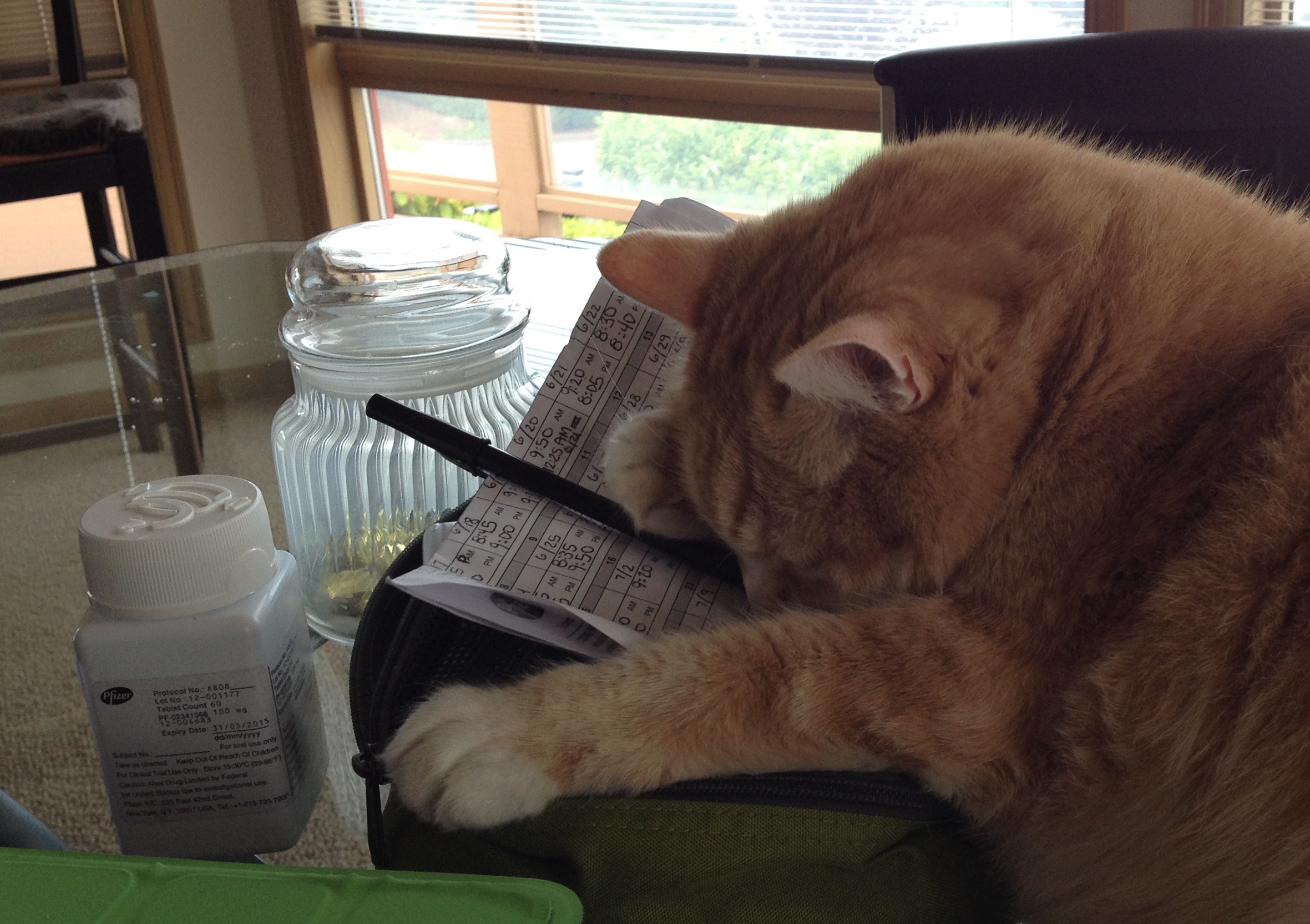
I never told a teacher “the dog ate my homework,” but as of this morning I have to explain to my cancer clinical trial that my log of dosing times for my trial drug may be hard to read because …

 “My cat licked my journal.”