Dear Congress: Please Consider Lifetime Caps and Pre-Existing Conditions Carefully

Dear Congress:
Some voters say they don’t want the government or insurance companies to spend THEIR money on other people’s healthcare.  They think repealing the Affordable Care Act will fix all their healthcare problems.
They probably are not aware that “other people” will likely include them or someone they love at some point.  All of us risk the ravages of accidents, illness, and age, and 39% of US citizens will get cancer in their lifetimes (per the NCI’s current SEER data).
nci-seer-cancer-fact-sheet-2016-all-cancers
Before the ACA was implemented, cancer was a “pre-existing” condition that prevented anyone who’d had it from obtaining health insurance, and most healthcare plans had “lifetime caps” on how much they would spend on individuals.  My exceptionally great employer-provided health plan’s lifetime cap was $250,000 before the ACA.
My insurance company was billed more than $250,000 during my very first year of advanced lung cancer (I was diagnosed May 2011).
If the lifetime cap and pre-existing conditions clauses were in place last year, I would have lost my health insurance, and likely would have no option to buy more. I would have been responsible for paying about $98,000 in 2016 alone in billed healthcare services and treatments (assuming I could still get my targeted therapy cancer drug free through a clinical trial). That’s despite not having other major health issues last year, like hospitalization for pneumonia or cancer treatment side effects.

I know the ACA is not perfect. I applaud any effort that will improve healthcare coverage in the US.  But repealing the ACA without a suitable replacement is not going to solve our health care crisis.

If you allow pre-existing conditions and lifetime caps to be reinstated, you will be forcing an estimated 14,140,254 cancer patients to choose between bankrupting their families, or foregoing treatment (and probably dying).

One of those people will be your constituent … or even someone you love.
Please consider your healthcare options carefully.  The life you save may be your own.  A six-figure salary is peanuts compared to cancer treatment.

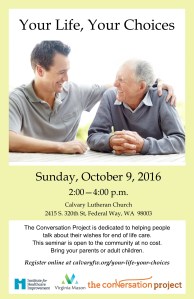
Your Life, Your Choices — A Conversation

your-life-your-choices-poster_10-9-16

If you live in the South Puget Sound area of Washington State, and are interested in starting a conversation with family members about what’s important to you when you think about the end of life (which comes to all of us, though we know not when), please join us on Sunday, October 9, 2016, at Calvary Lutheran Church in Federal Way, Washington, at 2 PM for a free two-hour workshop.  Ann Hagensen, RN, FABC, (Virginia Mason Medical Center) will be presenting materials based in part on The Conversation Project. She will be joined by Karen Freeman Worstell (transformational grief coach and founder of NarrowBridge Solutions), Pastor Lori Cornell (of Calvary Lutheran Church), and myself.

This is a topic of vital interest to me, and not just because I have metastatic cancer.  I have extensive experience exercising durable power of attorney and navigating communications between family members over estate and end-of-life choices. I know friends who had serious accidents or died unexpectedly without having these conversations with their loved ones, and as a result their family members were completely unprepared for the decisions they faced. Because this is so important to me, I serve as an advocate on regional and statewide initiatives to identify and honor patient goals of care and end-of-life wishes.

I hope you’ll join us!

Cancer Choices: Quality of Life versus Quantity

Life has an odd way of reinforcing its lessons.

Due to my own lung cancer journey, I’ve learned a lot about the uncertainties of cancer diagnostic procedures and treatment. I’ve learned that cancer is sneaky; sometimes it doesn’t announce itself until it is in advanced stages, doesn’t behave as expected, doesn’t present a clear diagnosis with a “best” treatment option. And I’ve learned the value of making treatment choices that allow the patient to do what matters most to them, rather than prolonging life at any cost. For many patients, qualify of life is more important than quantity of days.

Recently, life gave me the opportunity to apply my hard-won wisdom to my beloved 14-year-old cat, General Nuisance.

General is a fluffy, snuggly ball of love. He has been MY cat since … Read more

img_1484

How do you see a good death?

An emergency room physician has written a great piece comparing what dying is like today compared to a century ago.  The experience today isn’t necessarily better. Everyone needs to read I Know You Love Me — Now Let Me Die by .

The majority of humans will experience a gradual decline and loss of function in their lives before they die. Everyone–healthy or otherwise–needs to talk with loved ones NOW about what quality of life means, and how they would prefer to spend their last days. Because we WILL die.

Unfortunately, one can have all the Advance Directive paperwork in place and still have one’s wishes overridden by the hospital if the papers are not in the right hands at the right time. Also, Advanced Directives cannot cover every possibility–for instance, do you want your pneumonia treated with antibiotics if you’re already cognitively impaired by dementia? That’s why it’s so important to make sure loved ones know your wishes and will ensure they are carried out to the best of their ability.

Visit The Conversation Project to get started.

Gratitude, Year Four

What does it mean to be thankful when you have metastatic lung cancer?

Four years ago on Thanksgiving, my extended family gathered for a somewhat somber meal. I had been diagnosed with advanced lung cancer the previous May, and despite aggressive treatment, the cancer had spread further. Although the tumors in my left lung and between my lungs were shrinking due to chemo and radiation, the new mass at the base of my neck was starting to threaten my carotid artery. I could see it growing week by week. I felt flashes of hope mingled with panic, anger and regret. Lung cancer is the biggest cancer killer for both men and women and the survival rate for metastatic disease is less than 5 percent. My presence at future family gatherings was far from assured.

This year, I am immensely grateful to have seen three more Thanksgivings and to have no evidence of disease for three years and counting.

I’m grateful for the support I’ve received from so many throughout my cancer journey. I’m grateful for compassionate … READ MORE

“Moving On” — a yarn about knowing when to let go

The short film “Moving On” touched me both as a daughter who made care choices for dying parents, and as a metastatic lung cancer patient who is likely facing death sooner rather than later. It’s especially poignant since I spent yesterday in a workshop about palliative care and end of life. I needed several tissues after the subtle headshake, yet the tears were cathartic.

I pray all of us and our loved ones will  make the most of whatever time we have together, and know when it’s time to let go of the yarn — whether for ourselves or for those in our care.

Please remember to touch and be touched by your loved ones before the yarn is all gone.

Thanks to Lucy Goddard Kalanithi for sharing the link.

Reflections on a Cancerversary

Today is my fourth cancerversary.  Four years ago–May 10, 2011–I first heard a confirmed diagnosis of lung cancer.  On cancerversaries I review events of the past year and assess how I’ve spent my time.  I’m not looking to pat myself on the back for my accomplishments, or check locations off a travel list.  I’m looking to see if I stayed focused on what means the most to me, and whether I need to adjust my priorities.  My time is too precious to waste… continue reading 

Dying the Best Death – It’s Not Cancer

dying flower

Richard Smith wrote a New Years Eve opinion on The BMJ blog titled Dying of Cancer Is the Best Death. Early in the piece, he asks, “How do you want to die? You must think about it.”

As a metastatic lung cancer patient, I have spent significant time thinking about my death, which will likely come sooner rather than later.  I believe it’s important for people to accept death as a part of life and discuss end-of-life preferences with loved ones while life is still pleasant.

But Smith’s piece is not about awareness of death and treatment options.  It is about the best way to die.  And Smith gets it entirely wrong. I cannot accept his conclusion that cancer is the best death.

In Smith’s admittedly romanticized vision, a dying cancer patient “…can say goodbye, reflect on your life, leave last messages, perhaps visit special places for a last time, listen to favourite pieces of music, read loved poems, and prepare, according to your beliefs, to meet your maker or enjoy eternal oblivion …it is achievable with love, morphine, and whisky. “

The reality is that death from cancer often does not conform to Smith’s vision.  Death by cancer happens when tumors cut off your air supply, compress your heart so it can’t beat properly, block your gut so you can’t eat, cause organ failure, erode your bones, press on nerves, or destroy bits of your brain so you can’t control your body or think properly.  Sound painful?  Without pain medication – sometimes even WITH morphine and whisky – it is.  Yet according to the European Society for Medical Oncology, the majority of people in the world who die of metastatic cancer are NOT given the option to receive pain medication such as morphine. “Among patients with terminal cancer, 80% are estimated to experience moderate to severe pain due to inequitable access to medicine.” And this isn’t happening only in third world countries.

Not all forms of cancer give patients the luxury of time to set their affairs in order, resolve family issues, or tackle that bucket list.  In my too-familiar world of lung cancer, the majority of patients are diagnosed when the disease has already spread to the brain or other organs.  Among the lung cancer patients I’ve come to know online through their own posts or those of their caregivers, death can claim patients before they have established financial security for their family, raised their children, finished college — or even had time to recognize that they are dying. Many linger after they’ve lost the ability to do what they love, communicate, or think clearly. Most will eventually find themselves dependent on others for their basic needs while still aware of the emotional and financial stresses their illness imposes on their loved ones.

This is not the death I would prefer.

And then, Smith tacks on his ulterior motive: “But stay away from overambitious oncologists, and let’s stop wasting billions trying to cure cancer, potentially leaving us to die a much more horrible death.”

Wow.  If you follow this reasoning to its logical conclusion, we need no medical profession.  You’re going to die at some point, and being cured of one disease just means you’re going to die of something nastier later.  When you get sick, just take the morphine and whisky and get it over with.  Too bad we wasted our resources discovering antibiotics that cured the top three killers in the USA in 1900:  pneumonia/influenza, tuberculosis, and gastrointestinal infections.  Now people must die of heart disease or cancer instead.

**Deep breath**

I’ve lived long enough to know what different kinds of death look like.  A parent died from dementia over a decade.  Friends were struck down quickly by accidents or sudden sickness.  Other friends have dealt with organ failure, cycling in and out of good health.  And too many in my online and real life community have died of cancer.  Some metastatic cancer patients pursued clinical trials and aggressive treatments in search of a cure, while for others, solely palliative care was a brave and appropriate choice.  Ultimately, only the patient can decide which approach to treatment is the best for them.  Thanks to cancer research, most have some options, and some (like me) live comfortably for years.

Few of us know for certain how or when our death will come.  It would be lovely if Richard Smith’s idyllic vision of cancer death were true:  we could all know when death was near, take time to prepare, then take a pill and die comfortably.  Those who live in states that support death with dignity can actually make that choice, but most just have to wait for the credits to know how their story will end.

If I could choose my form of death, I would live each day with full awareness, do and say what’s important while I can, enjoy life and my loved ones as much as possible, and die quickly in my sleep.

I would not choose cancer.  If I could choose.

Joe Cocker Dies from Lung Cancer

Although I’m saddened by his death, I’m glad Joe Cocker’s obituary stated lung cancer as the cause of death. Only when prominent people are brave enough to admit they have lung cancer (despite the stigma) will the public realize the prevalence of the biggest cancer killer. All you need to get lung cancer are lungs.

RIP, Joe.

A Fog of Feeling

An onshore flow is washing over the Puget Sound this morning. The mocha-thick fog smells of shoreline and decaying leaves.  Fall is wafting in, and it soon will be dark when I get up at 7 AM.

If you detect a bit of melancholy in my words, you’re right. My emotions are foggy.  It’s been a week of highs and lows.

Yes, the highs outnumbered the lows. Friend and lung cancer advocate Tori Tomalia (who has the same type and stage of lung cancer as me) gave an inspiring and moving speech at a lung cancer event.  Someone found my blog by googling “wonderful late stage cancer blogs.”  A Facebook friend said my Stanford Medicine X speech on lung cancer stigma changed her life.  And a new lung cancer drug received Breakthrough designation by the FDA for those with ALK-positive non-small cell LC.

But the down came late, and hard: another stage IV lung cancer patient with my genomic mutation (ROS1) died yesterday.  Burton, a Harvard grad, was only 26.  He didn’t even have time to marry his fiancée, Emily (who’s been blogging about Burton’s lung cancer since April).

Being part of lung cancer community that includes advanced and late stage patients means the community, however educated and motivated, will lose members. I’m almost numb to it by now.  But I still feel something, even when the lost member is someone I’ve known only through Emily’s “ros1positive” blog.

For no logical reason, Burton’s death also makes me a bit anxious about my monthly blood work tomorrow. I’ve had so many blood draws over the past 3 years that I don’t really think about them.  But now, for the first time, I’m wondering if the blood draw will hurt, or if the nurse will even be able to draw my blood.  Last month my power port was seriously misbehaving, so I had to have the PET scan tracer and CT contrast injected into a vein on the flat inside of my left arm.  The tracer injection was fine, but the pressured injection of contrast HURT.  By the next day, I had a lumpy blood vessel at the injection site, and skin around the vein was angry red.  A month later, that section of vein is more black than blue.

My port is misbehaving on most scan days now, and the fibrin sheath I’ve grown over the tip of my power port’s catheter is getting tougher and tougher to remove. It may be time to have my port replaced.  Yes, it’s only minor surgery, but it means losing a day to the anesthetic  and accepting considerable discomfort around the surgery site for a week or so.

Being good at growing a fibrin sheath is not a useful skill. I wish I could grow something over my emotions when yet another friend who has lung cancer dies.