On October 14 I gave a brief talk at the STAT Summit in Boston, Massachusetts. You can watch the video here. The text of the talk is behind a paywall on the STAT site, so I’m sharing it here along with the sllides projected during my talk. Hope you find it valuable.
In May I celebrated my 15-year cancerversary. Back in 2011, when I learned I had advanced lung cancer, the majority of people with lung cancer died within a year of diagnosis. I was 55, younger than the average lung cancer case, and otherwise healthy with no known risk factors. When I first heard my diagnosis, my world turned upside down.
I was considered curable and was treated with chemotherapy combined with radiation. Being a writer and a science geek, I sought to learn as much as I could about my disease. The online lung cancer patient forum I joined informed me about symptoms and side effects, clinical trials, and the newly emerging field of molecular testing.
During a treatment break to allow my blood counts to recover, a 3-inch mass grew on my collarbone. I arranged to get molecular testing through a clinical trial, but all tests were negative. I had more chemo and more radiation. The post-treatment scan showed my cancer had metastasized to my other lung.
A person in the online group was in a clinical trial in Boston and told me I fit the profile of patients who might have cancer driven by a ROS1 rearrangement which occurred in 1-2% of non-small lung cancer cases. I asked my local oncologist about ROS1 testing, but he didn’t know anything about it. He said I would be on chemo for the rest of my life, which probably would be short.
And then, to quote a favorite Far Side comic, a miracle occurred.
I was visiting my nephew in Denver when I realized the cancer center that had done my molecular testing was nearby. I emailed to ask if I could drop in to say thank you. The researcher who had led the trial met me in the lobby. He told me their lab had developed and validated a test for ROS1, and they had some of my tumor tissue left.
I gave him permission to test my remaining slides. A few weeks later, he called to tell me my tumor tested wildly positive for ROS1, and they were holding their last slot in the ROS1 clinical trial for me.
I started a daily pill called crizotinib on November 6, 2012. I have had no evidence of disease on every scan since. I am not cured. I must continue taking the drug, but I am alive and have a good quality of life.
I hope someday every person living with this cancer will have access to a miracle. Alas, not all people have such good outcomes. Not all are offered biomarker testing or treated by doctors familiar with their subtype of lung cancer. Not all are informed about or have access to clinical trials. Not all respond to treatment or experience long responses.
I decided to give back. I became a patient research advocate.
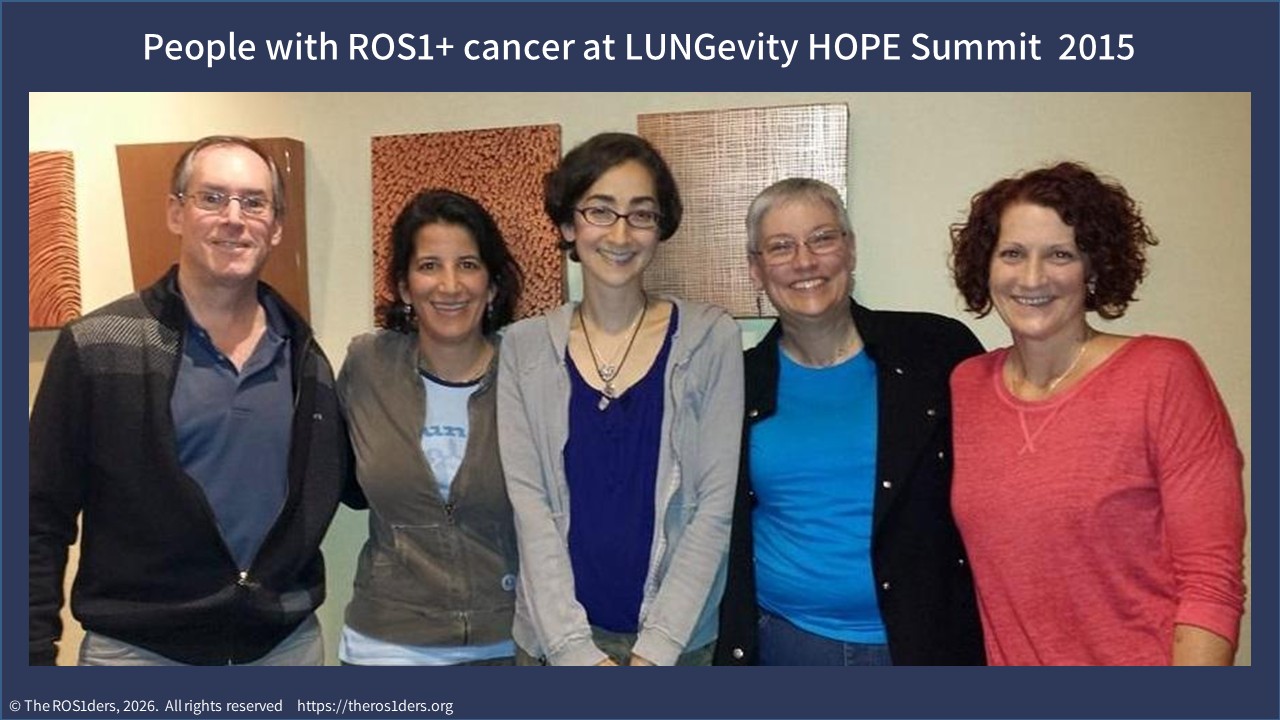
In 2015, five people with ROS1+ cancer met in a bar at an advocacy event. We were all on crizotinib, we all had kids at home, and we all had no other treatment options except chemo. We chose to act.
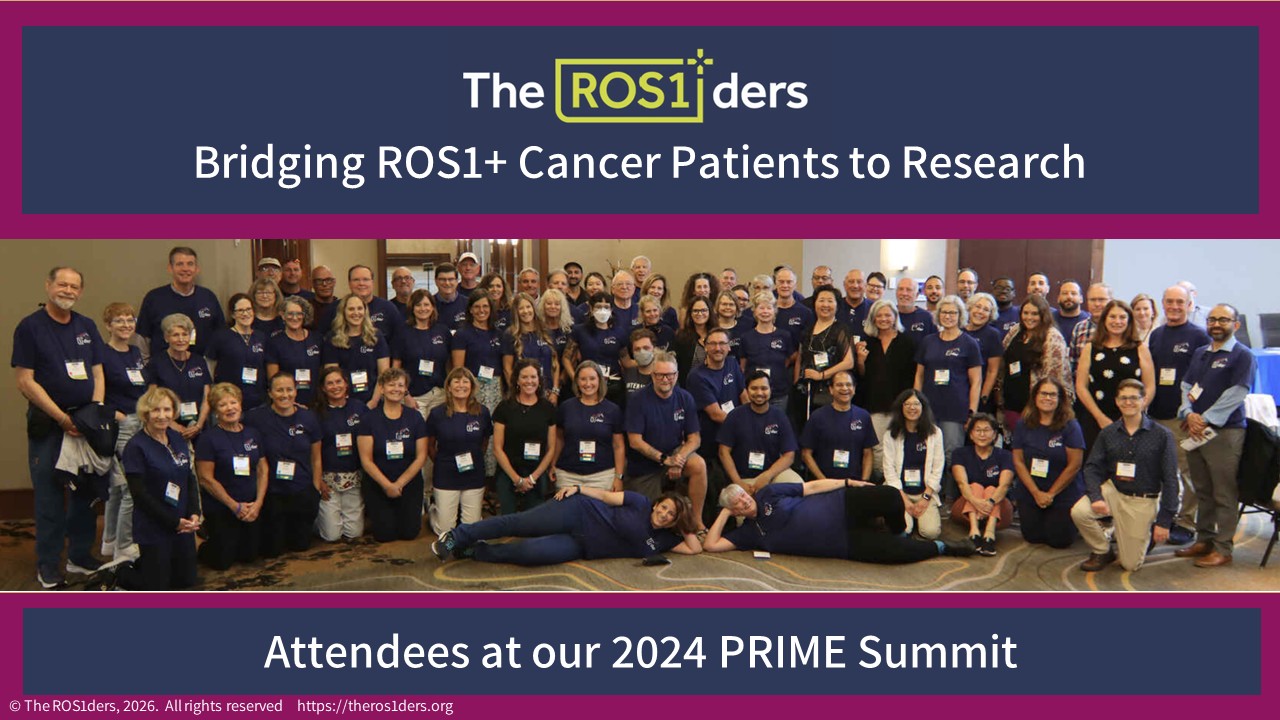
We started a global Facebook group for people who have ROS1+ cancer, created a website, and began looking for research partners. This evolved into The ROS1ders, a global group of patients and caregivers that seeks to improve outcomes for all ROS1+ cancers through community, education, and research.
In 2017 we co-created the ROS1 Cancer Model Project in partnership with nonprofits and researchers. Back then, only a few ROS1+ cancer models existed. The project helped create 12 new patient-derived cell lines that have been widely distributed and used for research into acquired resistance, surface-omics, and drug development. Another project, our PRIME Summit, brings our community together to learn about ROS1 treatments and research.
But it’s not enough. Two of our founders and many members have died. And living on treatment for years isn’t easy. I’ve had two TKI dose reductions and take prescriptions to cope with side effects. I’m also on a GLP-1 to lose the 70 pounds I gained on crizotinib.
This highlights a challenge of living on the cutting edge of cancer treatment. Research is big on tracking survival stats, but quality of life for survivors—not so much.
It’s hard to stay in the lung cancer advocacy space long term when you watch friends die on a regular basis. We advocates do it because so many unmet needs remain. More research needs to incorporate the patient perspective early in the process. More clinical trials need to use Patient Reported Outcomes. More sponsors need to own their toxicities.
We stay in the cancer space because helping others gives life meaning.
Thank you.